Jainism: An Overview
Content
- Introduction
- Vardhamana Mahavira
- Tirthankaras in Jainism
- Symbolism, Rituals, and Religious Practice
- Three Jewels
- Five Doctrines of Jainism
- Fundamentals of Jain Philosophy
- Anekantavada
- Syadavada
- Jain Councils
- Sects of Jainism
- Contemporary Relevance
- FAQs
Introduction
- Jainism is an ancient religion based on the teachings of 24 Tirthankaras (or great teachers).
- The word ‘Jain’ is derived from jina or jaina, meaning the ‘conqueror’.
- Rishabnath (or Adinath) was the first Tirthankara and was the founder of Jainism.
- Jainism came into prominence in the 6th century B.C. when Lord Mahavira propagated the religion.
- Lord Mahavira was the 24th and the last Tirthankara.
- Pre-Mahavira Origins: The faith predates Mahavir, with historical validation for Parsvanatha & Mahavir.
Vardhamana Mahavira
- Vardhamana was born in 599 B.C. in a village called Kundagram near Vaishali (Bihar).
- Mahavir Jayanti: Celebrated on 13th day of Chaitra month.
- Commemorates the birth of Mahavir. He added Brahmacharya as the fifth core vow of Jainism. The other four are Ahimsa, Satya, Asteya (non-stealing), & Aparigraha (Non-possessiveness).
- Mahavir Jayanti: Celebrated on 13th day of Chaitra month.
- He was a Kshatriya prince, and his father, Siddhartha, was the head of the Jnatrika clan.
- His mother, Trishala, was a Lichchhavi princess. She was the sister of Chetaka, the king of Vaishali.
- At the age of 30 years, he renounced his home and became an ascetic.
- After 12 years of austerity, he attained Kaivalya (perfect knowledge) at the age of 42 years on the banks of Rijupalika River. He passed away at the age of 72 years in 468 B.C. at Pavapuri in Bihar.
- Titles of Vardhamana: Mahavira, meaning the great hero; Jaina or Jitendriya, meaning one who conquers all his senses; Nirgrantha, meaning one who is free from all bonds.
- Considered the 24th and the last Tirthankara of Jainism.
Tirthankaras in Jainism
- Jainism recognises 24 Tirthankaras or enlightened teachers who show the path to liberation.
- The Rig Veda refers to Rishabha and Arishtanemi, indicating ancient roots of Jain tradition.
- Rishabhdeva (1st Tirthankara): Born in Ayodhya to Nabhi and Marudevi, his symbol is the bull, and he attained moksha at Mount Kailash.
- Parshvanatha (23rd Tirthankara): Born in Varanasi, symbol is serpent, attained moksha at Shikharji (Jharkhand), and preached Ahimsa, Satya, Asteya, Aparigraha.
- Mahavira (24th Tirthankara): Born in 599 BCE (debatable) in Kundalagrama (Bihar) to King Siddhartha & Queen Trishala. Renounced royal life at age 30; spent 12 years in rigorous asceticism. Travelled across India for 30 years spreading Jain philosophy.
- Expanded Parshvanatha’s teachings by adding Brahmacharya (celibacy) as the fifth vow.
Symbolism, Rituals, and Religious Practice
- Jain Emblem: Depicts the universe (Loka), raised hand with Ahimsa symbol, three dots for the Ratnatraya, and a crescent denoting Siddhashila, i.e., abode of liberated souls.
- Panch Parameshti: Arihant, Siddha, Acharya, Upadhyaya, Sadhu, revered in Navkar Mahamantra. Represent progressive stages of spiritual evolution.
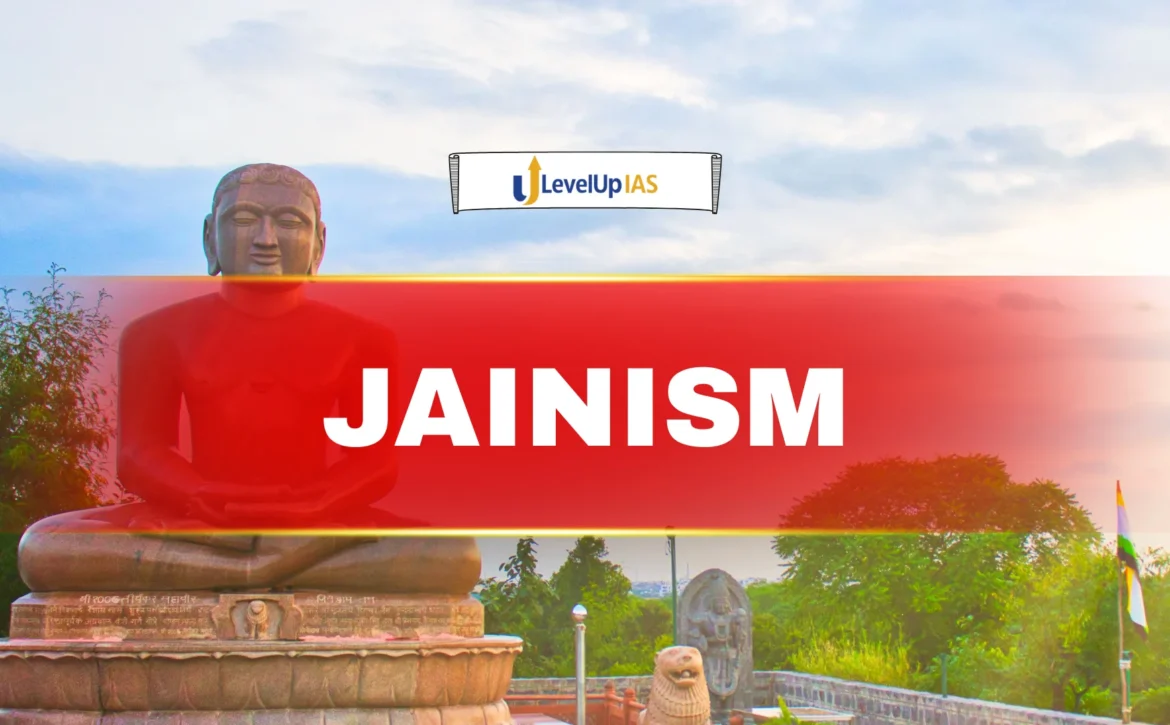
- Jina Image Worship: Tirthankara idols depicted in meditative posture (Padmasana or Kayotsarga), denoting detachment and inner purity.
- Ritual Practices: Include Paryushana, of which the last day is Samvatsari (forgiveness day), Pratikramana (introspection ritual) and temple worship.
- Sallekhana: Ritualistic fast unto death; spiritual vow practiced at the end of life to purify karma.
Three Jewels (TRIRATNA)
- Jainism believes that salvation can be attained by following the three-fold path:
- Right Faith (Samyakdarshana)
- Right Knowledge (Samyakjnana)
- Right Action (Samyakcharita)
- One of the three cannot exist exclusive of the others, and all are required for spiritual liberation.
Five Doctrines of Jainism
- To attain salvation, Jains must follow five doctrines:
- Ahimsa (non-violence)
- Satya (truthfulness)
- Asteya (not stealing)
- Aparigraha (non-acquisition)
- Brahmacharya (chaste living) — propounded by Mahavira.
Fundamentals of Jain Philosophy
- Panch Mahavratas (Five Great Vows): Ahimsa (non-violence), Satya (truth), Asteya (non-stealing), Brahmacharya (celibacy), Aparigraha (non-possession).
- Triratna or Three Gems: Right Faith (Samyag-darshana), Right Knowledge (Samyag-jnana), Right Conduct (Samyag-charitra).
- Anekantavada and Syadavada: Reality is manifold & complex. Hence, relative truth applies.
- Spiritual Detachment: Material body states (childhood, youth, old age) are illusionary; true identity lies in the soul.
- Everything has substance (dravya), quality (guna), and mode (paryaya), reflecting constant change.
- Dravya (Substances): Six eternal categories- Jiva (soul), Ajiva (non-soul), Dharma (motion), Adharma (rest), Akasha (space), and Kala (time).
- Guna (Qualities): Every Dravya possesses inherent and permanent attributes (Gunadharma) that determine its nature and behavior.
- Paryaya (Modes): Temporary states or modifications of substances; all things constantly change without losing their essential identity.
- Doctrine of Jiva & Ajiva: Jiva (soul) is eternal & conscious; Ajiva (non-soul) includes matter, space, time.
- Soul (Jiva): Every soul possesses infinite knowledge, faith, bliss & power (anantacatustaya).
- Types of Knowledge: Mati Jnana (sensory perception), Sruta Jnana (scriptural knowledge), Avadhi Jnana (clairvoyance), Manahparyaya Jnana (telepathy) & Kevala Jnana (omniscience).
- Anantacatustaya (Four Infinities): An omniscient soul possesses four infinite attributes, i.e., Ananta Jnana (infinite knowledge), Ananta Darshana (infinite perception), Ananta Sukha (infinite bliss), and Ananta Virya (infinite energy).
- Soul (Jiva): Every soul possesses infinite knowledge, faith, bliss & power (anantacatustaya).
- Karma and Rebirth: Subtle karmic matter binds the soul; even unintentional acts generate karma; hence occupations causing harm are avoided, eg, agriculture, animal transport, and related trades.
- Moksha: Liberation from the cycle of birth and death (Samsara) by shedding Karmic particles.
- Ascetic Traditions: Extreme asceticism, fasting & meditation are means of liberation (Kaivalya).
- Steps to Kaivalya: Asrav (influx of karmas), Samvara (stoppage of karmic inflow), Nirjara (shedding of karmas) and Kaivalya or Kevala Jnana (attainment of omniscience).
- Moksha: Liberation from the cycle of birth and death (Samsara) by shedding Karmic particles.
Anekantavada
- It is the doctrine that the ultimate truth and reality are complex and have multiple aspects.
- It believes in non-absolutism or pluralism, which means no single, specific statement can describe the nature of existence and the absolute truth.
Syadavada
- It is the doctrine that all judgments are conditional, holding good only in certain conditions, circumstances, or senses.
- According to it, ways of looking at a thing (called naya) are infinite in number, so there will be infinite judgments. Hence, all judgments are relative.
Jain Councils
| Jain Council | Year | Place | President | Major Outcome |
| First Jain Council | c. 300 BCE | Pataliputra (present-day Patna) | Sthalbhadra | The teachings of Lord Mahavira were compiled into 12 Angas to replace the 14 Purvas, which were believed to have been lost. |
| Second Jain Council | 512 CE | Vallabhi (Gujarat) | Devarddhi Kshamashramana | Final compilation and redaction of the 12 Angas and 12 Upangas, leading to the formal canonisation of Jain scriptures (mainly for the Svetambara tradition). |
Sects of Jainism: Svetambara and Digambara
| Digambara Sect | Svetambara Sect |
| Digambara means “sky-clad,” symbolising complete renunciation | Svetambara means “white-clad,” referring to the wearing of white garments |
| Monks practise complete nudity; female renunciates wear unstitched white sarees and are known as Aryikas | Monks wear simple white clothes |
| Do not believe in keeping any possessions | Carry a begging bowl, brush (rajoharana), books, and writing materials |
| Follow all five vows, including Brahmacharya | Follow the teachings of Parshvanatha, recognising four vows (excluding Brahmacharya) |
| Bhadrabahu was a key exponent | Sthulabhadra was a key exponent |
| Migrated to Karnataka during a prolonged famine | Remained in Magadha |
| Believe women cannot become Tirthankaras; regard Malli as male | Believe women can become Tirthankaras; regard Malli as female |
| Believe Tirthankaras did not marry | Believe the 23rd and 24th Tirthankaras were married |
| Monastic discipline is very strict | Monastic discipline is relatively less rigid |
| Sub-sects include Mula Sangh, Terapanthi, Taranpanthi, and Bispanthi | Sub-sects include Sthanakavasi and Murtipujaka |
| Do not accept the full Svetambara canon | Accept the 12 Angas and Upangas as canonical |
Contemporary Relevance of Jainism
- Navkar Mahamantra: The most revered chant in Jainism, offering homage to Panch Parmeshti.
- Emphasizes spiritual enlightenment, ethical living, inner transformation and Jain principles of non-violence, humility and truth-seeking.
- Wisdom in the Information Age: Jainism urges balancing knowledge with wisdom and using the Navkar Mahamantra as a moral compass to guide youth in blending technology with human values.
- Relevance of Anekantavada: PM underscored Anekantavada’s role in reducing conflicts by fostering empathy and acceptance of multiple perspectives rooted in the doctrine of non-absolutism.
- Mission LiFE and Jain Ideals: Promotes sustainable lifestyles as climate solutions, aligning with Jain principles of simplicity, Aparigraha and ecological restraint.
- Jainism’s Relevance to Global Problems:
- Jainism offers scientific, sensitive solutions to war, terrorism, and environmental issues through its principles of interdependence, non-violence and ecological ethics.
- Embodies ethical living through Ratnatraya (Right Faith, Right Knowledge, Right Conduct), Daslakshan (ten virtues), Solah Karan (sixteen attributes leading to liberation) and festivals like Paryushan that foster penance, introspection and social unity.
FAQs
1. What is Jainism in Ancient Indian history?
Jainism is one of the oldest religions of India, based on the teachings of 24 Tirthankaras, with Lord Mahavira as the 24th and last Tirthankara.
2. Who was Mahavira and why is he important?
Mahavira (599–527 BCE) was the 24th Tirthankara who systematised Jain philosophy and emphasised ethical living through self-discipline and non-violence.
3. What are the core principles of Jainism?
The core principles are Ahimsa (non-violence), Satya (truth), Asteya (non-stealing), Brahmacharya (celibacy), and Aparigraha (non-possession).
4. What is the concept of Triratna in Jainism?
Triratna refers to Right Faith (Samyak Darshan), Right Knowledge (Samyak Jnana), and Right Conduct (Samyak Charitra), which together lead to liberation (moksha).
5. What are the main sects of Jainism?
The two major sects are Digambar and Swetambar, differing mainly in monastic practices, attire, and views on scriptures.
Click on the question to see the Answers