Jal Jeevan Mission
Content
- Introduction
- What is Jal Jeevan Mission?
- Objectives
- Target Groups
- Major Components
- Implementation
- Significance
- Challenges and Criticism
- Way Forward
Introduction
Access to safe drinking water in rural India has historically been uneven and unreliable. Earlier rural water supply programmes focused largely on creating infrastructure such as handpumps and tube wells, but failed to ensure household-level access or long-term sustainability. Recognising these gaps, the Government of India launched the Jal Jeevan Mission (JJM) in August 2019, marking a shift from a supply-centric approach to a service delivery-oriented model of water governance.
What is Jal Jeevan Mission?
Jal Jeevan Mission is a centrally sponsored scheme aimed at providing Functional Household Tap Connections (FHTCs) to all rural households. The mission goes beyond physical connectivity and emphasises the regular availability of safe, adequate and affordable drinking water.
Key features include:
- Provision of household-level tap water connections to ensure convenience, dignity, and reliable access to drinking water.
- Assurance of potable water supply at a minimum service level of 55 litres per capita per day (LPCD).
- Integration of water supply infrastructure with long-term source sustainability and community-led management systems.
Objectives and Vision
The core objective of JJM is to make drinking water a basic household service, similar to sanitation or electricity. The mission seeks to ensure that water supply systems are planned, implemented and managed at the village level.
Broad objectives include:
- Achieving universal coverage of rural households with functional tap water connections.
- Improving public health indicators by reducing the prevalence of water-borne diseases.
- Reducing the physical and time burden on women by eliminating the need for water collection.
- Strengthening decentralised governance institutions through local planning and ownership.
Coverage and Target Groups
JJM covers all rural households across states and Union Territories, with special attention to vulnerable and water-stressed regions.
Priority areas include:
- SC/ST dominated habitations that historically suffer from inadequate public services.
- Aspirational districts identified for focused development interventions.
- Drought-prone, arid, and semi-arid regions facing chronic water scarcity.
- Areas affected by chemical contamination such as fluoride, arsenic, iron, and salinity.
- Inclusion of schools, Anganwadi centres, and health institutions to ensure comprehensive water security at the community level.
Major Components of Jal Jeevan Mission
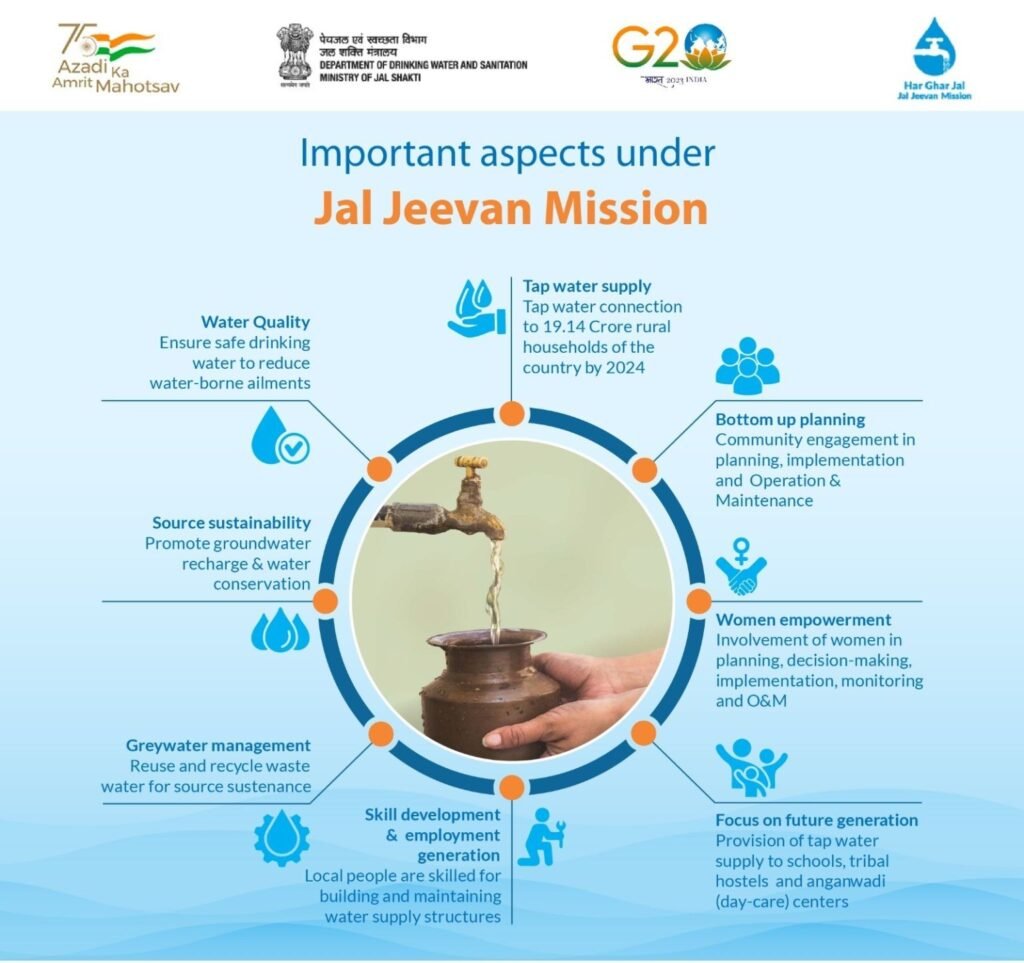
1. Household Tap Water Supply
The mission prioritises individual household tap connections rather than community standposts. This ensures dignity, convenience and reliability.
Key aspects:
- Development of village-level water supply infrastructure including sources, treatment units, overhead tanks, and distribution networks.
- Shift from public standposts to in-house connections to ensure equitable and uninterrupted access.
- Flexibility for states to adopt groundwater-based or surface water-based schemes based on local hydro-geological conditions.
2. Source Sustainability and Water Conservation
JJM recognises that expanding coverage without ensuring water availability can lead to long-term failure.
Therefore:
- Emphasis on groundwater recharge measures, rainwater harvesting structures, and watershed development.
- Promotion of convergence with schemes such as MGNREGA, PMKSY, and Swachh Bharat Mission to optimise resources.
- Revival and protection of traditional water bodies and local sources to reduce dependency on distant supply systems.
3. Water Quality Management
Ensuring water quality is a central pillar of JJM. The mission addresses both chemical and bacteriological contamination.
Measures include:
- Strengthening district and sub-district water testing laboratories for regular monitoring.
- Promotion of village-level water testing using Field Testing Kits (FTKs).
- Capacity building of local volunteers and awareness generation on safe water handling practices.
- Focused interventions in habitations affected by chronic water contamination.
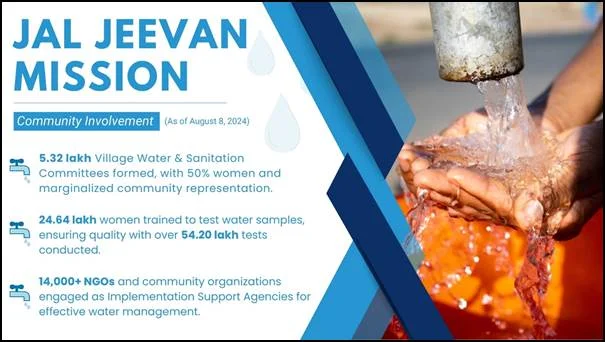
4. Community Participation and Institutional Framework
A key departure from earlier schemes is the stress on community ownership.
Institutional mechanisms include:
- Formation of Village Water and Sanitation Committees (VWSCs) under the Gram Panchayat framework.
- Preparation of Village Action Plans covering water demand assessment, source protection, and system maintenance.
- Collection of nominal community contributions to promote accountability and ensure sustainability.
Funding Pattern
The Mission follows a shared financing model:
- 50:50 funding between the Centre and States for general category states.
- 90:10 funding for Himalayan and North-Eastern states recognising their special constraints.
- 100% central funding for Union Territories.
Funds are linked to performance indicators such as coverage, water quality compliance, and efficient utilisation.
Governance and Implementation
The mission is implemented by the Ministry of Jal Shakti in partnership with state governments and local bodies.
Key governance features:
- Central role of Panchayati Raj Institutions in planning, execution, and monitoring.
- Extensive use of technology such as geo-tagging, real-time dashboards, and third-party verification.
- Emphasis on transparency, outcome-based monitoring, and citizen feedback mechanisms.
Significance of Jal Jeevan Mission
JJM has wide-ranging implications for governance and human development.
- Social Impact:
Reduction in the drudgery faced by women and girls, especially in water-scarce regions, leading to improved educational participation and livelihood opportunities. - Health Benefits:
Improved access to safe drinking water contributes to a decline in water-borne diseases, childhood malnutrition, and maternal health risks. - Governance Reforms:
Strengthens decentralised governance by empowering Panchayats with functional responsibilities, planning authority, and financial resources. - Economic Outcomes:
Time saved from water collection enhances productivity and supports rural livelihoods and economic participation.
Challenges and Criticism
Despite significant progress, several concerns remain.
- In many regions, tap connections have expanded faster than water source development, raising sustainability concerns.
- Intermittent water supply affects reliability and reduces public confidence in the system.
- Capacity gaps at the Panchayat level hinder effective operation and maintenance of infrastructure.
- Regional disparities persist due to differences in water availability, terrain, and administrative capacity.
Way Forward
To ensure long-term success:
- Greater emphasis is required on operation and maintenance funding mechanisms.
- Local technical capacity must be strengthened through training and institutional support.
- Climate resilience should be integrated into village-level water planning.
- Independent evaluations, social audits, and community monitoring need to be institutionalised.
Conclusion
Jal Jeevan Mission represents a structural reform in rural water governance by shifting the focus from infrastructure creation to service delivery. Its sustainability will depend on how effectively water availability, quality management, and community participation are balanced, making it a crucial topic for GS II and GS III in UPSC.