Joint Parliamentary Committee 2026

Content
- Why in News?
- Introduction
- Constitution and Composition
- Nature and Functions
- Major JPCs in India
- Working and Procedure
- Effectiveness of JPCs
- Conclusion
Why in News?
The Lok Sabha has recently extended the tenure of the Joint Parliamentary Committee (JPC) constituted to examine the ‘One Nation, One Election’ proposal, highlighting the role of parliamentary committees in detailed legislative scrutiny.
Introduction
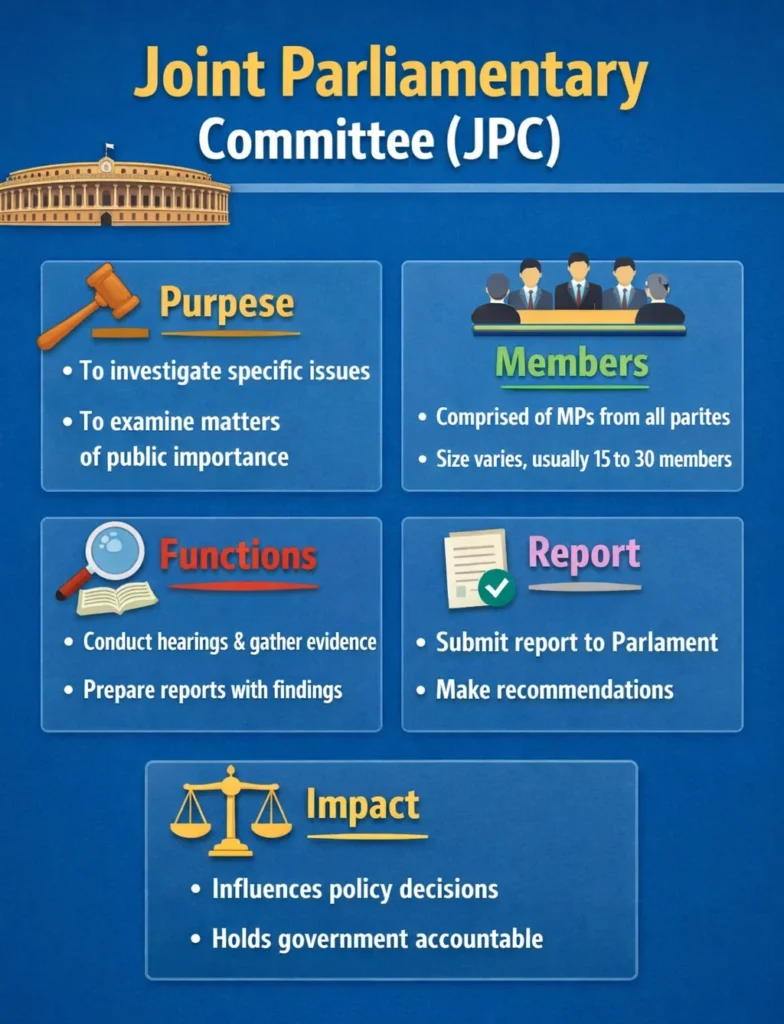
A Joint Parliamentary Committee (JPC) is an ad hoc parliamentary body constituted to examine a specific issue of public importance in detail. It functions as a mini-Parliament, enabling deeper scrutiny of complex matters that require specialised attention beyond regular parliamentary debates.
The committee system in India was strengthened in 1993 to enhance legislative oversight and improve accountability of the executive.
Constitution and Composition
A JPC is constituted through a motion passed in one House of Parliament and agreed to by the other. It includes members from both the Lok Sabha and the Rajya Sabha, ensuring representation from across the political spectrum.
The strength of the committee reflects the composition of Parliament, with proportional representation of political parties. Typically, the number of members from the Lok Sabha is twice that of the Rajya Sabha, reflecting its larger size.
The exact membership, size, and subject matter of the JPC are determined at the time of its constitution through the motion adopted by Parliament.
Nature and Functions
- A JPC is a temporary (ad hoc) body, constituted for a specific purpose and for a limited duration. Its primary function is to conduct a detailed examination of a particular issue, especially those involving significant public interest, financial irregularities, or policy controversies.
- The committee is empowered to collect evidence, examine witnesses, analyse documents, and investigate the issue comprehensively. It then submits a report to Parliament with its findings and recommendations.
- The terms of reference of a JPC typically include identifying irregularities, fixing responsibility, examining systemic loopholes, and suggesting corrective measures.
Major JPCs in India
Since Independence, several JPCs have been constituted, though only a few have dealt with major national controversies. Prominent examples include:
- JPC on Bofors Contracts
- JPC on securities and banking irregularities (1992 scam)
- JPC on stock market scam (2001)
- JPC on pesticide residues in soft drinks
These committees were set up to investigate complex issues involving governance, financial systems, and public safety.
Working and Procedure
- Once constituted, the JPC functions through meetings, evidence collection, and consultations with stakeholders. It submits its report within a specified timeframe.
- The recommendations of the JPC are not binding on the government, but they carry significant persuasive value. Based on the report, the government may initiate further investigations or policy changes.
- The government is required to present an Action Taken Report (ATR) on the recommendations. These reports are then laid before Parliament and can be discussed, ensuring continued legislative oversight.
Effectiveness of JPCs
- JPCs play an important role in strengthening parliamentary accountability and transparency. They allow for bipartisan scrutiny and detailed examination of complex issues.
- However, their effectiveness is sometimes limited by the fact that their recommendations are advisory in nature and not legally enforceable. Additionally, political differences among members may affect consensus-building within the committee.
- Despite these limitations, JPCs remain a significant instrument for investigative oversight and policy review.
- The JPC mechanism enhances the functioning of parliamentary democracy by enabling in-depth analysis beyond floor debates. It strengthens the role of Parliament in holding the executive accountable and improves the quality of decision-making.
- In the context of major policy proposals such as One Nation, One Election, the Joint Parliamentary Committee provides a platform for comprehensive evaluation of constitutional, legal, and administrative implications.
Conclusion
The Joint Parliamentary Committee is an important institutional tool for ensuring accountability, transparency, and detailed legislative scrutiny in India. While its recommendations are not binding, its role in shaping public debate and influencing policy decisions makes it a vital component of parliamentary governance.
Visit LevelUp IAS- Click Here