Kavach 4.0 System
Content
- Why in News?
- What is Kavach System?
- Key Features
- Significance
- Coverage and Implementation
- Challenges
- Way Forward
- Conclusion
Why in News?
The Union Railway Minister informed the Lok Sabha that Kavach 4.0, India’s indigenous train collision avoidance system, has been successfully commissioned across 1,452 route kilometres on the high-density Delhi-Mumbai and Delhi-Howrah corridors.
What is Kavach System?
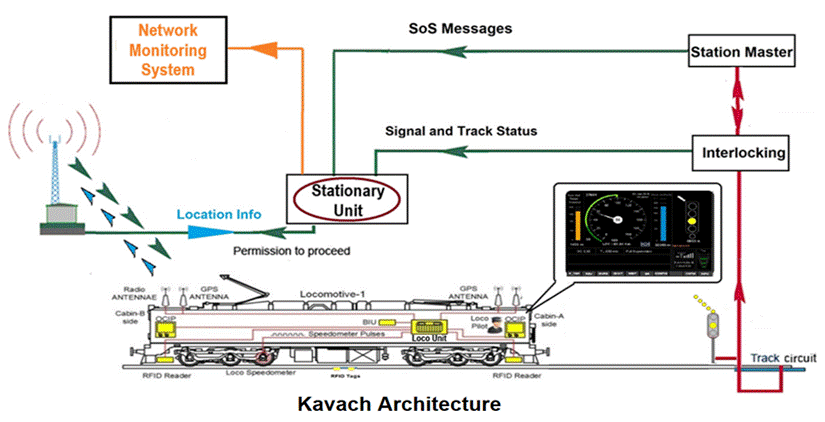
Kavach is a fail-safe, automatic train protection technology that uses a combination of radio communication, GPS-based tracking, RFID tags, and onboard equipment to monitor train movement and prevent unsafe operations.
Kavach is an indigenously developed Automatic Train Protection (ATP) system designed by Indian Railways in collaboration with domestic industry. It aims to enhance railway safety by preventing collisions, controlling train speed, and ensuring efficient operations.
Kavach 4.0 represents an advanced version of the system, incorporating improved reliability, scalability, and compatibility with high-density railway networks.
It is designed to automatically apply brakes if a train crosses a signal at danger or if there is a risk of collision, thereby reducing dependence on human intervention and minimising accidents.
Key Features of Kavach 4.0
Kavach 4.0 introduces enhanced safety features suited for India’s busiest railway corridors. It provides automatic braking in case of signal violation, ensuring that trains do not overshoot red signals.
The system enables real-time communication between trains and trackside equipment, allowing continuous monitoring of train positions and speeds. It also ensures safe distance maintenance between trains, especially on congested routes.
Another important feature is its ability to support high-speed and high-density traffic, making it suitable for major freight and passenger corridors. The system is designed to function in all weather conditions and is cost-effective compared to imported technologies.
Significance
Kavach 4.0 is a major step towards improving railway safety and accident prevention in India. By reducing human error, it enhances the reliability of train operations and minimises the risk of collisions.
From an economic perspective, safer railways contribute to efficient logistics and transportation, which are crucial for economic growth. The deployment on high-density corridors ensures better utilisation of railway infrastructure and improved operational efficiency.
The system also reflects India’s push for Atmanirbhar Bharat in technology, as it is developed indigenously and reduces dependence on expensive foreign systems.
Coverage and Implementation
The deployment of Kavach 4.0 on Delhi-Mumbai and Delhi-Howrah corridors, two of the busiest railway routes, demonstrates its strategic importance. These corridors handle a significant proportion of India’s passenger and freight traffic, making safety enhancements critical.
Indian Railways plans to expand the coverage of Kavach across the network in a phased manner, prioritising high-density and high-risk routes.
Challenges
Despite its advantages, the large-scale implementation of Kavach faces challenges such as high initial installation costs, integration with existing signalling systems, and the need for trained personnel.
Ensuring uniform deployment across a vast railway network and maintaining system reliability over time are also significant concerns.
Way Forward
- Accelerated Deployment: Prioritise rapid rollout of Kavach 4.0 on high-density, high-risk, and accident-prone routes, especially major freight and passenger corridors.
- Infrastructure Investment: Ensure adequate investment in signalling systems, onboard equipment, communication networks, and trackside infrastructure for seamless functioning.
- Capacity Building: Strengthen training programmes for loco pilots, railway staff, and technical personnel to ensure efficient operation and maintenance of the system.
- Technological Upgradation: Continuously upgrade the system to enhance reliability, scalability, and compatibility with increasing train speeds and traffic density.
- Monitoring & Evaluation: Establish robust mechanisms for real-time monitoring, periodic audits, and data-driven performance assessment to identify gaps and improve efficiency.
- Integration with Modernisation Initiatives: Align Kavach with high-speed rail projects, Dedicated Freight Corridors (DFCs), and advanced signalling technologies to build a comprehensive safety ecosystem.
- Promoting Indigenous R&D: Encourage domestic innovation and research to further improve the system and reduce dependence on foreign technologies.
- Global Competitiveness: Ensure interoperability with international standards to position Kavach as a cost-effective and exportable railway safety solution.
Conclusion
Kavach 4.0 represents a significant advancement in India’s railway safety framework, combining indigenous innovation with modern technology. Its successful deployment marks a crucial step towards building a safer, more efficient, and technologically advanced railway system, which is essential for India’s economic growth and infrastructure development.
Visit LevelUp IAS- Click Here