Kharg Island
Content
- Why in News?
- Introduction
- Location
- Historical Background
- Economic Importance
- Strategic Significance
- Challenges and Concerns
- Conclusion
Why in News?
Kharg Island has recently gained attention in the backdrop of escalating tensions in West Asia, particularly the US-Iran conflict (2026). Reports suggesting that the island could be a potential strategic target have highlighted its critical importance in global oil supply chains. For UPSC aspirants, this makes Kharg Island an important topic from both mapping and geopolitical perspectives.
Introduction
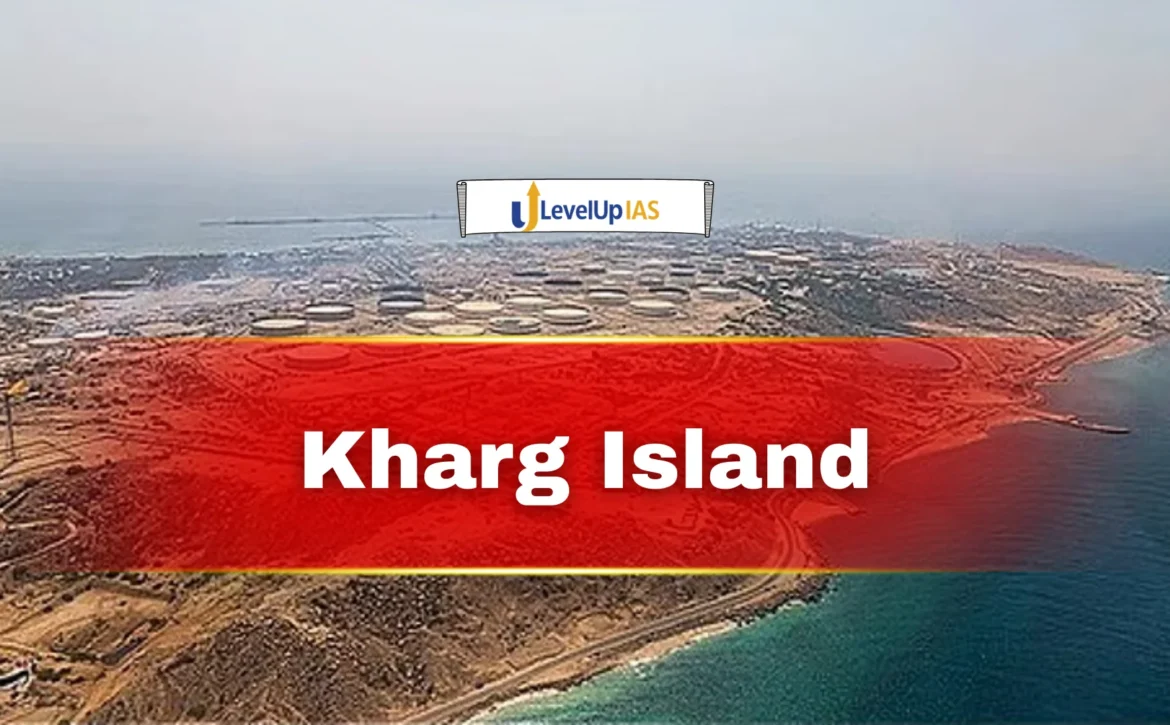
Kharg Island is a small island located in the northern part of the Persian Gulf, off the southwestern coast of Iran.
Despite its limited geographical size, it occupies a disproportionately significant position in global geopolitics because it serves as Iran’s principal oil export terminal.
The island represents a classic example of how geographical features, when combined with resource concentration, can influence international relations and economic stability.
Location and Geographical Setting
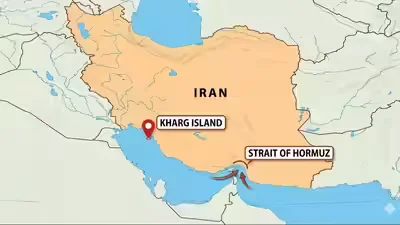
- Kharg Island is situated approximately 25-30 kilometres from the Iranian mainland in Bushehr province.
- It lies in the northern Persian Gulf, a region that forms the heart of global energy trade.
- Although it is not directly located on the Strait of Hormuz, it is positioned close enough to benefit from its strategic maritime connectivity.
- From a mapping perspective, the island must be understood in relation to three key geographical elements the Persian Gulf, the Strait of Hormuz, and the oil-rich regions of southwestern Iran.
- The Persian Gulf acts as a semi-enclosed water body connecting major oil-producing countries, while the Strait of Hormuz functions as the world’s most critical oil transit chokepoint.
- Kharg Island, located within this network, becomes a vital node linking inland oil production to global markets.
- Physically, the island is composed primarily of coral and limestone formations. It is relatively small in size, extending roughly 8 kilometres in length and 4-5 kilometres in width.
- One of its unique geographical features is the presence of freshwater resources, which is uncommon among Persian Gulf islands that are typically arid and dependent on desalination.
Historical Background
Historically, Kharg Island has served as an important maritime and commercial hub.
- Its location along ancient trade routes connecting India, Persia, and Mesopotamia gave it significance even before the discovery of oil.
- During the colonial period, it came under the influence of European powers such as the Portuguese and later the Dutch, reflecting its strategic maritime value.
However, its modern importance emerged in the 20th century with the discovery and commercialization of oil in Iran. The island was developed into a major oil terminal, transforming it into the backbone of Iran’s petroleum export system. During the Iran-Iraq War (1980-88), Kharg Island was heavily targeted due to its oil infrastructure, demonstrating its vulnerability as well as its strategic importance. Despite extensive damage, it was rebuilt, further strengthening its role in Iran’s economy.
Economic Importance
Kharg Island is central to Iran’s oil economy and serves as the primary hub for exporting crude oil.
- A significant proportion of Iran’s total oil exports often estimated at around 90 percent passes through this island. It is connected to major oil fields in Iran through an extensive pipeline network, enabling the efficient transportation of crude oil to the island for export.
- The island hosts large storage facilities capable of holding millions of barrels of crude oil. Its deep-water surroundings allow the docking of large oil tankers, including Very Large Crude Carriers (VLCCs), which are essential for transporting oil over long distances. This maritime advantage reduces transportation costs and enhances efficiency.
- In essence, Kharg Island functions as a critical link between Iran’s inland oil reserves and the global energy market. Any disruption in its functioning can significantly affect not only Iran’s economy but also global oil prices.
Strategic and Geopolitical Significance
The importance of Kharg Island extends beyond economics into the realm of geopolitics. Its proximity to the Strait of Hormuz places it within one of the most strategically sensitive regions in the world. Since a large portion of global oil trade passes through this region, any instability directly impacts international markets.
In the context of the US-Iran conflict, Kharg Island is often viewed as a strategic vulnerability for Iran. Because a large share of Iran’s oil exports is concentrated at this single location, targeting the island could severely disrupt its economy. This makes the island both a strategic asset and a potential liability.
For India, the significance of Kharg Island is indirect but important. India imports a large proportion of its crude oil from West Asia, and any disruption in supply routes or price volatility can affect its energy security, inflation levels, and balance of payments. Thus, developments related to Kharg Island have implications for India’s economic stability and foreign policy.
Challenges and Concerns
One of the primary challenges associated with Kharg Island is its high degree of concentration of critical infrastructure.
Since a large portion of Iran’s oil export capacity is located here, the island becomes a single point of failure. This creates strategic vulnerability, especially during conflicts.
Another concern is geopolitical instability in the Persian Gulf region. Frequent tensions, military presence, and the possibility of conflict increase the risk of disruption.
Additionally, environmental concerns related to oil extraction, storage, and transportation pose long-term risks to sustainability.
Conclusion
Kharg Island exemplifies the interplay between geography, resources, and geopolitics. Despite its small size, it plays a pivotal role in global energy markets due to its function as Iran’s primary oil export terminal. Its strategic location near the Strait of Hormuz enhances its importance, while also exposing it to significant vulnerabilities.
In the current geopolitical context, Kharg Island highlights how critical infrastructure can shape international relations and economic stability.