Launch of LVM-3 and BlueBird Block-2
Content
- Why in news?
- BlueBird Block-2
- Commercial significance
- Low Earth Orbit (LEO)
- LVM-3 Launch Vehicle
- Ongoing Upgrades
- Role in future missions
Why in news?
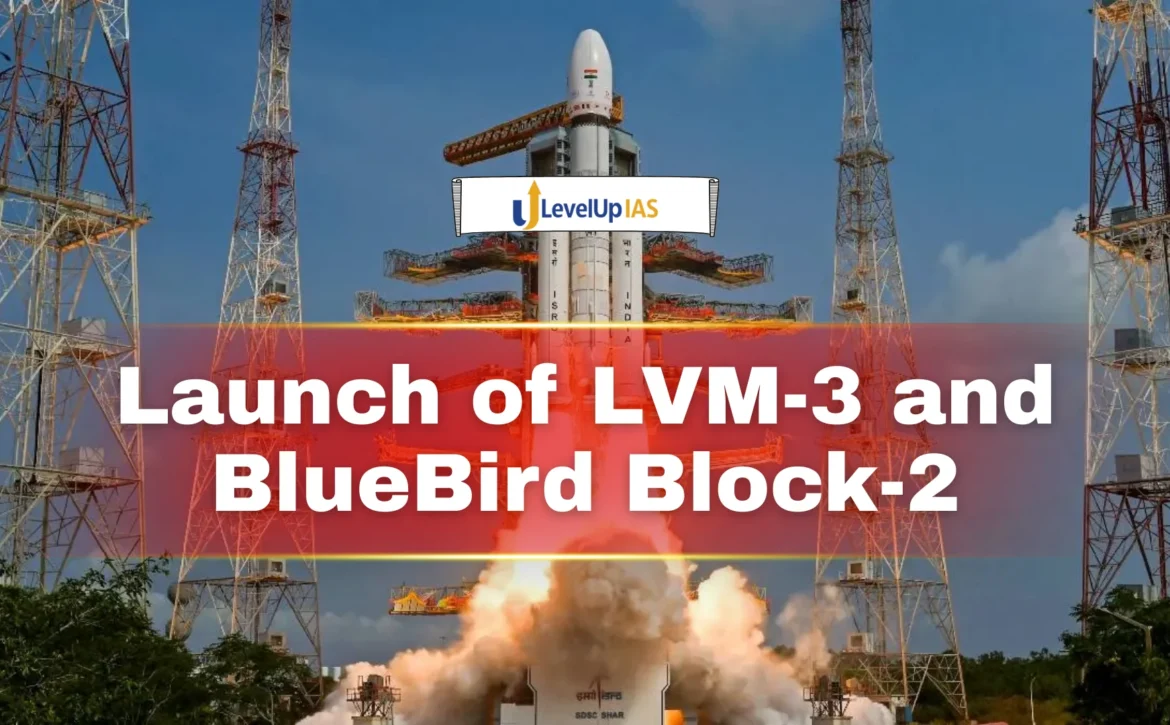
ISRO has achieved a significant milestone by launching its heaviest satellite, BlueBird Block-2 (6,100 kg). It is built by the US-based company AST SpaceMobile, using the Launch Vehicle Mark-3 (LVM-3). The mission underscores India’s strong heavy-lift launch capability in the global commercial space market.
- ISRO has placed BlueBird Block-2, weighing about 6,100 kg, into Low Earth Orbit (LEO). It marked as the heaviest payload ever launched by the agency to enable direct-to-mobile 4G/5G connectivity.
- ISRO is upgrading LVM-3 with a new C32 cryogenic stage, semi‑cryogenic engines, and bootstrap reignition to enhance its payload capacity and mission flexibility.
BlueBird Block-2
Key features
- BlueBird Block-2 is currently the heaviest satellite ISRO has deployed. It surpassed its earlier record of about 5,700 kg from the OneWeb constellation launches.
- The satellite has been placed in a Low Earth Orbit of roughly 520 km altitude, suitable for low-latency communication services.
Objective
- The satellite aims to provide direct-to-mobile connectivity, enabling 4G and 5G services directly to ordinary mobile phones without the need for specialised ground terminals.
Commercial significance
- This is ISRO’s third commercial mission using LVM-3, after the two OneWeb launches in 2022 and 2023.
- Despite competition from vehicles such as SpaceX’s Falcon‑9 and ESA’s Ariane‑6, LVM-3 offers heavy‑lift capability at comparatively lower cost, strengthening India’s position in the commercial launch market.
Low Earth Orbit (LEO)
Overview
- Agencies widely use it for communication satellites, Earth observation missions, scientific experiments, and select navigation applications.
- LEO extends from about 160 km to 2,000 km above the Earth’s surface, where satellites complete one orbit roughly every 90–120 minutes.
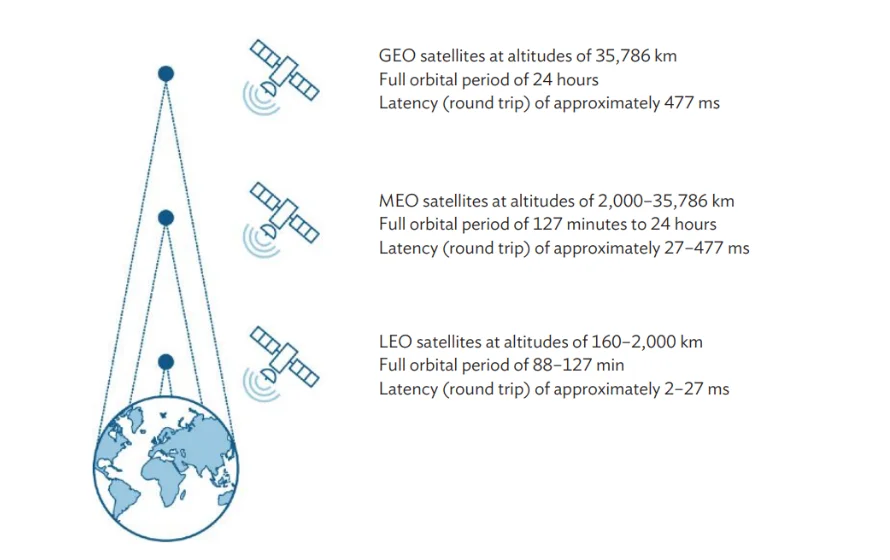
Orbit types
- Many LEO satellites use nearly circular orbits, but some missions operate in elliptical orbits depending on coverage needs.
- Special highly elliptical orbits like Molniya and Tundra provide longer dwell time over high‑latitude regions and are useful for communication and observation where geostationary coverage is weak.
LVM-3 Launch Vehicle
About LVM-3
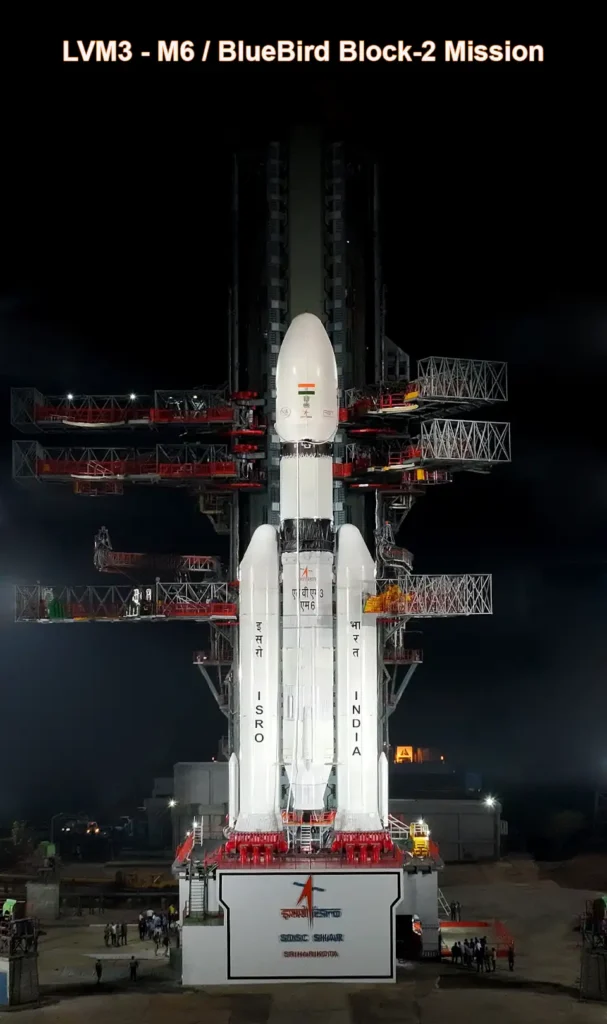
- LVM-3 is ISRO’s largest and most powerful operational launch vehicle, designed as a three‑stage heavy‑lift rocket.
- It can carry about 4,000 kg to Geosynchronous Transfer Orbit (GTO) and around 8,000 kg to Low Earth Orbit, making it suitable for communication satellites, constellations, and future human missions.
- Earlier known as the Geosynchronous Satellite Launch Vehicle Mk III (GSLV Mk III), it had its first experimental flight in December 2014.
Stages of LVM-3
- First stage (boosters): Two large S200 solid rocket boosters using HTPB-based solid propellant provide initial thrust at liftoff.
- Second stage (core liquid): A liquid‑fuelled stage powered by Vikas engines using UDMH (unsymmetrical dimethylhydrazine) and nitrogen tetroxide as oxidiser.
- Third stage (upper cryogenic): The C25 cryogenic upper stage powered by the CE20 engine, using liquid hydrogen as fuel and liquid oxygen as oxidiser.
Ongoing Upgrades to LVM-3
Engine and stage improvements
- Cryogenic stage upgrade: ISRO is developing the higher‑capacity C32 cryogenic stage to increase thrust and propellant load, thereby raising payload capability.
- Semi‑cryogenic engine: A new semi‑cryogenic stage using kerosene and liquid oxygen is under development and is expected to enhance LEO payload capacity from roughly 8,000 kg to about 10,000 kg.
- Bootstrap reignition: ISRO is working on bootstrap reignition for cryogenic engines so that the upper stage can restart in orbit without relying on external pressurant gases like helium, enabling multi‑orbit missions and better mass utilisation.
Role in future missions
- A human‑rated version of LVM-3, with additional safety margins and redundancies, will be used for the Gaganyaan human spaceflight missions.
- In later phases, modified LVM-3 variants are planned to carry modules for the Bharatiya Antariksh Station, India’s proposed modular space station in Low Earth Orbit.