Mahajanapadas: Formation of Early States in Ancient India
Content
- Introduction
- From Jana to Janapada: Background
- Sources for the Study of Mahajanapadas
- The Sixteen Mahajanapadas
- Nature of Political Organisation
- Administration and Governance
- Military Organisation and Warfare
- Economic Developments
- Social Changes
- Religious and Intellectual Developments
- Magadha and the End of the Mahajanapada Phase
- FAQs
Introduction
The period of the Mahajanapadas marks an important stage in ancient Indian history when political authority began to be exercised over clearly defined territories rather than over kinship groups. This phase broadly corresponds to the 6th century BCE, though its roots can be traced back to developments of the later Vedic period. The emergence of Mahajanapadas indicates the gradual transformation of tribal society into territorial states with organised administration, standing armies, and regular sources of revenue.
For UPSC, the Mahajanapada phase is important because it explains the background of state formation, urbanisation, economic expansion, and the rise of new religious ideas such as Buddhism and Jainism.
From Jana to Janapada: Background
In the early Vedic period, political organisation revolved around Janas (group of tribal people). Authority was personal and clan-based. There was no fixed territorial control. The chief (rajan) ruled with the consent of assemblies like the sabha and samiti.
Gradually, during the later Vedic phase, several changes occurred. Agriculture expanded, especially in the Ganga–Yamuna doab, due to the use of iron tools. Forests were cleared and permanent settlements came into existence. As tribal people began to settle in specific areas, the concept of territory became important. This led to the emergence of Janapadas, literally meaning the area where a group of tribal people had placed its foot (jana + pada).
Over time, some Janapadas grew larger in size and power due to better agricultural resources, strategic location, and military strength. These larger and more powerful Janapadas came to be known as Mahajanapadas.
Sources for the Study of Mahajanapadas
- Our knowledge of Mahajanapadas is derived mainly from Buddhist and Jaina texts, with limited references in Brahmanical literature.
- Buddhist texts such as the Anguttara Nikaya provide a list of sixteen Mahajanapadas, which is the most commonly accepted list in modern historiography. Other Buddhist works like the Digha Nikaya, Vinaya Pitaka, and Jataka stories contain incidental references to rulers, cities, and political conditions of the period.
- Jaina texts, especially the Bhagavati Sutra, also mention several Mahajanapadas, though the list does not exactly match the Buddhist one. Brahmanical texts remain relatively silent on this phase, partly because the period saw the decline of Vedic sacrificial dominance.
- Archaeologically, the period is associated with Northern Black Polished Ware (NBPW), urban settlements, fortified cities, and the widespread use of punch-marked coins, all of which support literary accounts of economic and political complexity.
The Sixteen Mahajanapadas
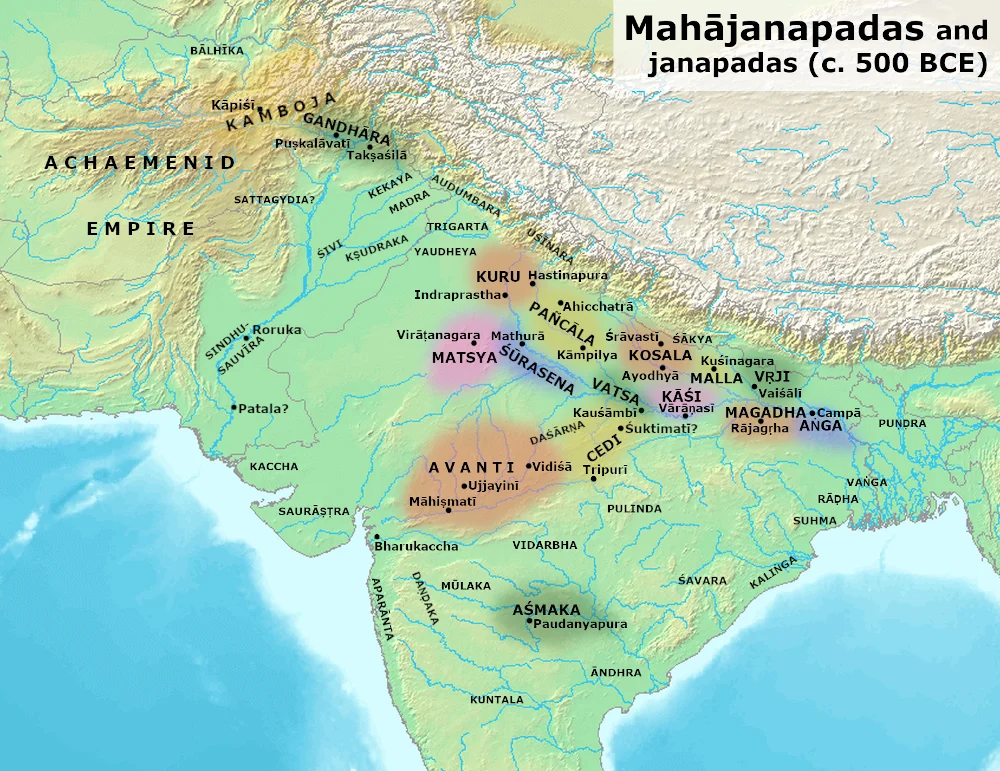
According to the Anguttara Nikaya, the sixteen Mahajanapadas were Anga, Magadha, Vajji, Malla, Kashi, Kosala, Vatsa, Chedi, Panchala, Kuru, Matsya, Surasena, Assaka, Avanti, Gandhara, and Kamboja.
Most Mahajanapadas emerged in the Indo-Gangetic plains, highlighting the crucial role of fertile land and river systems. Only a few, such as Gandhara and Kamboja, lay in the north-west, while Assaka was located in the Deccan.
Each Mahajanapada had a capital city, which functioned as the centre of administration, trade, and military control. Examples include Rajagriha for Magadha, Shravasti for Kosala, Ujjain for Avanti, and Taxila for Gandhara.
Nature of Political Organisation
The Mahajanapadas did not follow a uniform political system. Scholars broadly classify them into monarchies and republics (Gana–Sanghas).
Monarchical Mahajanapadas
Most Mahajanapadas were monarchies. In these states, political power was concentrated in the hands of a hereditary king. The king exercised authority over a defined territory and collected regular taxes. He was assisted by officials and maintained a standing army.
Examples of monarchical Mahajanapadas include Magadha, Kosala, Avanti, Vatsa, and Anga. Over time, monarchical states proved to be more stable and expansionist, which explains their eventual dominance.
Gana – Sanghas
Some Mahajanapadas, particularly in the Himalayan foothills, followed a republican form of government. These are known as Gana–Sanghas. Power in these states was not vested in a single king but in an assembly of chiefs, usually belonging to Kshatriya clans.
The most important Gana, Sanghas were Vajji, Malla, and possibly Kamboja. The Vajji confederacy, with its capital at Vaishali, is often cited as the most prominent example. Decisions were taken collectively in assemblies, though political participation was restricted to a small elite.
It must be noted that these republics were oligarchic in nature and should not be confused with modern democratic systems.
Administration and Governance
The administrative structure of Mahajanapadas became increasingly complex. Kings and assemblies relied on officials known as amathyas for governance. There were officers responsible for revenue collection, military affairs, and judicial functions.
Revenue was mainly derived from land tax, generally called bhaga, which was a fixed share of agricultural produce. Taxes were also collected from traders, artisans, and through tolls on trade routes.
Law and order became more formalised during this period. Courts existed, and punishments were more regular and institutionalised compared to the earlier tribal phase.
Military Organisation and Warfare
The Mahajanapada period witnessed the emergence of standing armies, replacing the earlier tribal militias. Armies were organised into infantry, cavalry, chariots, and elephants. Fortified cities and defensive structures became common.
Frequent wars were fought for territorial expansion and control over trade routes. These conflicts gradually reduced the number of independent Mahajanapadas, as stronger states absorbed weaker ones.
Economic Developments
Economically, the Mahajanapada period represents a phase of significant growth.
Agriculture formed the economic base. The use of iron tools allowed deeper ploughing and higher productivity, particularly in the fertile Gangetic plains. Rice cultivation became widespread.
Trade and commerce expanded due to surplus production. Both internal and long-distance trade developed. Cities emerged as centres of exchange, craft production, and administration. Important urban centres included Varanasi, Kaushambi, Rajagriha, and Ujjain.
The introduction of punch-marked silver coins facilitated monetisation and helped in the growth of trade.
Social Changes
Social stratification became sharper during this period. The varna system became more rigid, with Brahmanas and Kshatriyas occupying dominant positions. The emergence of private property and surplus strengthened social inequalities.
New social groups such as gahapatis (wealthy householders), merchants, and artisans gained prominence. At the same time, the condition of women declined compared to the early Vedic period, and practices like slavery and bonded labour became more visible.
Religious and Intellectual Developments
The Mahajanapada period coincided with intense religious and philosophical activity. Dissatisfaction with ritual-heavy Vedic religion led to the rise of heterodox sects, the most important being Buddhism and Jainism.
Both Gautama Buddha and Mahavira lived and preached during this period, mainly in the regions of Magadha, Kosala, and Vajji. These religions emphasised ethical conduct, non-violence, and renunciation. They also used Prakrit languages, which made their teachings accessible to common people.
Urbanisation and social inequality created conditions favourable for the spread of these new ideas.
Magadha and the End of the Mahajanapada Phase
Among all Mahajanapadas, Magadha emerged as the most powerful. Its success can be attributed to fertile land, access to iron resources, strategic location, strong rulers like Bimbisara and Ajatashatru, and effective military organisation.
By the end of this phase, Magadha had absorbed or subdued most other Mahajanapadas, paving the way for the Mauryan Empire. This marked the end of the Mahajanapada system as a multipolar political order.
Conclusion
The Mahajanapadas represent the first clear phase of state formation in ancient India. They reflect the transition from tribal political structures to territorial states with organised administration, economy, and military power. The developments of this period laid the foundation for imperial formations and shaped the social and religious landscape of ancient India.
For UPSC aspirants, understanding the Mahajanapadas is essential for grasping the evolution of Indian polity, economy, and society in the early historical period.
FAQs
Q1. What are Mahajanapadas?
Mahajanapadas were large territorial states that emerged in northern India during the 6th century BCE from earlier Janapadas, marking a crucial phase in ancient Indian political history.
Q2. How many Mahajanapadas were there?
Ancient texts such as the Anguttara Nikaya mention 16 Mahajanapadas, including Magadha, Kosala, Vatsa, Avanti, and Vajji.
Q3. What were the major sources for the study of Mahajanapadas?
Key sources include Buddhist texts (Anguttara Nikaya, Digha Nikaya), Jain literature, Brahmanical texts, archaeological evidence, and numismatic findings.
Q4. What were the two main types of political systems among Mahajanapadas?
Mahajanapadas followed either monarchical systems (e.g., Magadha, Kosala) or republican/ganasangha systems (e.g., Vajji, Malla).
Q5. Why did Magadha emerge as the most powerful Mahajanapada?
Magadha’s rise was due to strategic location, fertile Gangetic plains, iron resources, strong rulers like Bimbisara and Ajatashatru, and efficient administrative practices.
Click on the question to see the Answers