Major Dynasties (750 – 1200 AD)
Content
- The Pratiharas (8th to 10th Century)
- The Palas (8th to 11th Century)
- The Senas (11th to 12th Century)
- The Rajaputas (647 – 1200 AD)
- Pallavas (275 – 897 CE)
- Chalukyas (6th to 12 Century)
- Rashtrakutas (750 – 900 CE)
- Cholas (300 to 1300 CE)
- Chera (9th to 12th Century)
- Yadavas (12th to 13th Century)
- FAQs
The period 750–1200 CE in north India can be divided into two phases. Phase I (c. 750–1000 CE) – This period in north India saw the rise of three major empires: the Gurjara Pratiharas in the north, the Palas in the east, and the Rashtrakutas in the Deccan. Phase II (c. 1000–1200 CE) – This period is also known as the Age of Conflict.
The tripartite powers were divided into smaller kingdoms. The Gurjara Pratihara empire in north India disintegrated into various Rajput states ruled by various Rajput dynasties such as the Chahamanas (Chauhans), Paramaras of Malwa, Chandellas, and so on. In this article, we will discuss Major Dynasties (750-1200) of Early Medieval India which will be helpful for UPSC exam preparation.
The Pratiharas (8th to 10th Century)
- The origins of the Gurjaras, particularly the Gurjara-Pratiharas, are still unknown.
- The Pratiharas, also known as the Gurjara-Pratiharas (8th century CE – 10th century CE), ruled over western and northern India.
- The fortunes of this dynasty improved under Nagabhata-I (730–760 CE), who successfully defeated Arab invaders. The most well-known king of this dynasty was Bhoja or Mihira Bhoja (c. 836-885 CE).
- The Pratiharas were best known for their patronage of art, sculpture, and temple construction, as well as their ongoing conflict with contemporary powers such as the Palas of eastern India and the Rashtrakuta Dynasty of southern India.
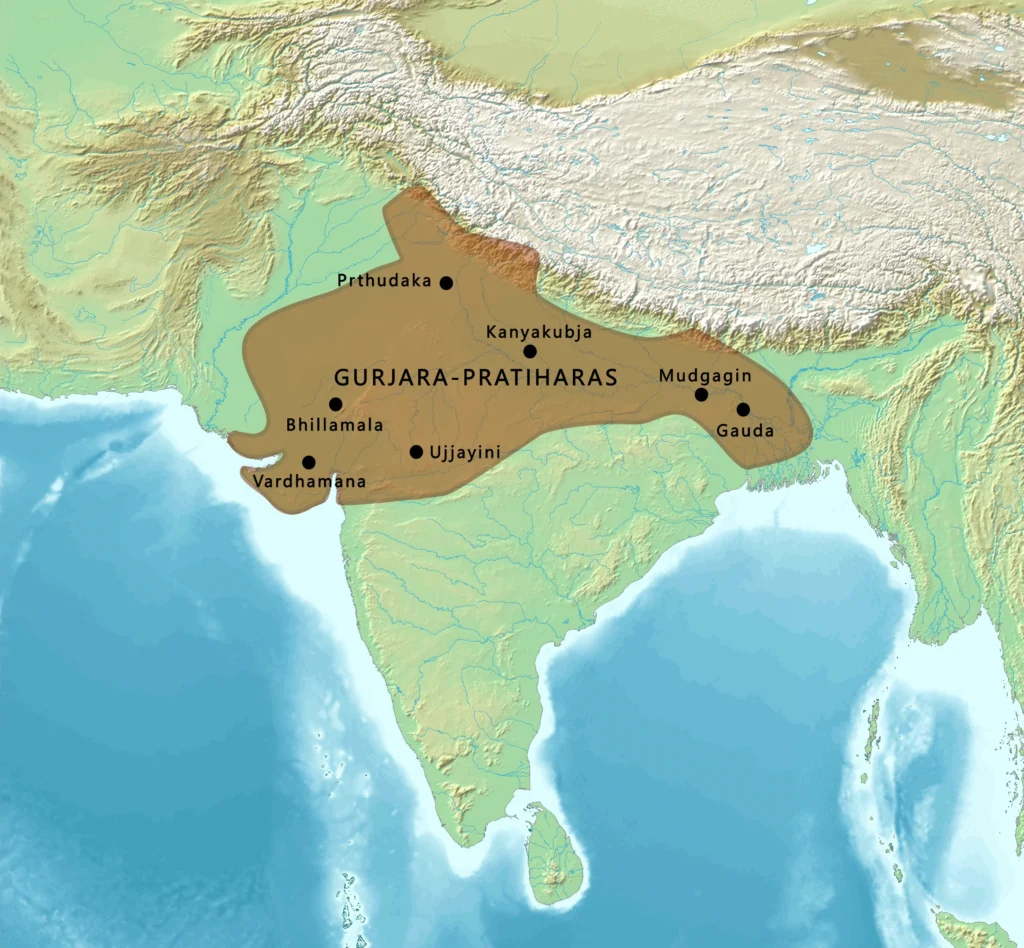
- The Gurjaras are variously viewed as foreign people gradually assimilated into Indian society, as local people who belonged to the Gurjara land (Gurjaradesha or Gurjaratra), or as a tribal group.
- The Pratiharas, whose name is derived from the Sanskrit word pratihara (which means “doorkeeper”), are regarded as a tribal group or clan of the Gurjaras.
- In the epic Ramayana, Prince Lakshmana worked as a doorkeeper for his elder brother King Rama.
- The Pratiharas adopted this title because Lakshmana was considered their ancestor.
- Several other Gurjara families began as local officials and eventually established small principalities to the south and east of Jodhpur in modern-day Rajasthan state.
- After successfully repelling Arab invaders in the late eighth century CE, the Pratiharas rose to prominence.
- Aside from inscriptions, the sculpture and monuments erected during their reign provide important evidence of their times and rule.
The Palas (8th to 11th Century)
- Pala empire was established in 750 CE, and it ruled 400 years, from the eighth to the twelfth centuries.
- Rulers of this dynasty had ‘Pala’ in their name, which means ‘protector’ and hence it was called the Pala dynasty.
- In the Indian subcontinent, this empire was one of the most powerful Buddhist imperial powers.
- The Palas were best known for their patronage of art, sculpture, painting and university construction, as well as their ongoing conflict with contemporary powers such as the Pratiharas of western India and the Rashtrakuta Dynasty of southern India.
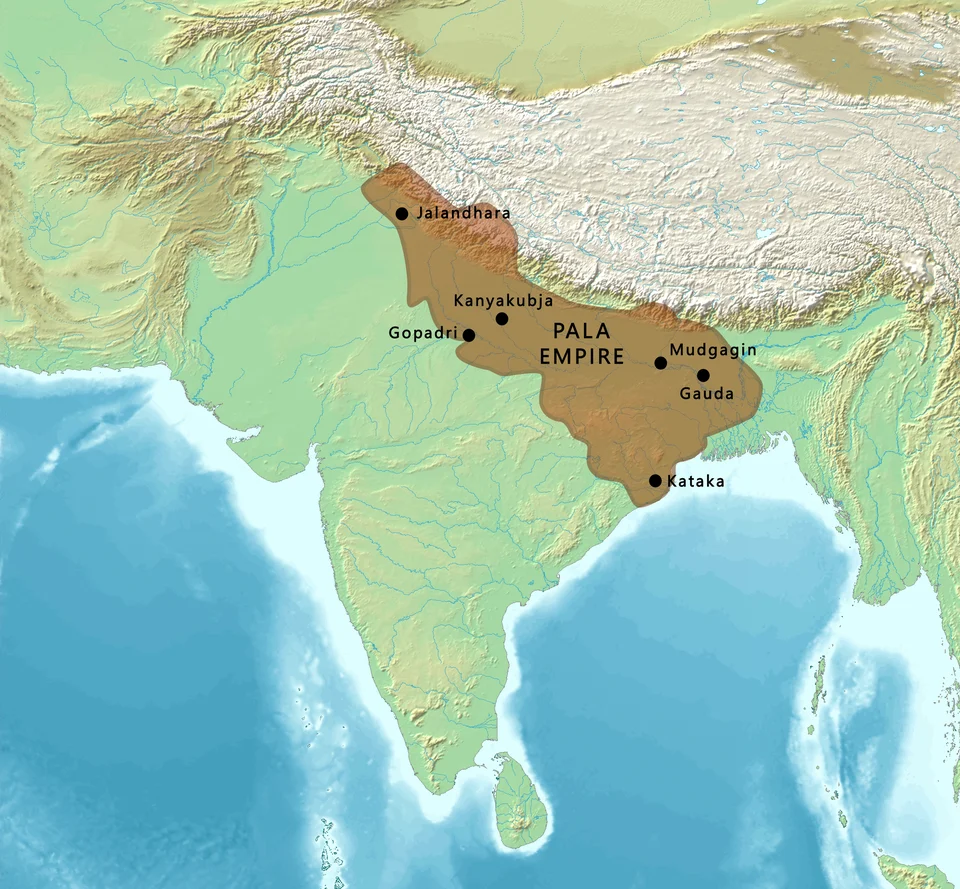
- Gopala established the Pala Empire in the eighth century.
- After Harshvardhana’s death, many kingdoms rose to dominance in Northern and Eastern India in the 7th century.
- The ruler of Gauda Kingdom i.e. Shashanka was the contemporary of King Harshavardhana and between 590 and 625 CE, he controlled the Bengal area.
- Soon after the death of Gauda King Shashanka, lawlessness erupted in the country’s northern and eastern parts, allowing the Palas to seize control and establish the Pala Empire.
- The Pala Empire began its authority in the states of Bihar and Bengal, but the borders of the Pala dynasty’s ruled provinces changed frequently due to the kingdom’s various collapses and revivals.
- The Bengal region was in a state of revolt after the fall of the Shashanka’s empire, and there was no central authority to rule the state, so Gopala ascended the throne as the first emperor.
- For nearly four centuries, the Palas dynasty ruled over Bihar, Bengal, and parts of Orissa and Assam, with numerous ups and downs.
The Senas (11th to 12th Century)
- The Sena Dynasty ruled Bengal from approximately 1097 to 1225 CE. The Sena dynasty ruled the majority of the Indian subcontinent’s northeast. Previously, the Pala dynasty ruled over both Bihar and Bengal.
- The Sena rulers were devout Hindus, as opposed to the Palas, who were Buddhists. They originated in the south Indian region of Karnataka, according to the Deopara inscription.
- The inscription mentions Samantha Sen, one of the southern founders, whose successor was Hemanta Sena, the first of the family to be given royal epithets in the family records, and who seized power from the Palas and styled himself king in around 1095 CE.
- His successor, Vijaya Sena, was instrumental in laying the groundwork for the dynasty.
- Vijayasena deposed Madanapala (the last ruler of the Pala dynasty) and established the Sena dynasty. He was the genuine founder of the Sena kingdom.
- His son, Ballala Sena (1160-1178), instituted the social reforms known as Kulinism in Bengal.
- Lakshamanasena succeeded Ballal Sena. This dynasty’s greatest ruler was Lakshmana Sena.
- He became weak near the end of his reign. Within his kingdom, there were signs of disintegration.
- Muhammad Bhaktiyar Khalji dealt the Sena kingdom its final blow (1204 AD).
The Rajaputas (647 – 1200 AD)
- With the downfall of Harsha, Rajput dominance began in the 7th century and continued till the 12th century.
- The name Rajaputas was derived from the word “Rajputra” meaning “ruler’s son.” Their bravery, loyalty, and royal status were adored. They were the battle-hardened warriors who managed the governing functions.
- They belonged to a patrilineal clan of western, central, and northern India and claimed to be descendants of North India’s ruling military aristocracy.
- There are several theories as to how Rajputs came to be. They were thought to be the offspring of foreign invaders and Indian Kshatriyas.
- The invaders were Indianized and assimilated into Indian society. Many Rajput legends support this theory.
- As a result, it is possible to say that various elements contributed to the formation of the Rajput clan.
- The Rajputs are divided into 36 clans and each clan belongs to one of three basic lineages (vanshas). These are Suryavansh, Chandravanshi and Agnivanshi.
- Suryavanshi Rajput clan is related to Surya, the Hindu Sun God. It is known as the Solar Dynasty in English.
- Chandravanshi Rajput clan to be a descendant of Chandra (the moon). In English, the Chandravanshi lineage is known as the Lunar Dynasty.
- Agnivanshi Rajputs assert that they are descendants of Agni, the Hindu god of fire.
- Each of these Vanshas or lineages is broken into multiple clans or kula, each of which claims direct patrilineage from a remote but common male ancestor who allegedly belonged to that Vansha.
Pallavas (275 – 897 CE)
- The Pallava Dynasty was located in the South Indian subcontinent. The span of Pallavas’s reign was from 275 CE to 897 C.E.
- They were the most influential rulers of South India and contributed enormously in the fields of religion, philosophy, art, coins and architecture.
- Pallavas were at their peak during the reign of Mahendravarman I and Narasimhavarman I.
- Throughout their rule in Tondaimandalam, they were in constant conflict with both Chalukyas of Badami in the north and the Tamil kingdom of Cholas and Pandyas in the south.
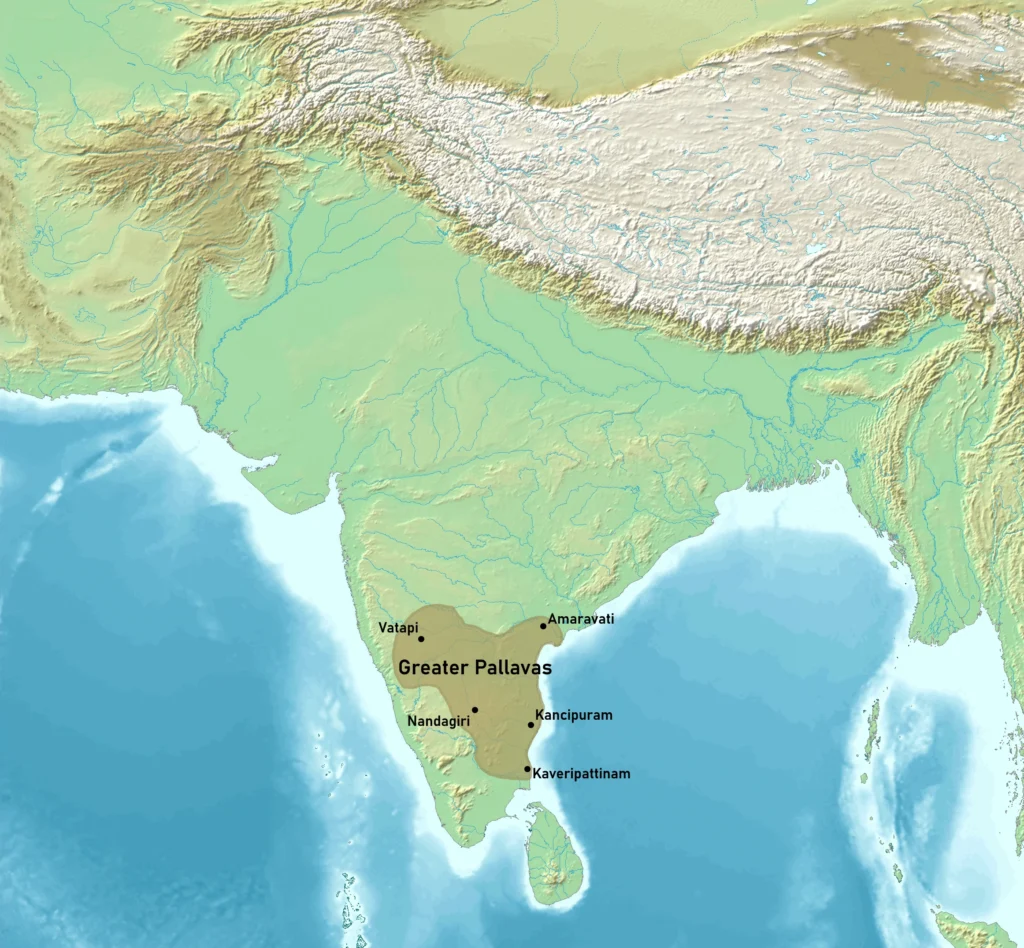
- They are most remembered for their shore temple architecture.
- The Pallavas’ origins are shrouded in mystery. Historians have proposed a number of theories.
- According to some historians, they are a branch of the Parthian people (an Iranian tribe) who gradually migrated to South India.
- Some claim they are an indigenous dynasty that arose in the Southern region and was a mash-up of various tribes.
- Some experts believe they are of Naga origin and first settled near Madras in the Tondaimandalam region.
- Another theory holds that they are the offspring of a Chola prince and a Naga princess from Manipallavam (Sri Lanka).
- Others believe that the Pallavas were feudatories of the Satavahanas.
- The first Pallava kings ruled in the early fourth century AD.
- By the 7th century AD, three kingdoms vied for supremacy in southern India: the Chalukyas of Badami, the Pandyas of Madurai, and the Pallavas of Kanchipuram.
Chalukyas (6th to 12 Century)
- With the downfall of the Gupta dynasty, dramatic changes began to occur in the Deccan and southern areas of Vindhyas.
- With the rise of the Chalukyas, the political climate in South India shifted from smaller kingdoms to large empires.
- The Chalukyas of Badami were the Vakatakas’ successors in western Deccan. They established their capital in Vatapi, modern Badami, in the Bijapur district of Karnataka.
- From 543 to 753 CE, they ruled over a large area in the Deccan and united the entire south of India.
- The Chalukya dynasty ruled from the sixth to the twelfth centuries when Pulakeshin I established the Chalukya dynasty in 543 AD.
- For the first time in history, a South Indian kingdom seized and consolidated control of the entire region between the Kaveri and Narmada rivers.
- Later, they split into several independent ruling houses, but the main branch remained in power at Vatapi.
- Their era was also significant in Indian history because of their cultural contributions.
- Between the 6th and 12th centuries, the Chalukya dynasty ruled vast areas of southern and central India.
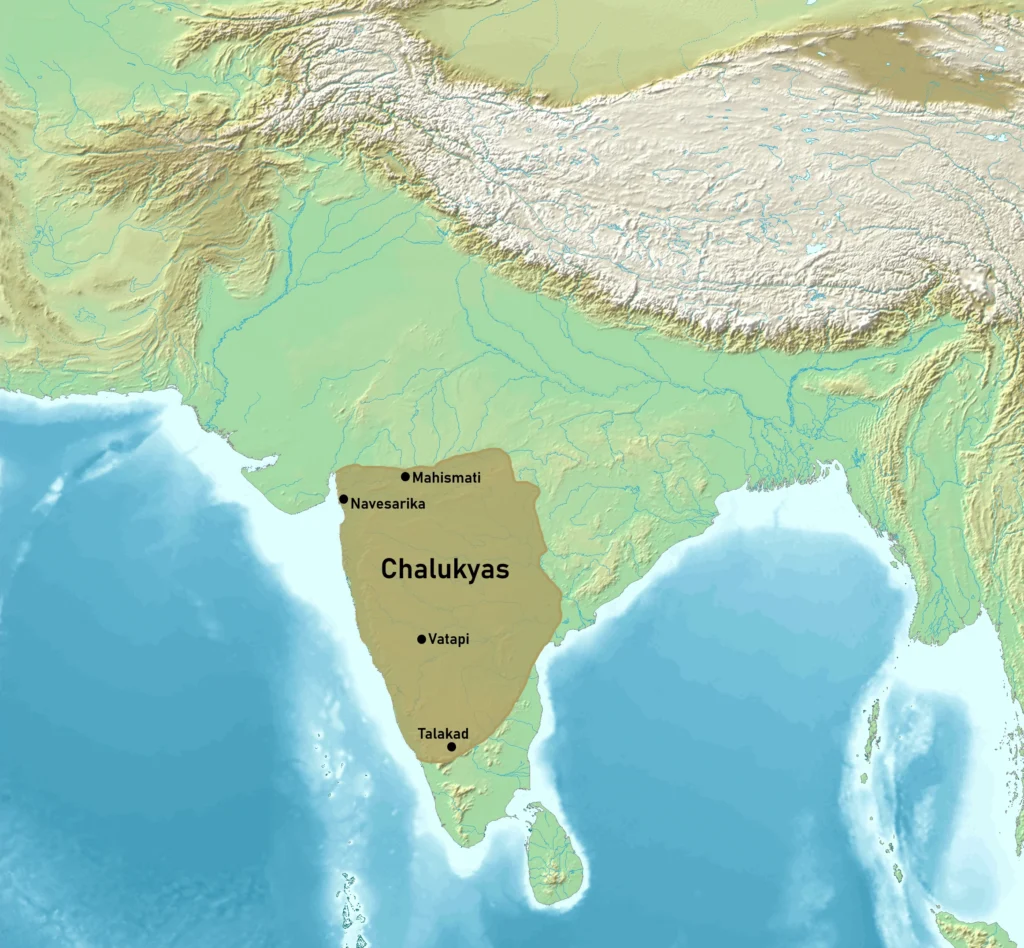
- The Chalukyas ruled from Vatapi (modern Badami) from the middle of the sixth century.
- They asserted their independence and rose to prominence under Pulakeshin II’s reign.
- Jayasimha was the first ruler of the Chalukyas dynasty.
- But the real founder of the Chalukyan dynasty was Pulakesin I (543–566 CE).
- After him, Pulakeshin II ruled over the whole Deccan and was the Badami dynasty’s most well-known ruler.
- Following the death of Pulakeshin II, the Badami Chalukya dynasty had a brief period of decline due to internal feuds.
- During the reign of Vikramaditya I, who succeeded in driving the Pallavas out of Badami and restoring order to the empire.
- The next great ruler was Vikramaditya II (733–744 AD) and the kingdom reached its pinnacle under his reign.
- Vikramaditya II conquered the three traditional kingdoms of Tamil land i.e. the Pandyas, Cholas, and Cheras.
Rashtrakutas (750 – 900 CE)
- The Rashtrakuta Dynasty ruled parts of South India from the eighth to the tenth centuries CE.
- At its peak, their kingdom encompassed the entire modern state of Karnataka, as well as parts of the current Indian states of Tamil Nadu, Andhra Pradesh, Telangana, Maharashtra, and Gujarat.
- Their capital was Malkhed, which was located near Sholapur. Because of their geographical location, the Rashtrakuta Dynasty was involved in alliances and wars with both their northern and southern neighboring kingdoms.
- The Rashtrakuta Dynasty’s earlier rulers were Hindus, but later rulers were Jains, according to historical records.
- The relationship of medieval Rashtrakutas who ruled in the 6th century to Manyakheta Rashtrakutas who ruled between the 8th and 10th centuries has also been disputed.
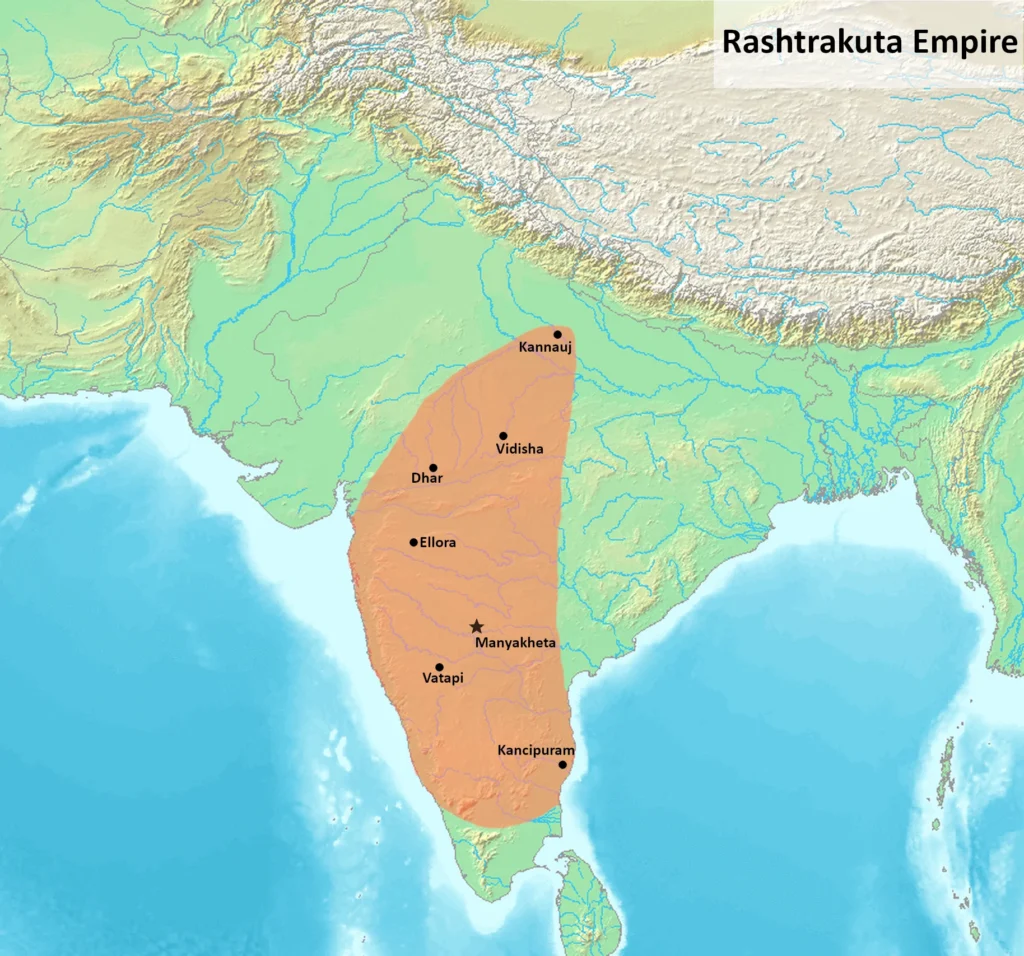
- Several hypotheses have been advanced to explain their genesis. They do claim to be descended from the Epic-era Yadava family. According to some scholars, they are of the Kshatriya race that gave Maharashtra its name.
- According to popular belief, they were a clan of ancestry officials tasked with governing Rashtrakutas’ provinces. As a result, it was adopted as a surname.
- It is clear, however, that they established their empire over the ruins of the Chalukyas.
Cholas (300 to 1300 CE)
- The Tamil Chola dynasty ruled in southern India and is considered one of the longest-ruling dynasties in history.
- The earliest datable references to it are in Ashoka inscriptions from the third century BC. The dynasty ruled over various sized territories until the 13th century AD.
- The Cholas were based in the fertile valley of the Kaveri River, but at their peak from the late 9th century to the early 13th century, they ruled over a much larger area.
- The Cholas left behind a legacy that includes Tamil literature and the great living Chola Temples.
- They established a disciplined bureaucracy and pioneered a centralized form of government.
- The Chola school of art spread throughout Southeast Asia, influencing architecture and art.
- Records available after the Sangam Age show that the Cholas remained in the Kaveri region as subordinates to the Pallavas.
- The resurgence of the Cholas began with the conquest of the Kaveri delta from Muttaraiyar by Vijayalaya (850–871 CE).
- In 850, he founded the Chola kingdom and built the city of Thanjavur. As a result, historians refer to them as the Later Cholas or Imperial Cholas.
- The Cholas trace their ancestry to the Karikala, the most well-known of the Cholas of the Sangam age, according to copper plate documents of his successors.
- The progenitor of their lineage is an eponymous king named ‘Chola,’ according to their genealogy.
- In these copper plates, the names Killi, Kochenganan, and Karikalan are mentioned as members of the line.
- From Parantaka I (907–955) to Kulothunga III (1163–1216), Vijayalaya’s illustrious successors brought the Cholas glory and fame.
- Parantaka Chola set the tone for territorial expansion and broadened the base of governance.
Cheras (9th to 12th Century)
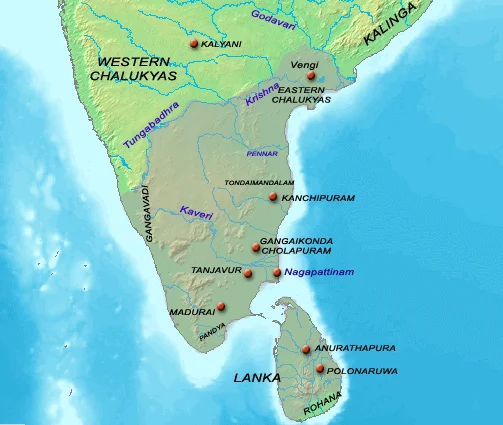
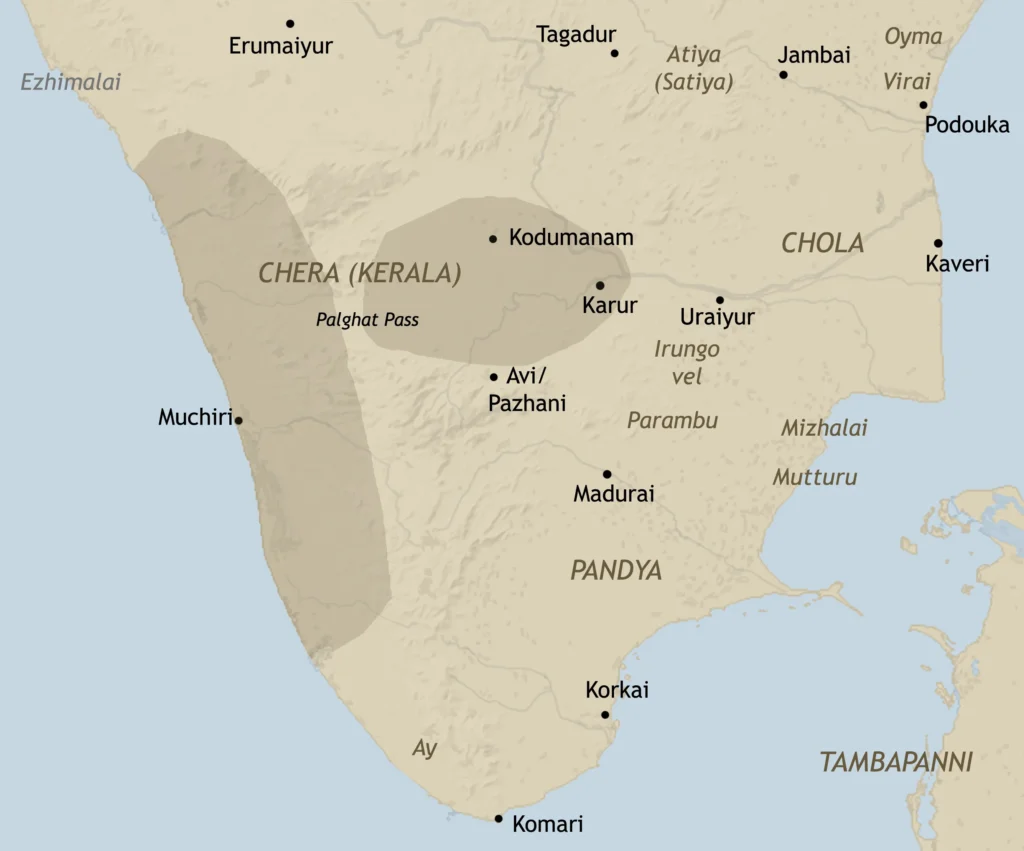
- The Cheras were a Dravidian sovereign dynasty from Tamil Nadu. They were the first in the area to establish a medieval ruling dynasty, ruled over vast stretches of Tamil Nadu and Kerala, respectively, in south-eastern and south-western India.
- There were two distinct periods in this dynasty. The Early Chera governed between the 4th and 5th centuries BC, and the Later Chera (also known as the Kulasekharas) ruled between the 8th and 12th centuries AD.
- The Chera dynasty was one of the most significant dynasties of the Sangam period in regions of Tamil Nadu and the present-day state of Kerala.
- In the early centuries of the Common Era, the early Cheras was known as one of the three major powers of ancient Tamilakam, alongside the Cholas of Uraiyur and the Pandyas of Madurai.
- They were also referred to as ‘Keraputras,‘ and their kingdom was located to the west and north of the Pandya kingdom.
- The Cheras’ history has been marked by constant conflict with the Cholas and the Pandyas.
- Uthiyan Cheralathan is regarded as the earliest known ruler of the Chera line as per Tamil scriptures. His ruling base was in Kuzhumur in Kuttanad, Kerala.
- Whereas, Kulasekhara Alwar was the first king of the later Chera kingdom, which later evolved into the Kulasekhara dynasty.
- For more than five centuries, there was no trace of a Chera monarch, but Kulasekhara Alwar appeared on the scene, claiming to be a descendant of the Chera.
- Most likely he ruled around 800 AD from Tiruvanchikkulam in the present state of Kerala and he ruled for more than 20 years.
- Then throne was held by Ramavarma; Kulasekhara Perumal, Ramar Tiruvati, or Kulasekhara Koyiladhikarikal was his name. He was the last ruler of the Later Chera dynasty.
Yadavas (12th to 13th Century)
- The Yadavas or Seuna dynasty ruled a kingdom spanning from the Tungabhadra to the Narmada rivers, comprising present-day Maharashtra, north Karnataka, and parts of Madhya Pradesh.
- They were initially feudatories of the Western Chalukyas but later on, they declared independence and founded a sovereign kingdom.
- The Yadava kingdom flourished until the early 14th century when it was annexed by the Delhi Sultanate.
- Yadavas reached their peak under the rule of Simhana II. They made significant contributions to cultural activities and during their reign Marathi became the main language of the region.
- The earliest historical ruler of the Seuna/Yadava dynasty can be traced back to the mid-9th century but little is known about their early history, their 12th century court poet Hemadri records the names of the family’s early rulers.
- The territory of the early Yadava rulers was in present-day Maharashtra, and several scholars have claimed that the dynasty had a “Maratha” origin.
- During this time, the Marathi language emerged as the dominant language in the dynasty’s inscriptions. Prior to this, the primary languages of their inscriptions were Kannada and Sanskrit.
- Hemadri’s traditional genealogy of the Yadavas traces their descent from Visnu, the Creator and Yadu were his later descendants.
- The dynasty’s first historically attested ruler is Dridhaprahara (860-880 AD), who is credited with founding the city of Chandradityapura (modern Chandor). He was a feudatory of Chalukyas.
- Bhillama ( 1175-1191 CE) was the first sovereign ruler of the Yadava dynasty in the Deccan region.
- Bhillama forced Ballala to retreat around 1187, conquered the former Chalukya capital Kalyani, and declared himself a sovereign ruler.
- He then founded the city of Devagiri, which became the new Yadava capital.
Conclusion
This period was marked by various political, social and cultural activities. Politically, the period from 750 to 1200 AD is known as the early Medieval period, which saw the rise of numerous regional states. This is a time of rapid cultural development. Around this time, regional languages and literature emerged. During this time, temple architecture styles such as Nagara, Dravida, and Vesara emerged. Cultural contacts with South East Asia (Java, Sumatra, Malay, Cambodia, Thailand, Vietnam, and Indonesia) arose as a result of Indian traders settling in these areas.
FAQs
1. Which were the major regional powers in India between 750–1200 AD?
The key dynasties were the Rashtrakutas, Palas, Gurjara-Pratiharas, Cholas, Chalukyas (later), Paramaras, Chandellas, and Palas in Bengal, among others.
2. Why is this period known as the “Tripartite Struggle”?
Because the Rashtrakutas, Palas, and Gurjara-Pratiharas fought for control over Kannauj, a symbol of political supremacy in North India.
3. What was the most significant achievement of the Cholas during this period?
The Cholas, especially Rajaraja I and Rajendra I, built a maritime empire, expanded to Sri Lanka and Southeast Asia, and promoted temple architecture (e.g., Brihadeshvara Temple).
4. Which dynasty played a key role in the spread of Buddhism during this period?
The Pala dynasty patronised Mahayana Buddhism, established Nalanda and Vikramashila universities, and sent Buddhist missions to Tibet and Southeast Asia.
5. What was the administrative feature common among these medieval dynasties?
Most adopted a feudal system, granting land to samantas and officials in exchange for military service and revenue collection.
Click on the question to see the Answers