Mauryan Empire (321 BCE – 185 BCE)

Content
- Introduction
- Historical Background
- Sources of Mauryan History
- Extent and Capital
- Major Rulers
- Mauryan Administration
- Mauryan Economy
- Mauryan Society and Religion
Introduction
The Mauryan Empire marks a turning point in ancient Indian history, representing the first large-scale, centralised imperial state that brought vast regions of the Indian subcontinent under a single political authority. Emerging in the aftermath of Alexander’s invasion, the Mauryan state laid the foundations of imperial governance, administrative centralisation, economic integration, and ethical statecraft. The empire reached its zenith under Ashoka, whose policies of Dhamma continue to attract scholarly and ethical debate.
Historical Background and Rise of the Mauryas
The rise of the Mauryan Empire must be understood against the background of political instability in northern India during the 4th century BCE.
- The Nanda dynasty, ruling Magadha, had accumulated enormous wealth but was widely unpopular due to oppressive taxation and autocratic rule.
- The invasion of Alexander the Great (326 BCE) weakened north-western polities and created a power vacuum, particularly after his withdrawal.
- This context enabled Chandragupta Maurya, with the guidance of Chanakya (Kautilya), to mobilise resources and overthrow the Nandas around 321 BCE.
The establishment of Mauryan rule marked the transition from regional kingdoms to an imperial structure, integrating military strength with political strategy.
Sources of Mauryan History
Our understanding of the Mauryan Empire is derived from a rich combination of literary, epigraphic, archaeological, and foreign sources.
Literary Sources
- Arthashastra (attributed to Kautilya) provides a detailed account of statecraft, administration, taxation, espionage, and diplomacy.
- Buddhist texts such as Dipavamsa and Mahavamsa offer insights into Ashoka’s reign and the spread of Buddhism.
Foreign Accounts
- Megasthenes’ Indica, written after his stay at Chandragupta’s court, describes Mauryan administration, society, and the grandeur of Pataliputra.
Epigraphic and Archaeological Sources
- Ashokan edicts (rock and pillar inscriptions) form the most reliable contemporary evidence of Mauryan governance.
- Excavations at Kumrahar and Bulandi Bagh reveal remains of Mauryan palaces and wooden architecture.
Extent and Capital
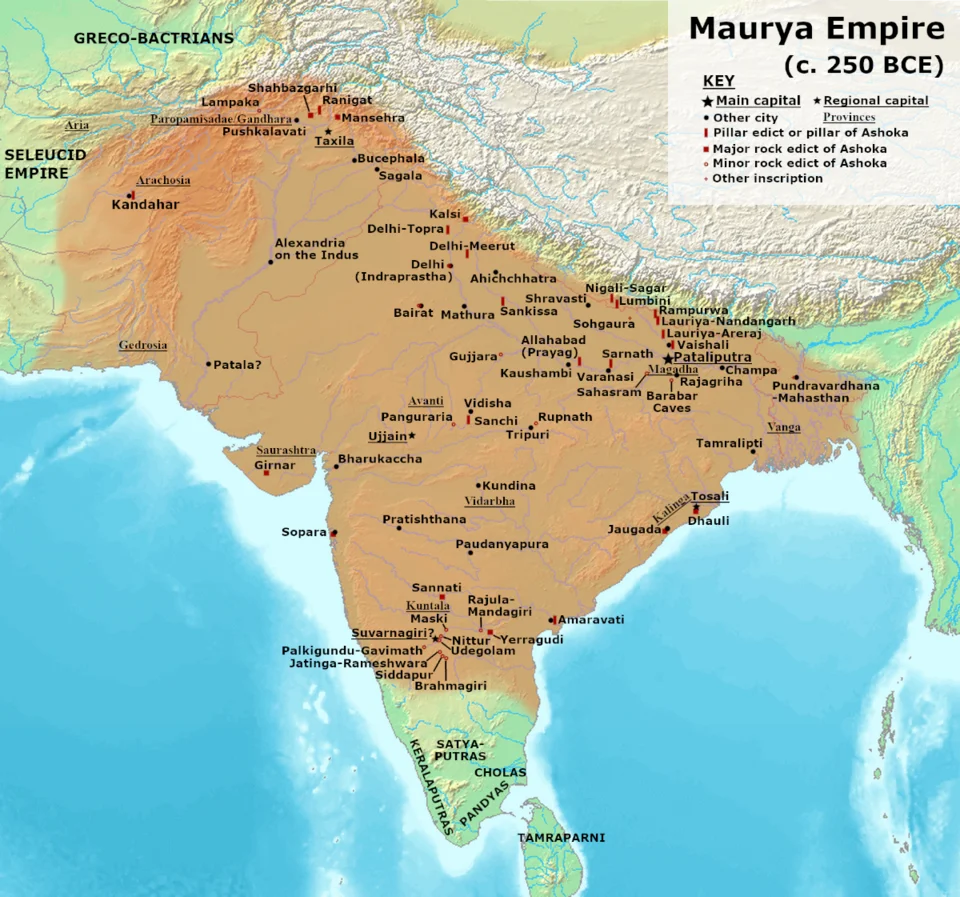
Pataliputra served as the imperial capital, strategically located at the confluence of major rivers, facilitating trade, communication, and military movement.
At its height, the Mauryan Empire stretched from Afghanistan and Baluchistan in the northwest, across the Indo-Gangetic plains, up to Kalinga (Odisha) in the east, and deep into the Deccan plateau.
Major Rulers of the Mauryan Empire
Chandragupta Maurya (321–297 BCE)
- Chandragupta Maurya was the founder of the Mauryan Empire and one of the most significant figures in ancient Indian political history. Rising from relatively humble origins, he capitalised on the widespread dissatisfaction against the Nanda rulers of Magadha and successfully overthrew them around 321 BCE with the strategic guidance of Chanakya (Kautilya).
- His reign marked the beginning of imperial unification in India, as he brought large parts of northern India under a single, centralised authority. Chandragupta also extended Mauryan control into the north-western regions, defeating the Greek satraps left behind after Alexander’s retreat. A notable achievement of his reign was the treaty with Seleucus Nicator, one of Alexander’s successors, through which Chandragupta gained territories in Afghanistan and Baluchistan in exchange for a matrimonial alliance.
- Administratively, Chandragupta laid the foundations of a strong, centralised bureaucratic state, supported by a well-organised army, efficient revenue collection, and a vast intelligence network, as described in the Arthashastra. In his later years, he embraced Jainism, abdicated the throne in favour of his son Bindusara, and is believed to have ended his life through Sallekhana in Shravanabelagola, reflecting the religious diversity of the Mauryan age.
Bindusara (297–273 BCE)
- Bindusara, the son of Chandragupta Maurya, inherited a vast and well-organised empire and played a crucial role in consolidating and expanding Mauryan authority. Known by the title Amitraghata (destroyer of enemies), Bindusara extended Mauryan influence further into the Deccan region, though the southernmost territories remained outside direct Mauryan control.
- Unlike his father, Bindusara focused more on administrative stability and territorial consolidation rather than dramatic military campaigns. His reign ensured continuity in governance, allowing the empire to remain politically stable and economically prosperous. Bindusara also maintained diplomatic relations with Hellenistic powers, indicating that the Mauryan Empire was an active participant in contemporary international politics.
- Religiously, Bindusara is believed to have patronised the Ajivika sect, further reinforcing the Mauryan tradition of religious tolerance. His reign served as a transitional phase, strengthening imperial structures and preparing the ground for the expansive and transformative rule of his successor, Ashoka.
Ashoka the Great (c. 272–232 BCE)
- Ashoka is the most celebrated ruler of the Mauryan dynasty, remembered both for his military conquests and for his profound transformation as a ruler.
- In the early years of his reign, Ashoka followed the traditional Mauryan policy of expansion, culminating in the Kalinga War, one of the bloodiest conflicts in ancient Indian history.
- The immense human suffering caused by the Kalinga War deeply affected Ashoka, leading to a fundamental change in his outlook. He renounced aggressive warfare and embraced Buddhism, adopting Dhamma as the guiding principle of his rule.
- Ashoka’s Dhamma was not a strictly religious doctrine but a moral and ethical framework emphasising non-violence, tolerance, compassion, respect for elders, and harmonious coexistence.
- Ashoka communicated his ideas and administrative policies through rock and pillar edicts, inscribed across the length and breadth of the empire. These edicts provide invaluable insights into Mauryan governance, covering issues such as justice, welfare measures, treatment of prisoners, religious tolerance, and relations with neighbouring states.
- To implement his moral policies, Ashoka appointed Dhamma Mahamatras, special officers responsible for promoting ethical conduct and social welfare.
- One of Ashoka’s most enduring contributions was the internationalisation of Buddhism. He sent missionaries to regions such as Sri Lanka, Southeast Asia, Central Asia, and the Mediterranean world, transforming Buddhism into a major world religion. Under Ashoka, the Mauryan Empire reached its moral and cultural zenith, even as territorial expansion gave way to ethical governance.
Later Mauryan Rulers
- After Ashoka’s death, the empire gradually declined under a series of weak and less effective successors, including Dasharatha and Brihadratha.
- These rulers struggled to maintain central authority over a vast empire, leading to administrative inefficiency and growing provincial autonomy.
- Ultimately, the last Mauryan ruler, Brihadratha, was assassinated by his general Pushyamitra Shunga in 185 BCE, bringing the Mauryan dynasty to an end.
Mauryan Administration
- The Mauryan Empire developed a highly organised and centralised system of administration to govern its vast territory. The king stood at the centre of the administrative structure and exercised supreme authority over military, judicial, and executive matters.
- However, governance was not arbitrary, as the king was assisted by a council of ministers and a well-defined bureaucracy. Administrative principles described in Kautilya’s Arthashastra reveal a state that valued efficiency, discipline, and accountability.
- For effective governance, the empire was divided into provinces, usually administered by royal princes or trusted officials. Important provincial centres such as Taxila and Ujjain functioned as administrative hubs.
- These provinces were further divided into districts and villages, allowing the central authority to maintain control even at the local level. Village headmen played a crucial role in day-to-day administration, including tax collection and maintaining order.
- One of the distinctive features of Mauryan administration was its extensive espionage system, which helped monitor officials and prevent rebellions. The empire also maintained a large standing army, supported by efficient revenue collection.
- Under Ashoka, administration acquired a moral dimension, with officers appointed to promote welfare, justice, and ethical conduct, reflecting the fusion of political authority with moral governance.
Mauryan Economy
- The economy of the Mauryan Empire was primarily agrarian but supported by well-regulated trade, industry, and state control over resources. Agriculture formed the backbone of the economy, and the state actively promoted cultivation through land reclamation and irrigation facilities.
- Land revenue was the main source of income for the state, generally collected as a fixed share of agricultural produce.
- In addition to land tax, the Mauryan state levied taxes on trade, crafts, mines, forests, and tolls on roads and waterways. Several key industries such as mining, salt production, arms manufacture, and forest resources were directly controlled by the state.
- This reflects a state-supervised economic system aimed at ensuring steady revenue and availability of essential materials.
- Trade flourished both within the empire and with foreign regions. The political unification of India under the Mauryas facilitated internal trade, while well-maintained roads and ports supported long-distance and maritime commerce.
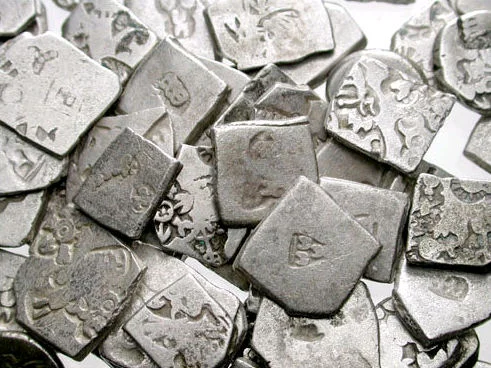
- Punch-marked coins were widely used, indicating a monetised economy. Under Ashoka, economic resources were increasingly utilised for public welfare, including roads, rest houses, and medical facilities, strengthening both productivity and social stability.
Mauryan Society and Religion
- Mauryan society was diverse and dynamic, shaped by political unification, economic growth, and religious interaction. While the traditional varna system existed, social life was not rigid, and the growth of cities, administration, and the army allowed for some degree of social mobility.
- Urban centres housed merchants, artisans, officials, and labourers, while rural society remained largely agrarian and village-based.
- The position of women was mixed. Although society was patriarchal, women participated in economic activities and were employed in various professions, as indicated in the Arthashastra.
- Slavery and bonded labour existed, but they were regulated by the state to prevent excessive exploitation.
- Religiously, the Mauryan period was marked by pluralism and tolerance. Brahmanism coexisted with Buddhism, Jainism, and Ajivikism. Buddhism gained special prominence under Ashoka, who promoted moral values such as non-violence, compassion, and tolerance through his policy of Dhamma.
- Importantly, Ashoka did not impose Buddhism but encouraged respect for all faiths. This emphasis on ethical living and religious harmony helped maintain social cohesion in a culturally diverse empire.
Conclusion
The Mauryan Empire stands as a milestone in India’s political and cultural evolution. From Chandragupta’s statecraft to Ashoka’s moral governance, it combined power with principle. Its administrative efficiency, economic integration, and emphasis on ethical rule laid enduring foundations for Indian civilisation. For UPSC aspirants, the Mauryan period offers crucial insights into early state formation, governance models, and the relationship between power and values in ancient India.