Passive Euthanasia
Content
- Why in News
- Introduction
- Understanding Euthanasia
- Constitutional Basis
- Evolution of Legal Position in India
- Living Will
- Ethical and Moral Dimensions
- Global Perspective on Euthanasia
- Significance
- Challenges in Implementation
- Way Forward
Why in News?
Recently, the Supreme Court of India allowed passive euthanasia in the case of Harish Rana, a patient who had been in a vegetative state for more than 13 years after a severe accident. The Court permitted the withdrawal of life-support systems and reiterated the principle of the “right to die with dignity” under Article 21 of the Constitution. The case has revived debate over end-of-life decisions and the need for a comprehensive law on euthanasia in India.
Introduction
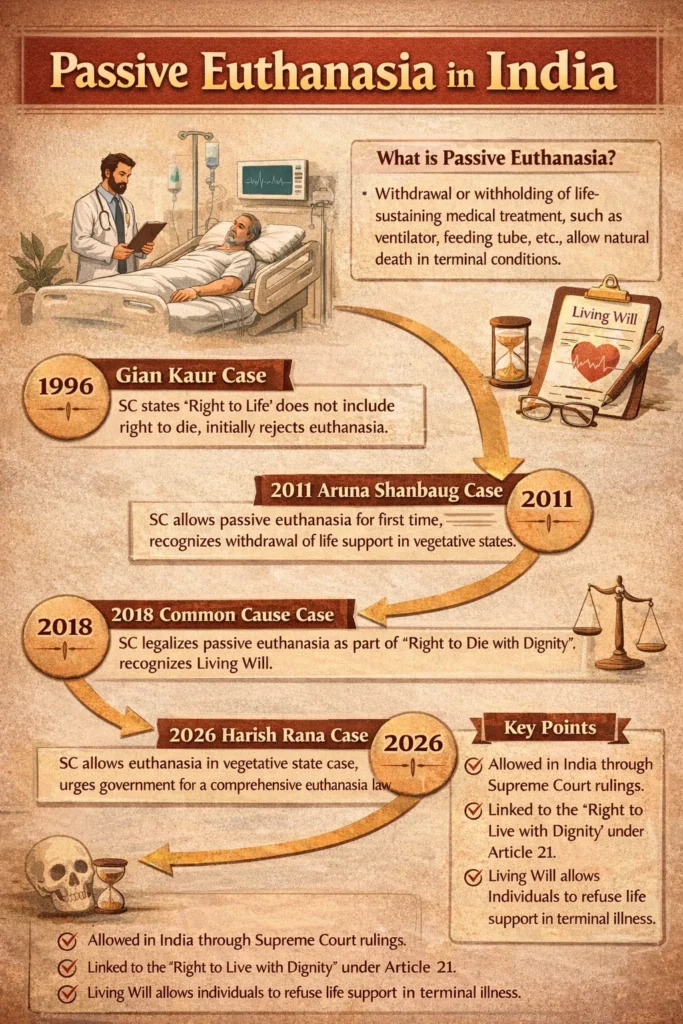
Passive euthanasia refers to the withdrawal or withholding of life-sustaining medical treatment such as ventilators, feeding tubes, or artificial hydration allowing a terminally ill patient to die naturally. It is usually considered when the patient is suffering from an irreversible condition with no chance of recovery. The practice is justified on humanitarian and ethical grounds as it aims to prevent prolonged suffering and uphold the dignity of the patient at the end of life.
In India, passive euthanasia has gradually evolved through judicial interpretation rather than direct legislation, with the Supreme Court recognizing it as part of the fundamental right to life and dignity under Article 21.
Understanding Euthanasia
Meaning: Euthanasia literally means “good death.” It refers to the deliberate act of ending a person’s life to relieve suffering caused by terminal illness or irreversible medical conditions.
Types of Euthanasia:
- Active Euthanasia
Active euthanasia involves directly causing a patient’s death through medical intervention such as administering a lethal injection or drugs. This form of euthanasia is illegal in India because it amounts to culpable homicide under criminal law. - Passive Euthanasia
Passive euthanasia involves withdrawing or withholding life-sustaining medical treatment, thereby allowing the patient to die naturally. In India, this form is legally permitted under strict guidelines laid down by the Supreme Court. - Voluntary Euthanasia
It occurs when a competent patient voluntarily requests termination of treatment or life support. - Non-Voluntary Euthanasia
This occurs when the patient is unable to express consent such as patients in coma or vegetative states and decisions are taken by family members or medical authorities. - Involuntary Euthanasia
Ending life without the consent of the patient. It is illegal and treated as a criminal offense in most countries.
Constitutional Basis of Passive Euthanasia in India
Article 21 and Right to Die with Dignity:
- Article 21 of the Constitution guarantees the Right to Life and Personal Liberty. Over time, the Supreme Court expanded its interpretation to include the concept of living and dying with dignity.
- The Court has held that forcing a terminally ill patient to remain on artificial life support despite irreversible suffering may violate the dignity component of Article 21.
Thus, the right to die with dignity is interpreted as a natural extension of the right to life.
Evolution of Legal Position in India
1. Gian Kaur v. State of Punjab (1996)
In this case, the Supreme Court held that the right to life does not include the right to die, thereby rejecting euthanasia in principle.
However, the Court acknowledged that dignified death in cases of terminal illness may require special consideration, laying the groundwork for future developments.
2. Aruna Shanbaug Case (2011)
The issue of euthanasia gained national attention after the case of Aruna Shanbaug, a nurse who remained in a vegetative state for more than four decades following a brutal assault.
The Supreme Court allowed passive euthanasia under strict conditions, marking the first time the concept was legally recognized in India. Key features included:
- Passive euthanasia could be permitted only in exceptional circumstances.
- Decisions required approval from the High Court after consultation with medical experts.
- The ruling distinguished clearly between active and passive euthanasia.
3. Common Cause v. Union of India (2018)
In this landmark judgment, a Constitution Bench of the Supreme Court significantly expanded the legal framework for passive euthanasia.
The Court held that:
- The right to die with dignity is a fundamental right under Article 21.
- Individuals have the right to refuse medical treatment in terminal conditions.
- The concept of Living Will (Advance Directive) was legally recognized.
A living will allows a person to specify in advance whether life-support treatment should be withdrawn if they become terminally ill or permanently unconscious.
4. Simplification of Guidelines (2023)
In later rulings, the Supreme Court simplified the procedures for implementing living wills and passive euthanasia. Earlier procedures involving complex judicial approvals were relaxed, and hospital-level medical boards were authorized to take decisions in accordance with guidelines.
5. Recent Supreme Court Case (2026)
In the Harish Rana case, the Supreme Court permitted withdrawal of life-support treatment for a patient who had been in a vegetative state for over 13 years. The Court emphasized that continuing treatment without hope of recovery would undermine the patient’s dignity and suffering.
The Court also urged the government to enact a comprehensive law on euthanasia to address the existing legal vacuum.
Living Will / Advance Directive
A Living Will is a written document in which a person states their wishes regarding medical treatment if they become unable to communicate or make decisions.
Key Features
- Executed voluntarily by an adult with sound mind.
- Specifies whether life-support treatment should be continued.
- Guides doctors and family members in making end-of-life decisions.
Importance
The recognition of living wills protects the patient’s autonomy, dignity, and freedom of choice regarding medical treatment.
Ethical and Moral Dimensions
Passive euthanasia raises several ethical debates in society.
- Right to Dignity:Supporters argue that a terminally ill patient should not be forced to live in unbearable pain or irreversible medical conditions.
- Medical Ethics:Doctors face moral dilemmas between the duty to preserve life and the obligation to relieve suffering.
- Autonomy of the Patient:The principle of autonomy allows individuals to make decisions about their own bodies and medical treatment.
- Sanctity of Life:Opponents argue that life is sacred and should not be intentionally ended under any circumstances.
Global Perspective on Euthanasia
Different countries adopt varying approaches toward euthanasia.
- Netherlands, Belgium, and Canada permit active euthanasia under strict regulations.
- United States allows physician-assisted suicide in some states.
- Many countries, including India, permit only passive euthanasia under legal safeguards.
These differences reflect diverse cultural, ethical, and legal perspectives.
Significance of Passive Euthanasia
Protection of Human Dignity: Passive euthanasia recognizes that dignity is an essential part of the right to life and prevents prolonged suffering in terminal conditions.
Respect for Individual Autonomy: The concept of living wills allows individuals to decide in advance how they want to be treated in critical medical situations.
Humane End-of-Life Care: It ensures that medical treatment is not unnecessarily prolonged when recovery is medically impossible.
Development of Palliative Care: The debate around euthanasia has highlighted the need for better palliative care and end-of-life medical support systems.
Challenges in Implementation
- Lack of Comprehensive Legislation: India currently relies mainly on judicial guidelines rather than a dedicated statute, leading to legal uncertainty and inconsistent implementation.
- Low Awareness: Many patients, families, and healthcare professionals are unaware of legal provisions such as living wills and passive euthanasia guidelines.
- Ethical and Religious Opposition: Many communities oppose euthanasia due to religious and moral beliefs that consider life sacred.
- Fear of Misuse: There are concerns that euthanasia may be misused due to economic pressures, inheritance disputes, or inadequate safeguards.
- Weak Healthcare Infrastructure: Unequal access to hospitals, ethics committees, and medical boards makes implementation difficult in many parts of India.
Way Forward
- Enact Comprehensive Legislation: Parliament should enact a clear law regulating euthanasia, defining procedures, safeguards, and accountability.
- Strengthen Medical Ethics Committees: Hospitals should establish ethics committees to supervise end-of-life decisions.
- Increase Public Awareness: People must be informed about living wills and legal rights related to end-of-life care.
- Promote Palliative Care: Expanding palliative care services can reduce unnecessary suffering and improve the quality of life for terminally ill patients.
Conclusion
Passive euthanasia in India represents an evolving balance between human dignity, medical ethics, and legal safeguards. Through landmark judgments, the Supreme Court has recognized that the right to life under Article 21 includes the right to die with dignity. However, the absence of comprehensive legislation and the complexity of ethical issues highlight the need for a clear legal framework.
With proper safeguards, awareness, and institutional mechanisms, India can ensure that end-of-life decisions respect both human compassion and constitutional values.