Plate Tectonics Theory
Content
- Introduction
- Plate Tectonics Theory
- Types of Tectonic Plates
- Plate Tectonics Theory Significance
- Plate Tectonics Major and Minor Divisions
- Forces Driving Plate Tectonics Movement
- Pate Tectonics Boundaries
- Plate Tectonics and Continental Evolution
- FAQs
Introduction
Plate tectonics is a geological theory that pertains to the lithosphere, the Earth’s outer layer, which is divided into large segments referred to as tectonic plates. These tectonic plates move gradually below the Earth’s surface and are responsible for the creation of mountains, volcanoes, and various geographical features that develop and evolve over time. In this article, we will explore the intricacies of Plate Tectonic Theory.
Plate Tectonics Theory
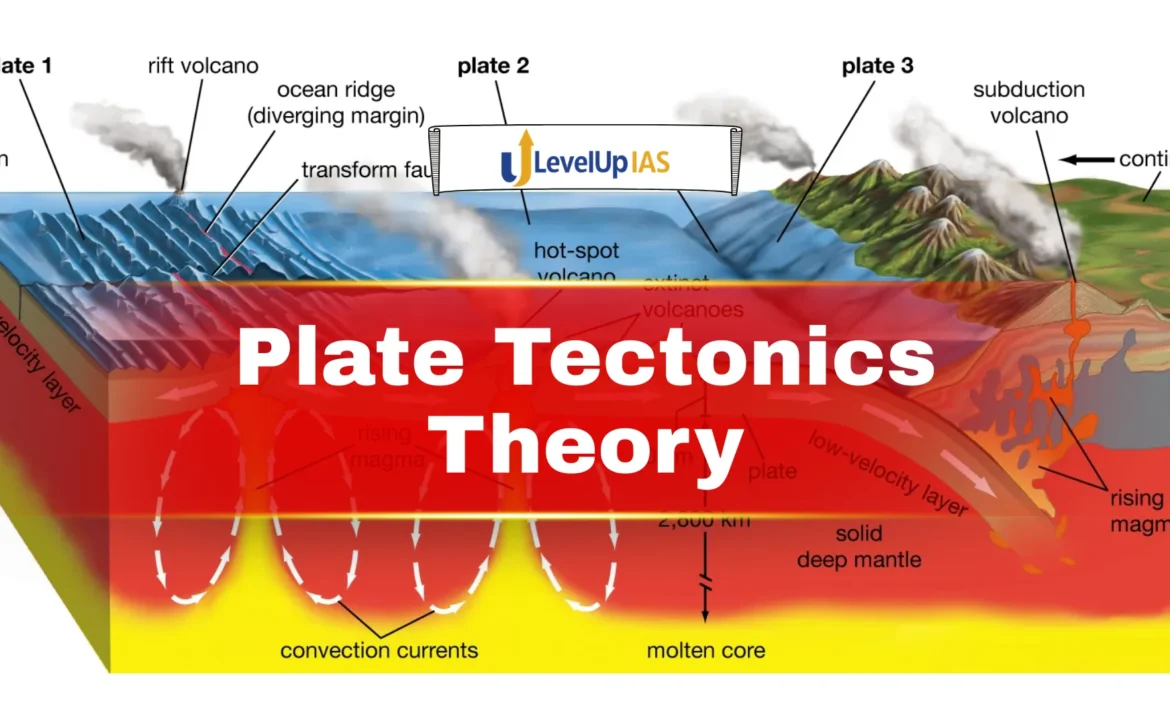
A tectonic plate is a rigid slab of solid rock that continually shifts, causing alterations in the lithosphere, which is Earth’s outermost layer. Tectonic plates are dynamic and move slowly over the asthenosphere, a semi-fluid, malleable layer situated beneath the lithosphere that facilitates this movement.
Types of Tectonic Plates
Tectonic plates can be classified into the following categories:
- Continental Plates: Composed of granitic rocks, relatively light but thicker.
- Oceanic Plates: Composed of basaltic rocks, denser but thinner.
- Mixed Plates: Contain both continental and oceanic crust.
- A tectonic plate can be classified as either continental or oceanic based on the predominant type of crust it encompasses. For example:
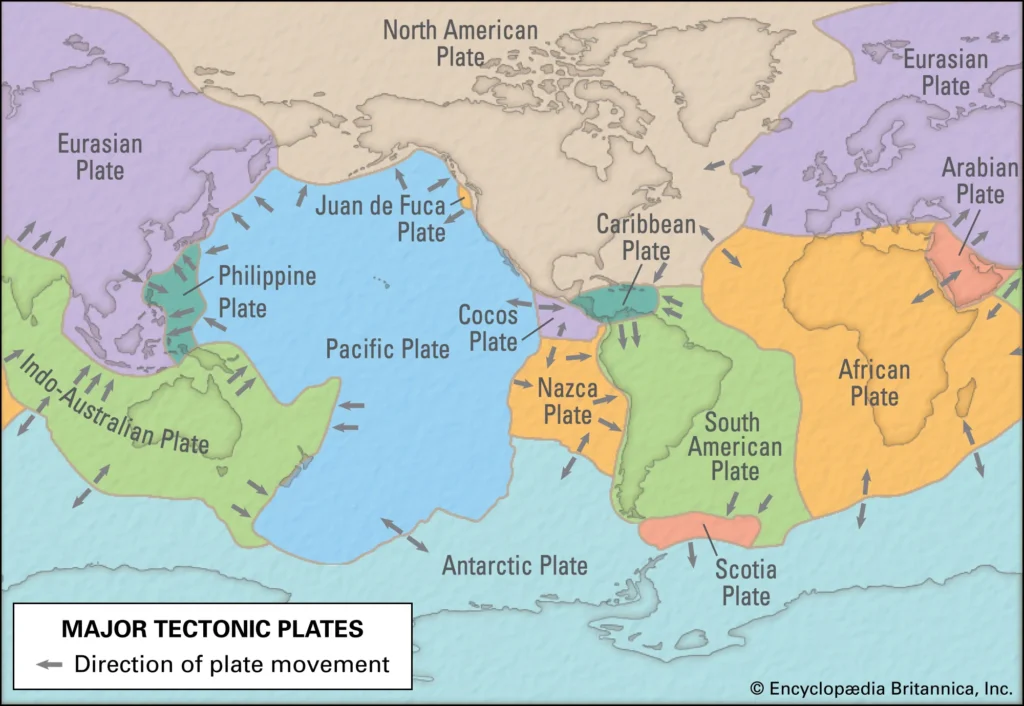
- Pacific Plate – Oceanic Plate
- Eurasian Plate – Continental Plate
Plate Tectonics Theory Significance
Alfred Wegener proposed the Plate Tectonics Theory in the mid-20th century, and scientists widely regard it as the most credible explanation for Earth’s large-scale geological processes. It clarifies the following aspects:
- The formation and separation of oceans and continents
- The creation of mountains resulting from plate collisions
- The occurrence of earthquakes along fault lines
- The eruption of volcanoes at subduction zones and mid-ocean ridges
- This knowledge aids in comprehending the Earth’s ever-changing surface
Plate Tectonics Major and Minor Divisions
The lithosphere of Earth is segmented into several major and minor tectonic plates:
Major Tectonic Plates:
- Pacific Plate
- Eurasian Plate
- North American Plate
- South American Plate
- African Plate
- Indo-Australian Plate
- Antarctic Plate
Minor Tectonic Plates:
- Fuji Plate – Northeast of Australia.
- Cocos Plate – Situated between Central America and the Pacific Plate
- Nazca Plate – Located between South America and the Pacific Plate
- Arabian Plate – Encompasses a large portion of the Middle East
- Philippine Plate – Positioned between Asia and the Pacific
- Caroline Plate – Found to the north of New Guinea
Forces Driving Plate Tectonics Movement
- The movement of tectonic plates is driven by heat energy originating from the Earth’s interior. The forces that contribute to this movement include:
- This concept, introduced by Arthur Holmes in the 1930s, formed the basis for Harry Hess’ seafloor spreading theory developed in the 1960s.
- Flow in the Asthenosphere: The movement of tectonic plates is influenced by convection currents within the semi-fluid asthenosphere.
- Sources of heat involve the radioactive decay of various elements (such as uranium, thorium, and potassium) along with residual heat from the Earth’s formation.
- Convection Cells: The ascent of hot mantle material, its subsequent spread, cooling, and sinking creates circular flow that exerts forces on the plates.
Pate Tectonics Boundaries
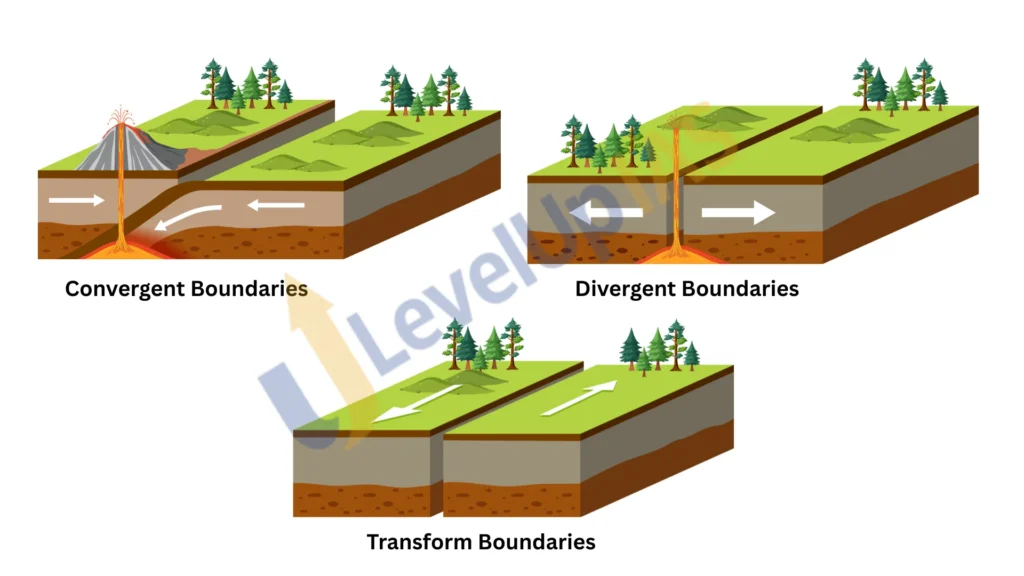
The boundaries of Plate Tectonics can be categorized into three types:
Divergent Boundaries (Constructive)
- Plates separate, resulting in the formation of new crust from rising magma.
- Example: Mid-Atlantic Ridge (North American Plate separating from Eurasian Plate).
Convergent Boundaries (Destructive)
- Plates come together, which can lead to subduction or the creation of mountains.
- Oceanic–Oceanic Convergence: One oceanic plate subducts beneath another, forming volcanic island arcs (e.g., Philippines, Indonesia).
- Oceanic–Continental Convergence: The denser oceanic plate subducts under the continental plate, resulting in volcanic mountains (e.g., Andes).
- Continental–Continental Convergence: Both plates collide, creating fold mountains (e.g., Himalayas, Alps).
Transform Boundaries (Conservative)
Example: San Andreas Fault in California.
Plates slide horizontally past one another, causing earthquakes.
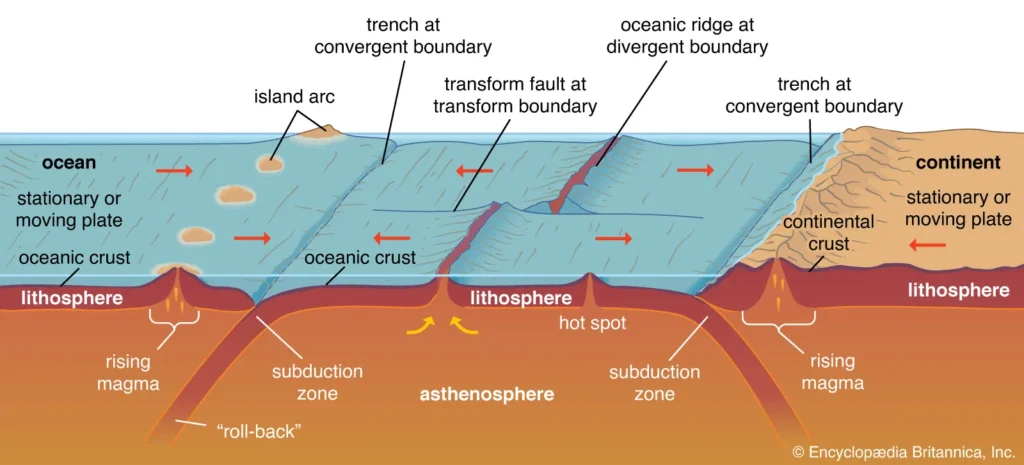
Plate Tectonics and Continental Evolution
- Alfred Wegener proposed the Theory of Continental Drift in 1912, suggesting that all continents were once part of a supercontinent known as Pangaea.
- Over time, advancements in the study of seafloor spreading and paleomagnetism confirmed that continents were divided by tectonic plates.
- Continents continuously shift, collide, fracture, and reshape the Earth’s surface.
- Example: The Indian subcontinent moved from near Antarctica and collided with Asia, resulting in the formation of the Himalayas.
FAQs
Q1: What is Plate Tectonics Theory?
A1: Plate Tectonics Theory explains that Earth’s lithosphere is divided into rigid plates that float on the semi-fluid asthenosphere, constantly moving and interacting to shape the planet’s surface.
Q2: Who proposed the Plate Tectonics Theory?
A2: Alfred Wegener first proposed the idea of continental drift in 1912, which laid the foundation. The modern Plate Tectonics Theory was developed in the 1960s by scientists like J. Tuzo Wilson and Harry Hess.
Q3: How many major tectonic plates are there?
A3: There are seven major plates, Pacific, North American, Eurasian, African, South American, Antarctic, and Indo-Australian and several minor plates.
Q4: How do plate movements cause earthquakes and volcanoes?
A5: Stress at plate boundaries leads to earthquakes. Volcanic activity occurs where plates diverge or converge, allowing magma to rise through the crust.
Q5: What is the difference between continental drift and plate tectonics?
A6: Continental drift explains the movement of continents only, while plate tectonics provides a complete theory including oceanic plates, earthquakes, volcanoes, and mountain formation.
Click on the question to see the Answers