Post-Mauryan Empires, Shunga, Kanva, Satavahanas, Chedi Dynasties

Content
- Introduction
- Political Developments
- The Shunga Dynasty
- The Kanva Dynasty
- The Satavahana Dynasty
- The Mahameghavahana (Chedi) Dynasty
- Significance
- FAQs
Introduction
The decline of the Mauryan Empire after the death of Ashoka led to the fragmentation of political authority in the Indian subcontinent. With the weakening of centralized control, several regional powers emerged in different parts of India. These regional dynasties played a crucial role in shaping the political, economic, and cultural landscape of the subcontinent during the Post-Mauryan period.
The period between approximately 200 BCE and 300 CE is therefore often described as the age of regional kingdoms. Prominent among these were the Shungas, Kanvas, Satavahanas, and the Chedis (Mahameghavahanas) of Kalinga.
Despite political fragmentation, this era witnessed significant developments in trade, religion, art, literature, and regional administration, laying the foundations for later classical civilizations such as the Gupta Empire.
Political Developments after the Mauryan Decline
The Mauryan Empire had established a vast centralized administration across the Indian subcontinent. However, after Ashoka’s death, the empire gradually weakened due to internal conflicts, administrative inefficiency, and succession disputes.
By the mid-2nd century BCE, the last Mauryan ruler Brihadratha was assassinated by his general Pushyamitra Shunga, marking the beginning of the Shunga dynasty.
With the collapse of Mauryan authority, the Indian subcontinent witnessed the rise of several regional powers. Northern India came under the control of the Shungas and later the Kanvas, while the Deccan region was dominated by the Satavahanas. At the same time, Kalinga in eastern India witnessed the emergence of the Mahameghavahana or Chedi dynasty.
The Shunga Dynasty (185 BCE – 73 BCE)
Establishment of the Dynasty
The Shunga dynasty was founded by Pushyamitra Shunga, a Brahmin general in the Mauryan army who overthrew the last Mauryan ruler in 185 BCE.
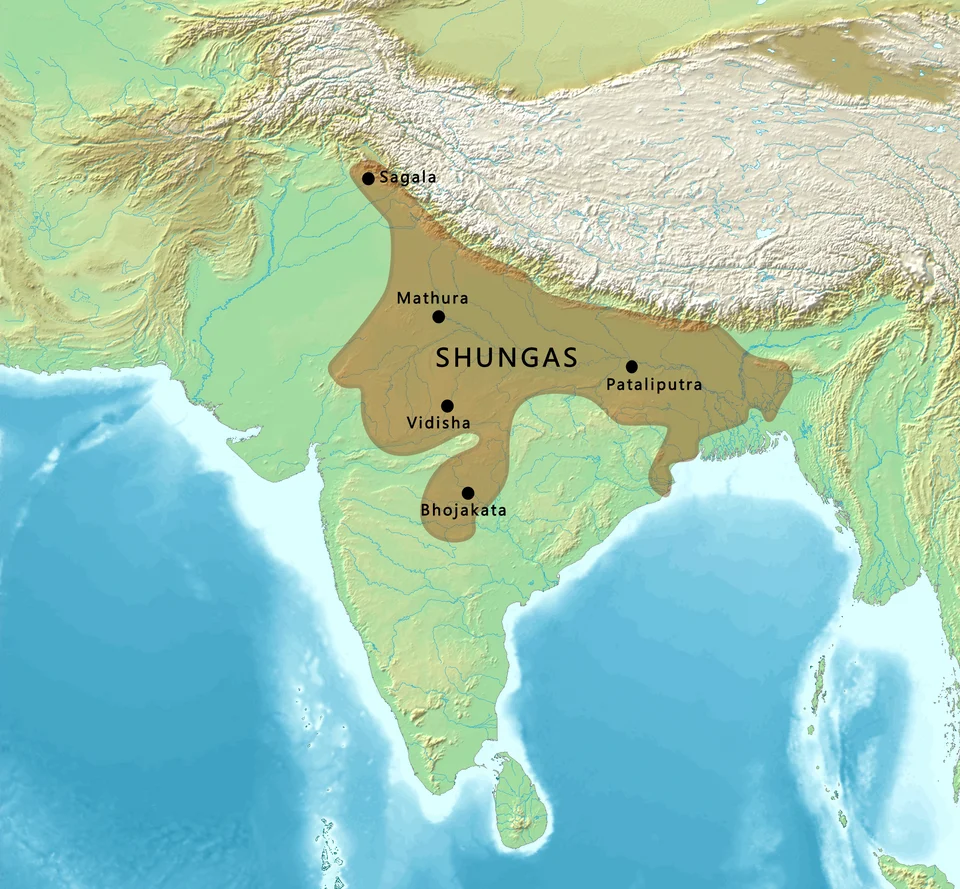
- The Shungas established their capital at Pataliputra, though Vidisha also served as an important administrative center under later rulers such as Agnimitra.
- Important rulers of the dynasty included Pushyamitra Shunga, Agnimitra, Vasumitra, and Devabhuti.
Political and Military Achievements
- Pushyamitra Shunga worked to consolidate his power and revive political authority in northern India.
- One of the key achievements of the Shunga rulers was their resistance against Indo-Greek invasions. The Indo-Greek rulers, including Demetrius I and Menander (Milinda), attempted to expand into northwestern India, but the Shungas successfully resisted these incursions.
- Pushyamitra also performed two Ashvamedha sacrifices, which symbolized imperial sovereignty and reaffirmed Brahmanical political authority.
Under the Shungas, the empire extended across Magadha, Ayodhya, Vidisha, Bihar, Bengal, Uttar Pradesh, and parts of central India up to the Narmada River.
Religious and Cultural Developments
- The Shunga period is often associated with the revival of Brahmanical traditions.
- Pushyamitra Shunga patronized Vedic rituals and Hindu traditions, and the period witnessed renewed emphasis on Brahmanical ideology.
- Some Buddhist sources suggest persecution of Buddhism during this period. However, archaeological evidence shows that Buddhist monuments such as the Sanchi and Bharhut stupas continued to flourish, indicating coexistence of religious traditions.
- An important religious monument of the period is the Heliodorus Pillar at Besnagar (Vidisha). This pillar was erected by Heliodorus, a Greek ambassador of the Indo-Greek king Antialcidas, who dedicated it to the god Vishnu.
Art and Architecture
The Shunga period witnessed a transition in architectural styles. Wooden structures of earlier periods gradually gave way to stone constructions, particularly in Buddhist architecture.
The Sanchi and Bharhut stupas were expanded and decorated with intricate carvings depicting Jataka tales, floral motifs, and mythological figures.
These developments represent an important phase in the evolution of Indian art.
Literature and Intellectual Contributions
The Shunga period saw the revival of Sanskrit as a court language.
Important literary and scholarly works associated with the period include:
- Mahabhashya by Patanjali, a commentary on Panini’s grammar.
- Yoga Sutras, attributed to Patanjali.
- Later literary works such as Kalidasa’s Malavikagnimitram, which describes the life of Agnimitra.
Epigraphic evidence such as the Yavanarajya inscription and the Ayodhya inscription of Dhanadeva also mention the Shungas.
The Kanva Dynasty (73 BCE – 28 BCE)
Establishment
- The Kanva dynasty succeeded the Shungas in Magadha.
- The founder Vasudeva Kanva was originally a minister under the last Shunga ruler Devabhuti. He overthrew his master in 73 BCE and established the Kanva dynasty.
- Important rulers of this dynasty included Vasudeva Kanva, Bhumimitra, Narayana, and Susharman.
Political Features
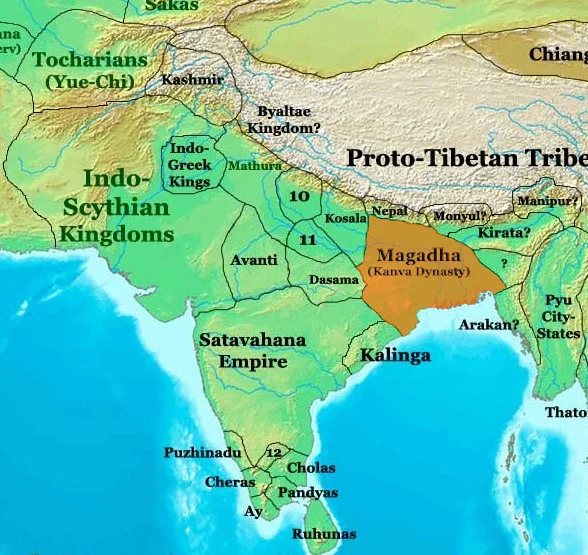
During this time, several smaller kingdoms emerged in northern India, including the Mitras of Kaushambi.
The Kanva dynasty ruled from Pataliputra, with Vidisha serving as an administrative center.
However, the political power of the Kanvas was significantly weaker than that of the Shungas. Their authority was largely confined to Magadha, while other regions experienced political fragmentation.
Decline
The Kanva dynasty lasted for approximately 45 years.
The last ruler Susharman was overthrown by the Satavahanas, marking the end of Kanva rule and the final decline of Magadhan supremacy in northern India.
The Satavahana Dynasty (1st Century BCE – 3rd Century CE)
Emergence and Territorial Extent
- The Satavahanas, also known as the Andhras, were one of the most powerful dynasties of the Post-Mauryan period.
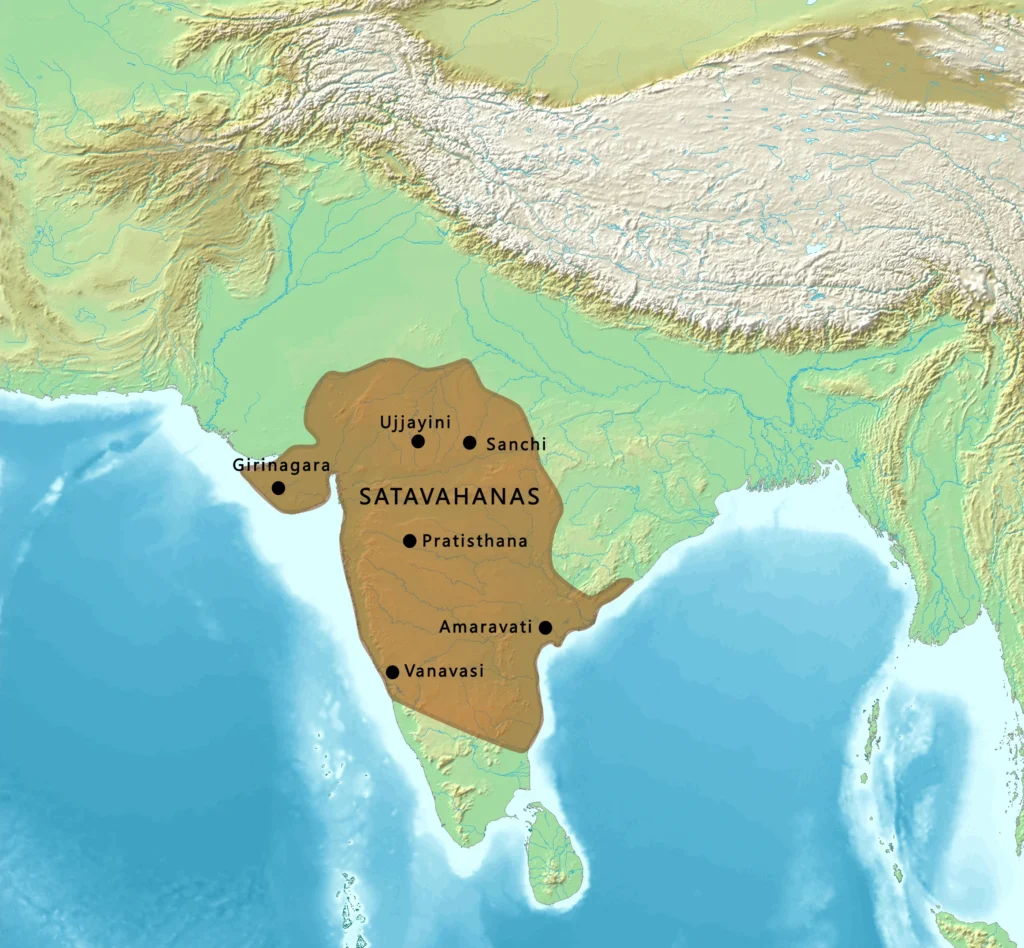
- They ruled large parts of the Deccan region, including present-day Maharashtra, Andhra Pradesh, Karnataka, and parts of Madhya Pradesh.
- The dynasty was founded by Simuka Satavahana.
- The main capital was Pratishthana (Paithan), while Amaravati served as a secondary capital.
Administration
The practice of land grants to Brahmins and officials also became common, which gradually contributed to the emergence of feudal structures.
The Satavahana administration reflected a blend of centralized monarchy and regional governance.
The king was regarded as the upholder of Dharma, ruling according to principles of Dharmashastra.
Administrative units included:
Ahara – district-level administrative unit
Amatyas and Mahamatras – officials responsible for administration
Gaulmika – rural administrator
Military camps known as Katakas and Skandhavaras were maintained to ensure security.
Important Rulers
Gautamiputra Satakarni (c. 106 – 130 CE)
- Gautamiputra Satakarni was the most powerful ruler of the Satavahana dynasty.
- He defeated several foreign powers including the Shakas, Greeks, Parthians, and the Western Kshatrapa ruler Nahapana.
- His achievements are recorded in the Nasik inscription issued by his mother Gautami Balashri.
- He also revived Vedic traditions and described himself as “Ekabrahmana” (the sole Brahmin).
Vashishtiputra Pulumavi
- He expanded maritime trade with the Roman Empire and strengthened economic ties between northern and southern India.
Yajna Sri Satakarni
- Yajna Sri Satakarni was the last powerful ruler of the Satavahana dynasty.
- He succeeded in reclaiming territories such as Gujarat, Malwa, and Andhra, which had earlier been lost.
Economy and Trade
The Satavahana period witnessed significant economic prosperity.
- Trade networks expanded both within India and across international routes.
- Important ports such as Sopara and Bharuch connected India with the Roman Empire and the Mediterranean world.
- Agriculture also flourished due to improved irrigation systems. Crops such as paddy and cotton were widely cultivated.
- Mining activities, particularly iron ore mining in regions like Karimnagar and Warangal, contributed to industrial development
Art and Architecture
- The Satavahana period is particularly famous for its rock-cut Buddhist architecture.
- Important cave complexes were developed in the Western Ghats, including:
- Ajanta
- Nasik
- Karle
- Bhaja
- Kondane
- Kanheri
- The Karle Chaitya is considered the largest Buddhist cave temple of the period.
- Major centers of Buddhist art also emerged at Amaravati and Nagarjunakonda, where stupas were decorated with white marble sculptures.
Society and Culture
- The Satavahana period witnessed religious syncretism, with both Brahmanism and Buddhism receiving patronage.
- The worship of Krishna and Vasudeva gained popularity, while Mahayana Buddhism also spread.
- Another unique feature was the matrilineal influence, as rulers were often identified with their mother’s name, such as Gautamiputra Satakarni and Vashishtiputra Pulumavi.
Language and Literature
- The official language of the Satavahanas was Prakrit, and most inscriptions of the period were written in this language.
- King Hala, a Satavahana ruler, composed the famous Prakrit literary work Gathasaptasati, a collection of poems.
The Mahameghavahana (Chedi) Dynasty of Kalinga
Emergence of the Dynasty
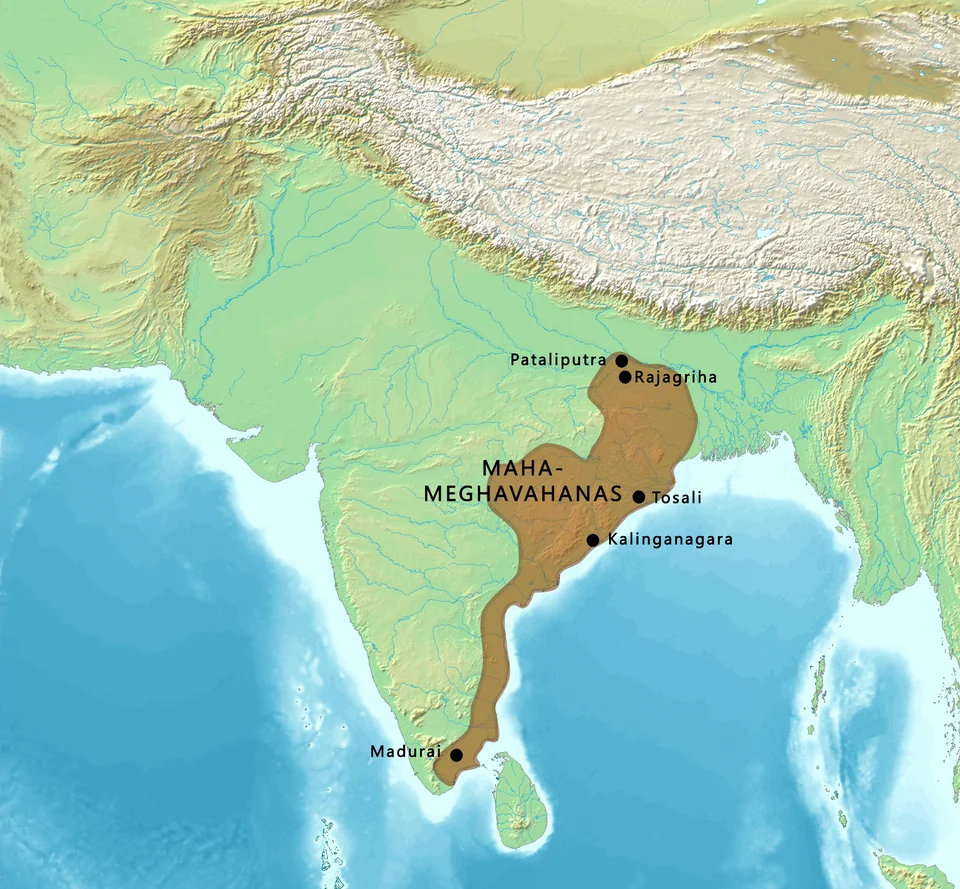
- After the decline of Mauryan control, the region of Kalinga (modern Odisha) witnessed the rise of the Mahameghavahana or Chedi dynasty around the 1st century BCE.
- The dynasty played a significant role in restoring Kalinga’s power after the devastation caused by Ashoka’s conquest.
Kharavela: The Greatest Ruler
- The most famous ruler of this dynasty was Kharavela, who is remembered for his military achievements and administrative capabilities.
- Kharavela launched several military campaigns and restored the political strength of Kalinga. His conquests extended from northwestern India to the southern regions.
He defeated the Satavahanas, expelled Indo-Greek forces, and even invaded Magadha.
Administration and Governance
- Kharavela maintained a centralized monarchy and strengthened the state administration.
- He promoted economic prosperity and revived Kalinga’s maritime trade networks.
Religion and Culture
- Kharavela was a great patron of Jainism and supported Jain monks and institutions.
- The Hathigumpha inscription, located in the Udayagiri hills near Bhubaneswar, provides valuable historical information about his reign.
- The inscription is written in Prakrit using Brahmi script and describes his conquests, administration, and religious patronage.
Significance of the Post-Mauryan Period
The Post-Mauryan period marked an important phase in Indian history.
- First, it witnessed the transition from a centralized empire to regional political systems.
- Second, the period saw increased interaction with foreign cultures, including Indo-Greek, Indo-Scythian, and Indo-Parthian influences.
- Third, trade networks expanded significantly, especially with the Mediterranean world and Southeast Asia.
- Fourth, the era witnessed major advances in art, architecture, and literature, including the development of Buddhist stupas, rock-cut caves, and Sanskrit and Prakrit literary traditions.
These developments ultimately paved the way for the Gupta Empire, which is often regarded as the classical age of Indian civilization.
Conclusion
The Post-Mauryan period represents a crucial transitional phase in ancient Indian history. Although the collapse of the Mauryan Empire led to political fragmentation, the rise of regional dynasties such as the Shungas, Kanvas, Satavahanas, and Chedis of Kalinga ensured continuity in political authority and cultural development.
During this period, regional kingdoms promoted trade, religion, art, and literature, while also interacting with foreign cultures and expanding maritime commerce. These developments created the socio-economic and cultural foundations for the emergence of the Gupta Empire, which later ushered in a new phase of classical Indian civilization.
FAQs
Q1. What is meant by the Post-Mauryan period in Indian history?
The Post-Mauryan period refers to the phase after the decline of the Mauryan Empire when several regional kingdoms emerged across the Indian subcontinent.
Q2. Which major dynasties ruled during the Post-Mauryan period?
Important dynasties included the Shunga Dynasty, Kanva Dynasty, Satavahana Dynasty, Kushan Empire, and the Indo-Greek Kingdom.
Q3. What were the key features of the Post-Mauryan period?
This period witnessed political fragmentation, growth of regional kingdoms, expansion of trade networks, and cultural interactions with Central Asia and the Mediterranean world.
Q4. What role did the Kushans play in this period?
The Kushan Empire, especially under Kanishka, promoted trade along the Silk Route and supported the spread of Buddhism and Gandhara art.
Q5. Why is the Satavahana dynasty important in the Post-Mauryan era?
The Satavahana Dynasty ruled large parts of the Deccan and played a key role in facilitating trade between northern and southern India.
Click on the question to see the Answers