Project Tiger
Content
- Why in News
- Introduction
- Objectives
- Population Trends
- Emerging Issues
- Ecological Importance
- Conclusion
Why in News
The Government of India has recently constituted four expert working groups to review and modernise policy decisions under Project Tiger as the programme completes over 50 years of implementation. These groups covering the North, South, East, and West tiger landscapes, will assess past policies, regional conservation pressures, human-wildlife conflict patterns, and strategic priorities to ensure the programme’s effectiveness in the coming decades.
This exercise reflects the evolving challenges in tiger conservation and the need for scientific, coordinated, and policy-oriented solutions.
Introduction and Background
- Project Tiger is India’s flagship conservation programme launched on 1 April 1973 by the Ministry of Environment, Forest and Climate Change to ensure the survival of the endangered tiger (Panthera tigris), protect its habitats, and maintain viable prey populations.
- It marked a paradigm shift in wildlife conservation, foregrounding ecosystem-based management and legal protection.
- The initiative initially covered nine tiger reserves, spanning around 18,278 sq km of forested habitat.
- Over five decades, this network has expanded to 58 tiger reserves across 18 states, strategically distributed over India’s major tiger-bearing landscapes, covering roughly 2.4 % of the country’s land area.
- The National Tiger Conservation Authority (NTCA), a statutory body under the Wildlife (Protection) Act, 1972, oversees the project’s implementation, policy formulation, monitoring, and capacity building. Scientifically rigorous methods like camera trapping, M-STRIPES monitoring, and GIS-based surveillance are routinely used to track tiger populations and threats.
Objectives and Strategic Framework
The core objectives of Project Tiger include:
- Stabilising and increasing wild tiger populations through habitat protection and management.
- Restoring prey base and ecological integrity of tiger habitats.
- Minimising human-tiger conflicts through community engagement, compensation schemes, and alternative livelihood options.
- Strengthening anti-poaching measures and law enforcement.
- Scientific monitoring and periodic censuses, ensuring data-driven interventions.
- Protecting broader biodiversity and safeguarding ecosystem services such as water regulation, carbon sequestration, and soil conservation.
Population Trends and Achievements
Population Growth
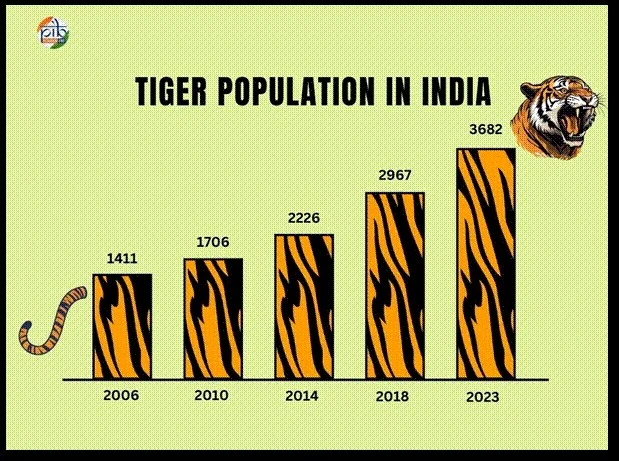
According to the All-India Tiger Estimation Cycle 2022, India’s wild tiger population was estimated at 3,682 individuals, accounting for nearly 75 % of the global wild tiger population. This reflects a substantial increase from approximately 1,411 tigers in 2006, indicating many years of successful conservation.
Not only has the absolute number increased, but the TX2 goal, doubling global tiger numbers by 2022 under the St. Petersburg Declaration (2010), was achieved early by India through sustained habitat protection, anti-poaching measures, and community involvement.
Spatial Expansion and Reserve Network
The tiger reserve network expanded from nine in 1973 to 58 reserves by 2025, spread across the Central India & Eastern Ghats, Western Ghats, Shivalik-Gangetic Plains, Northeast Hills and Brahmaputra Plains landscapes. These reserves collectively encompass diverse ecosystems, from tropical evergreen forests in the northeast to dry deciduous forests in central India underscoring Project Tiger’s expansive ecological reach.
Success Stories and Local Gains
Certain reserves report notable population increases, such as:
- Pilibhit Tiger Reserve, where the tiger population rose to around 80 individuals by 2025.
- Corbett landscape and adjoining zones continue to register strong tiger numbers and prey bases, reflecting robust ecosystem health.
These successes underline that habitat quality, connectivity, and conflict mitigation directly influence tiger persistence.
Emerging Issues and Challenges
Tiger Mortality and Human Pressures
Despite overall gains, tiger mortality remains a growing concern. Government data indicate that India lost around 166 tigers in 2025 alone, with Madhya Pradesh reporting the highest number of deaths (55), highlighting mortality due to natural causes, territorial infighting, accidents, and possible poaching.
In early 2026, several deaths, including in Nauradehi Sanctuary, have sparked investigations, underlining ongoing threats like electrocution, territorial conflict, and habitat pressures.
Distribution Inequality and Habitat Constraints
Tiger populations are unevenly distributed: a significant proportion often over 40 % are concentrated in a small fraction of reserves; many others have very low counts (<10 individuals) outside core strongholds, which raises concerns over genetic isolation and local extinctions.
Moreover, rising densities in core zones have forced some tigers into marginal forests and human-dominated landscapes, increasing instances of conflict. Recent NTCA analysis suggests many reserves like Bandipur and Nagarahole can sustain additional individuals, indicating potential for carefully planned expansion or connectivity enhancement.
Edge Forests and Outside Reserve Populations
India’s tiger conservation challenge now includes animals living beyond designated reserves, especially in Maharashtra, where NTCA has allocated around ₹5.40 crore for managing tigers outside reserves. This TOTR (Tigers Outside Tiger Reserves) strategy includes rapid response teams, drones, GPS monitoring, and stakeholder engagement to manage conflict and dispersal.
Human-Wildlife Conflict and Displacement
Human encroachment, livestock depredation, and retaliatory killings remain key conflict drivers. Historical reports suggest that Project Tiger’s expansion plans resulted in displacement pressures for forest-dependent communities, highlighting the need for socio-ecological solutions.
Habitat Fragmentation and Prey Decline
Tiger habitats continue to face fragmentation due to infrastructure development, mining, agriculture, and resource extraction. Prey depletion in certain reserves has been linked to increased livestock predation, fuelling conflict.
Poaching and Illegal Trade
Although poaching has declined compared to earlier decades, it continues to threaten tigers and co-predators, with habitat fragmentation often facilitating illegal access. Strengthening enforcement remains critical.
Environmental and Ecological Importance
From an environmental perspective:
- The tiger is classed as Endangered on the IUCN Red List and protected under Schedule I of the Wildlife (Protection) Act, 1972, affording it the highest legal protection in India.
- As an apex predator, tigers help regulate prey populations preventing overgrazing, maintaining vegetation dynamics, and supporting broader food web stability.
- Healthy tiger habitats contribute to water regulation, soil conservation, and carbon sequestration, making them crucial to ecosystem services that benefit human populations.
- Protecting tiger landscapes safeguards myriad other species from herbivores to avifauna thereby preserving biodiversity.
Project Tiger’s success exemplifies landscape-level conservation, aligning with India’s commitments under global frameworks such as the Convention on Biological Diversity (CBD) and the St. Petersburg Declaration on tiger conservation.
Conclusion
Over fifty years, Project Tiger has transformed India’s wildlife conservation landscape, turning the tiger from a threatened species to a growing population that constitutes the majority of the global wild tiger base. While recent challenges including rising mortality events, habitat fragmentation, and human-wildlife conflicts underscore that conservation is not a static achievement, the continued expansion of reserves, scientific interventions, and recent policy recalibration efforts signal commitment to safeguarding tigers for the long term.
As apex species and ecological indicators, tigers not only reflect India’s conservation success but serve as custodians of forest ecosystems upon which millions of people depend.