Protection of Coastal Regions
Content
- Introduction
- Key Problems
- Coastal Regulation Zone
- CRZ Notification, 2018
- Coastal Aquaculture Authority Act, 2023
- Coastal Erosion
- FAQs
Introduction
- Coastal zones are places of enormous ecological, cultural, social and economic significance. They contain unique and sensitive ecosystem of great natural and economic value and is home to numerous endangered species. The region also serves as home to 50% of the world’s population and generates 40% of the global economic activities.
Key Problems Faced by Coastal Regions
- Climate Change: Along much of the earth’s coast, a warming climate and sea-level rise are already negatively affecting natural ecosystems and human communities.
- Rapid Industrialization and Deforestation
- Pollution: Mining, municipal waste disposal and industrial waste disposal are leading to environmental problems in coastal regions.
- Invasive Species → Biodiversity Loss
- Coastal Erosion has started hampering a number of coastal regions. E.g. Vishakhapatnam
COASTAL REGULATION ZONE
- CRZ notification is issued under the Environmental Protection Act, 1986 for regulation of activities in the coastal area by the MoEF&CC.
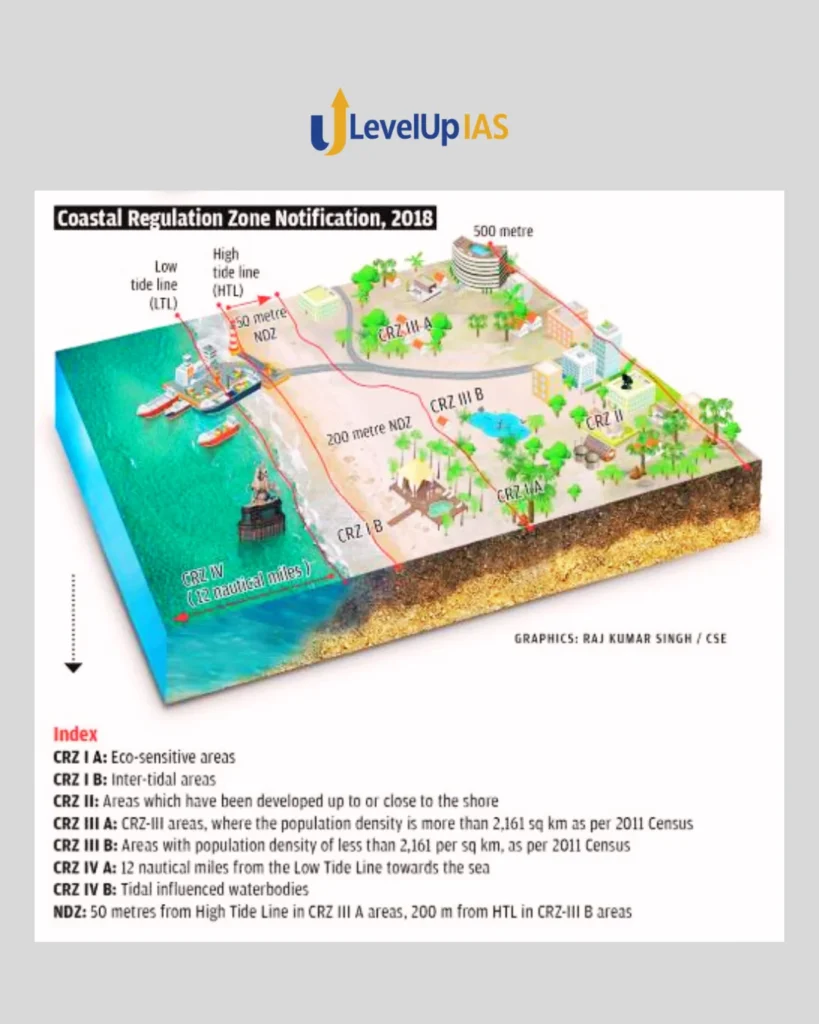
- It classifies the coastal land upto 500 m from the HTL as the Coastal Regulation Zone (CRZ).
- The CRZ are further classified in four categories:
CRZ-1 (Ecologically sensitive areas)
- CRZ 1-A: Ecologically sensitive areas and geomorphological features which play a role in maintaining the integrity of the coast. Mangroves, corals, sand dunes, salt marshes, national parks, WLS, Reserved forests, nesting grounds for turtles, birds etc.
- CRZ 1-B: Inter-tidal zones (between HTL and LTL)
CRZ-2
Areas that have been developed upto or close to the shoreline. Unauthorized structures are not allowed.
CRZ-3
Areas that are relatively undisturbed (both urban and rural)
CRZ-4
Areas covered between Low Tide Line and 12 nautical miles seaward.
CRZ Notification, 2018 (Easing of Norms for CRZ)
Need
Stringent norms were hindering development activities.
Key Changes
1. Delegation of Project Clearance Power to State Governments
- Only Projects in CRZ-1 and CRZ-IV require permission from the Union Ministry.
- Powers to clear projects in CRZ-2 and CRZ-3 delegated to State Governments.
2. Defreezing of Floor Area Ratio (FAR)
- Earlier, for CRZ-2, FAR was frozen to 1991 Development Control Regulation (DCR) levels.
- Now it will be based on laws which are in vogue.
3. Relaxation of No Development Zone (NDZ)
- Densely populated (density > 2,161 per sq km) rural areas (CRZ-III → CRZ III-A) now have an NDZ of 50 m from HTL (earlier 200 m).
- For islands close to the mainland and all backwater islands, NDZ is 20 m.
4. Pollution Control
- Treatment facilities have been permitted in CRZ-I B areas, with safeguards.
5. Tourism Promotion
Permission for temporary tourism facilities (shacks, toilet blocks, change rooms, drinking water facilities etc.) even in NDZ of CRZ-III.
Analysis: Positives
- Economic growth through promotion of tourism by ensuring more activities, more infrastructure and more opportunities in the coastal region.
- Reduction in NDZ helps in achieving infrastructure objectives such as PMAY.
- Supports port-led industrialization approach.
Analysis: Criticism
- Climate change adaptation requires us to move away from coastal regions, not towards them.
- Hampers fishermen livelihood, tourism infrastructure can make tourists disaster-prone and hinder fishermen earning.
- Environmental cost that is destruction of dunes and forests may make coasts more vulnerable to tsunamis and natural disasters.
COASTAL AQUACULTURE AUTHORITY (AMENDMENT) ACT, 2023
Why in news?
Coastal Aquaculture Authority (Amendment) Act, 2023 passed by both houses of Parliament.
Background
- The Coastal Aquaculture Authority Act 2005 was enacted to protect coastal environment while promoting orderly growth of coastal aquaculture.
- It established Coastal Aquaculture Authority to regulate aquaculture activities.
- Defined coastal aquaculture as culturing in controlled conditions in ponds, pens, enclosures in saline or brackish water (not freshwater).
- Ensures continued operation within CRZ subject to restrictions.
- Penalizes unregistered farms in prohibited areas.
Impact
- Facilitated millions of jobs, self-employment opportunities, business and environmental protection.
- Increased production in fishery sector.
Need for Amendment
Ambiguities in CRZ notifications like “No Development Zone” misinterpreted to apply to hatcheries as well.
2023 Amendment
- Broadens coastal aquaculture definition includes cage culture, sea-weed culture, bivalve culture, marine ornamental fish culture, etc.
- Registration under CAA Act becomes valid permission under CRZ notification → avoids need for multiple CRZ clearances.
- Some activities (hatcheries, nucleus breeding centres) can be established in NDZ [200 m from HTL] of seas and buffer zones.
- Decriminalization of illegal aquaculture + fixed penalties.
Increase in role of the Authority
- Fix standards of effluent discharge.
- Prohibit harmful inputs.
- Monitor and regulate aquaculture units, inputs and outputs.
Health Protection
The Act prohibits the use of insecticides and pharmacologically active substances harmful to human health.
COASTAL EROSION
Introduction
A coastline is a complex series of interlinked physical systems involving both offshore and onshore processes.
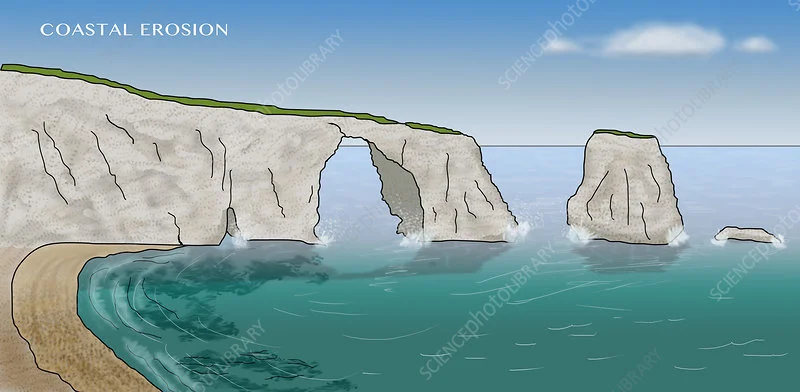
Coastal erosion refers to the wearing away of land and removal of beach and dune sediments by wave action, tidal currents, drainage or high winds.
Causes of Coastal Erosion
1. Natural Causes
i. Wave action is the main cause.
ii. Winds, tides, near-shore currents, sea-level rise.
iii. Subsidence lowering surface area.
iv. Catastrophic events such as storms, tidal surges, cyclones.
2. Artificial Factors
i. Infrastructure creation (land reclamation, construction on sand dunes).
ii. Excessive sand removal disrupting longshore sand transport.
iii. Coral mining damaging protective corals.
iv. Seawalls and breakwaters increasing erosion in adjacent areas.
v. Deforestation, especially mangrove destruction.
vi. Human-induced climate change causing sea-level rise.
vii. Unscientific coastal management.
Impact of Coastal Erosion
- Floods, including worsening high-tide flooding
- Saltwater penetration into rivers and coastal agricultural plains
Coastal Erosion Control Strategies
A) Soft Erosion Controls / Non-Structural Methods
Temporary options for slowing erosion:
- Artificial nourishment of beaches
- Coastal vegetation (mangroves, palm plantations)
- Dune reconstruction/rehabilitation
- Beach scraping, bulldozing (creating artificial dunes)
Beach Nourishment Projects
- Additional sand placed on beach to buffer erosion or enhance recreation.
- Needs repeated application.
Advantages:
- Restores and widens beach
- Protects structures while sand remains
- No hazards in beach/surf zone
Disadvantages:
- Added sand erodes faster
- Storm frequency affects life of nourishment
- Expensive and repeated periodically
- May harm marine/beach life
- Grain size mismatch affects surf conditions
B) Hard Erosion Controls / Structural Measures
- More permanent than soft measures.
- Includes seawalls, groynes, breakwaters, tetrapod-based seawalls.
Limitations:
- Prone to wear and tear.
- Can interfere with currents and sand transport.
- Can cause erosion in adjacent beaches.
C) Combination of Structural + Non-Structural Methods
Hybrid approach:
- Beach nourishment + artificial headlands/groynes
- Revegetation + temporary breakwaters/artificial reefs
- Helps trap downdrift sediments and reduce re-nourishment frequency.
D) Relocation
Humans move away from coast and allow natural processes to continue, an eco-centric solution.
Situation of Coastal Erosion in India (April 2022)
Ministry of Earth Sciences informed Lok Sabha:
- 34% of India’s coastal region is eroding
- 40% stable
- 26% accreting
Other Way Forward
Upgrade infrastructure: raising roadways, installing backflow preventers, increasing building height above flood levels. Create resilient shoreline: preserve and restore coastal habitats such as marshes and barrier islands.
FAQs
Q1: What is Coastal Regulation Zone (CRZ)?
A: CRZ refers to the Coastal Regulation Zone Notification issued by the Ministry of Environment, Forest and Climate Change under Environment (Protection) Act, 1986, regulating development activities within 500m of the High Tide Line (HTL) or 100-200m from creeks/estuaries to protect coastal ecosystems.
Q2: What are the different CRZ categories?
A: CRZ-I (ecologically sensitive areas like mangroves, coral reefs), CRZ-II (developed urban areas), CRZ-III (rural/coastal villages, 50-200m buffer), CRZ-IV (territorial waters up to 12 nautical miles), and CRZ-V (islands). Recent 2023 amendments prioritize sustainable development.
Q3: Why is coastal protection important for India?
A: India has 7,500 km coastline supporting 20% population; vulnerable to cyclones, erosion, sea-level rise; hosts biodiversity hotspots and livelihoods for 4 million fisherfolk.
Q4: What measures protect coastal ecosystems?
A: Mangrove restoration, coastal afforestation, Integrated Coastal Zone Management (ICZM), National Coastal Mission, shoreline protection via seawalls/ tetrapods, and CRZ enforcement.
Q5: What causes coastal erosion in India and what are the management measures?
A: Coastal erosion affects 33.6% of India’s 7,500 km coastline due to natural factors (waves, tides, cyclones) and human activities (urbanization, mangrove loss). Management includes hard structures (seawalls, groynes, tetrapods), soft solutions (beach nourishment, mangrove restoration via MISHTI scheme), and policy tools like CRZ notifications, ICZM plans by NCSCM/NCCR.
Click on the question to see the Answers