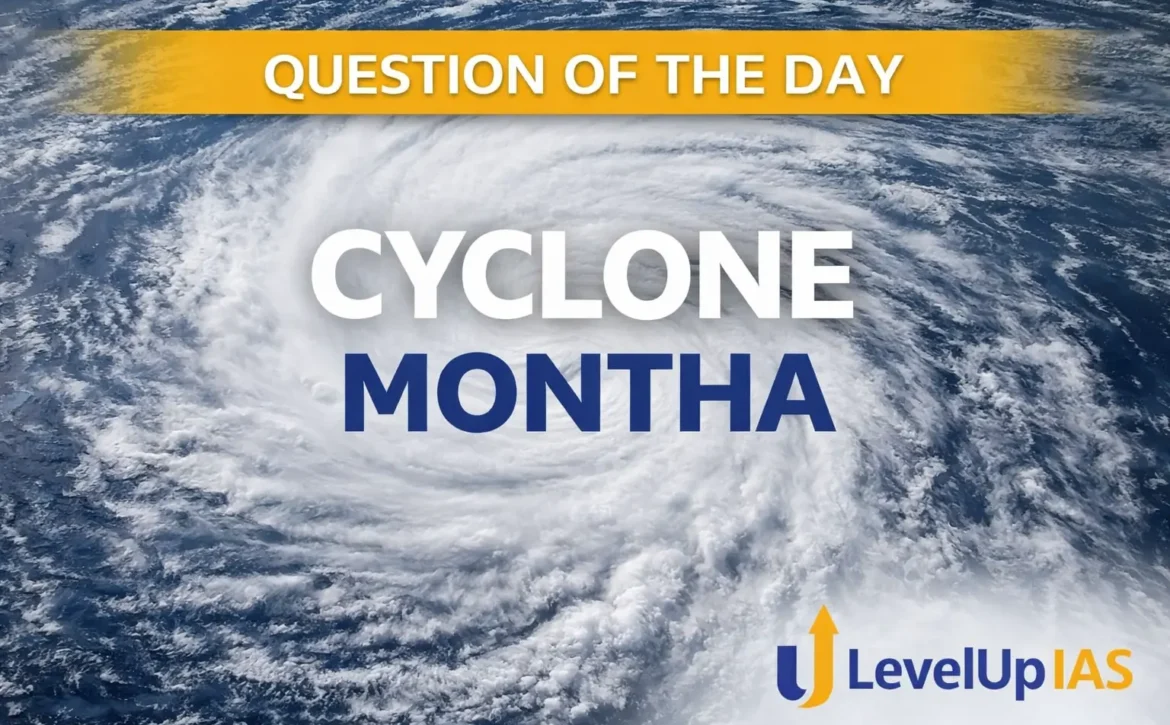
Question of the Day – CYCLONE MONTHA
QOTD April 5,2026
Consider the following statements regarding tropical cyclones:
- Tropical cyclones in the Bay of Bengal are generally more intense than those in the Arabian Sea.
- Tropical cyclones derive their energy primarily from temperature differences between land and sea.
Which of the statements given above is/are correct?
(a) 1 only
(b) 2 only
(c) both 1 and 2
(d) neither 1 nor 2
Answer: (a) 1 only
Explanation:
Statement 1 is correct
Bay of Bengal cyclones are generally more intense due to warmer waters, higher humidity, and favorable atmospheric conditions.
Statement 2 is incorrect
Tropical cyclones derive energy from latent heat released by condensation of water vapor, not from land-sea temperature differences.
Why in news–
Cyclone Montha has recently formed over the Bay of Bengal, attracting attention due to its rapid intensification and possible impact on India’s eastern coastline. The India Meteorological Department has issued warnings regarding heavy rainfall, strong winds, and storm surges in vulnerable coastal regions. This cyclone is significant as it has developed during the pre-monsoon season, when sea surface temperatures are highly conducive for cyclogenesis. Authorities in states such as Odisha and Andhra Pradesh have initiated preparedness measures including evacuation and disaster management planning. The system is being continuously monitored through satellite imagery and ocean observation systems. Increasing frequency and intensity of such cyclones in the Bay of Bengal region are raising concerns about climate change and coastal vulnerability. Hence, Cyclone Montha has become important from both disaster management and climate perspective.
There are more questions from this topic that you should practice to make your concepts stronger.
Practice Questions (PQ)
PQ1.Consider the following statements:
- Cyclones rotate clockwise in the Northern Hemisphere.
- The eye of a cyclone is characterized by calm weather conditions.
- Cyclones weaken after making landfall.
Which of the statements given above is/are correct?
(a) 2 and 3 only
(b) 1 and 2 only
(c) 1 and 3 only
(d) 1, 2 and 3
Answer : (a) 2 and 3 only
Explanation:
Statement 1 is incorrect
Cyclones rotate anticlockwise in the Northern Hemisphere due to the Coriolis force.
Statement 2 is correct
The eye of a cyclone has calm winds and clear skies due to descending air.
Statement 3 is correct
Cyclones weaken after landfall due to loss of moisture and increased friction.
PQ2. Consider the following statements:
- The Coriolis force is zero at the equator, hence cyclones do not form there.
- Tropical cyclones can form over oceans with temperatures above 26°C.
- Vertical wind shear enhances cyclone formation.
Which of the statements given above is/are correct?
(a) 1 and 2 only
(b) 2 and 3 only
(c) 1 and 3 only
(d) 1, 2 and 3
Answer: (a) 1 and 2 only
Explanation:
Statement 1 is correct
Coriolis force is absent at the equator, preventing cyclone rotation.
Statement 2 is correct
Warm ocean temperatures above 26°C provide necessary energy for cyclone formation.
Statement 3 is incorrect
High vertical wind shear disrupts cyclone formation by displacing heat and moisture.
PQ3. Consider the following statements:
- Storm surge is primarily caused by high-speed winds pushing seawater towards the coast.
- Low atmospheric pressure in a cyclone contributes to storm surge formation.
Which of the statements given above is/are correct?
(a) 1 only
(b) 2 only
(c) both 1 and 2
(d) neither 1 nor 2
Answer: (c) both 1 and 2
Explanation:
Statement 1 is correct
Strong winds push seawater toward the coast, causing flooding.
Statement 2 is correct
Low pressure leads to a rise in sea level, contributing to storm surge.
Previous Year Question (UPSC Prelims)
Consider the following statements:
- The winds which blow between 30° N and 60° S latitudes throughout the year are known as westerlies.
- The moist air masses that cause winter rains in the northwestern region of India are part of westerlies.
Which of the statements given above is/are correct?
(a) 1 only
(b) 2 only
(c) both 1 and 2
(d) neither 1 nor 2
Answer: (c) Both 1 and 2
Explanation:
Statement 1 is correct
Westerlies blow in mid-latitudes between 30° and 60° in both hemispheres.
Statement 2 is correct
Western disturbances embedded in westerlies bring winter rainfall to northwestern India.