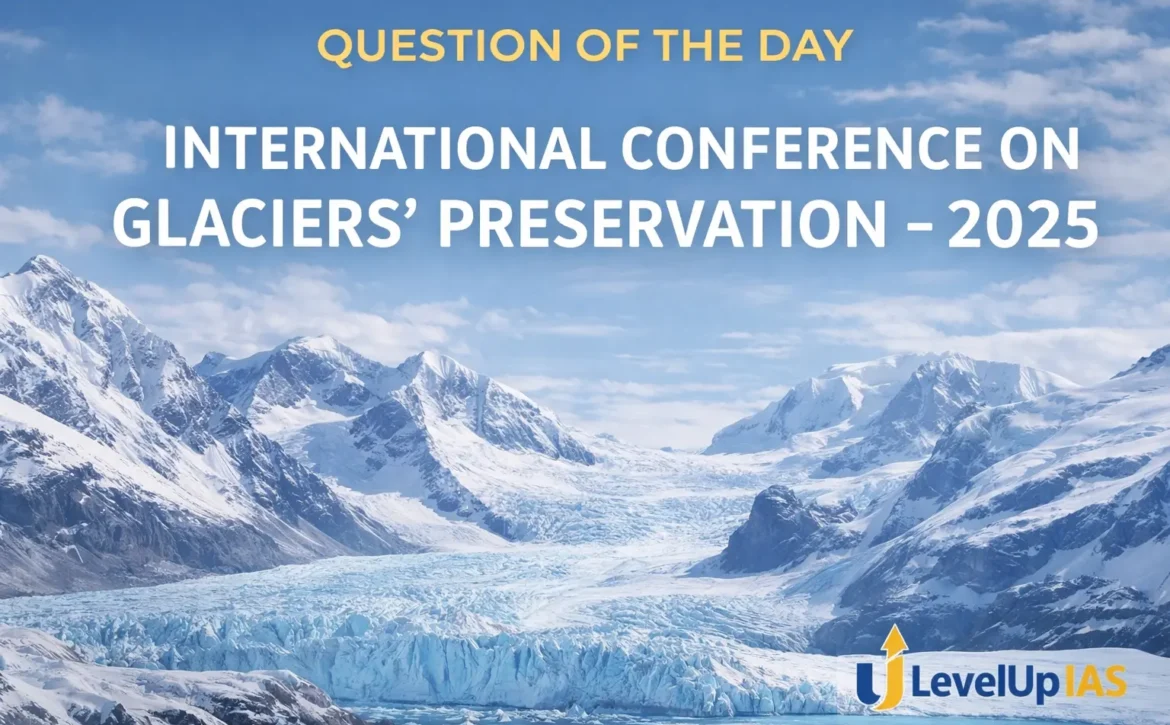
Question of the Day – INTERNATIONAL CONFERENCE ON GLACIERS’ PRESERVATION – 2025
QOTD March 29,2026
Consider the following statements regarding glaciers:
- Glaciers are permanent masses of ice formed primarily from accumulated snowfall over years.
- Glacier retreat is solely caused by natural climatic variability.
- Glaciers act as freshwater reservoirs and regulate river flows.
Which of the statements given above is/are correct?
(a) 1 and 3 only
(b) 2 only
(c) 1, 2 and 3
(d) 1 only
Answer: (a) 1 and 3 only
Explanation:
Statement 1 is correct
Glaciers form from long-term accumulation and compaction of snow into ice
Statement 2 is incorrect
Human-induced climate change is a major cause of accelerated glacier retreat
Statement 3 is correct
Glaciers store freshwater and release it gradually, sustaining rivers
Why in news–
The International Conference on Glaciers’ Preservation – 2025 has gained global attention as countries, scientists, and policymakers have come together under the leadership of the United Nations to address the alarming rate of glacier melting across the world. The conference focuses on the impact of climate change on glaciers, which are critical freshwater resources and key indicators of environmental health. With increasing concerns over rising sea levels, water security, and glacier-related disasters like GLOFs, the event aims to strengthen international cooperation, promote sustainable policies, and accelerate climate action to preserve the cryosphere.
News- https://sdgs.un.org/partnerships/international-conference-glaciers-preservation-2025
There are more questions from this topic that you should practice to make your concepts stronger.
Practice Questions (PQ)
PQ1.Consider the following statements:
- The Hindu Kush Himalaya region is often called the “Third Pole”.
- Glacial melt directly impacts sea level rise.
- India has no glaciers outside the Himalayan region.
Which of the statements given above is/are correct?
(a) 1 and 2 only
(b) 1 only
(c) 2 and 3 only
(d) 1, 2 and 3
Answer: (a) 1 and 2 only
Explanation:
Statement 1 is correct
The region contains vast ice reserves, hence called the Third Pole
Statement 2 is correct
Melting glaciers contribute to global sea level rise
Statement 3 is incorrect
India has glaciers in the Karakoram as well, not just Himalayas
PQ2.Consider the following statements about glacial landforms:
- Moraines are deposits of debris left behind by glaciers.
- Fjords are formed due to glacial erosion and subsequent sea flooding.
- Eskers are formed by wind deposition in glacial regions.
Which of the statements given above is/are correct?
(a) 1 and 2 only
(b) 2 and 3 only
(c) 1, 2 and 3
(d) 1 only
Answer: (a) 1 and 2 only
Explanation:
Statement 1 is correct
Moraines consist of rocks and sediments carried and deposited by glaciers
Statement 2 is correct
Fjords are deep glacial valleys later filled with seawater
Statement 3 is incorrect
Eskers are formed by subglacial streams, not wind action
PQ3.Consider the following statements:
- Black carbon deposition accelerates glacier melting.
- Glaciers have no role in influencing regional climate systems.
- Glacier Lake Outburst Floods (GLOFs) are a potential hazard in mountainous regions.
Which of the statements given above is/are correct?
(a) 1 and 3 only
(b) 2 only
(c) 1, 2 and 3
(d) 3 only
Answer: (a) 1 and 3 only
Explanation:
Statement 1 is correct
Black carbon reduces albedo and increases heat absorption
Statement 2 is incorrect
Glaciers influence local and regional climate patterns
Statement 3 is correct
GLOFs occur due to sudden release of water from glacial lakes
Previous Year Question (UPSC Prelims)
Consider the following statements:
- The retreat of glaciers is a result of global warming.
- Glaciers are important indicators of climate change.
Which of the statements given above is/are correct?
(a) 1 only
(b) 2 only
(c) Both 1 and 2
(d) Neither 1 nor 2
Answer: (c) Both 1 and 2
Explanation:
Statement 1 is correct
Rising global temperatures lead to glacier retreat
Statement 2 is correct
Glaciers respond sensitively to climate variations, making them key indicators