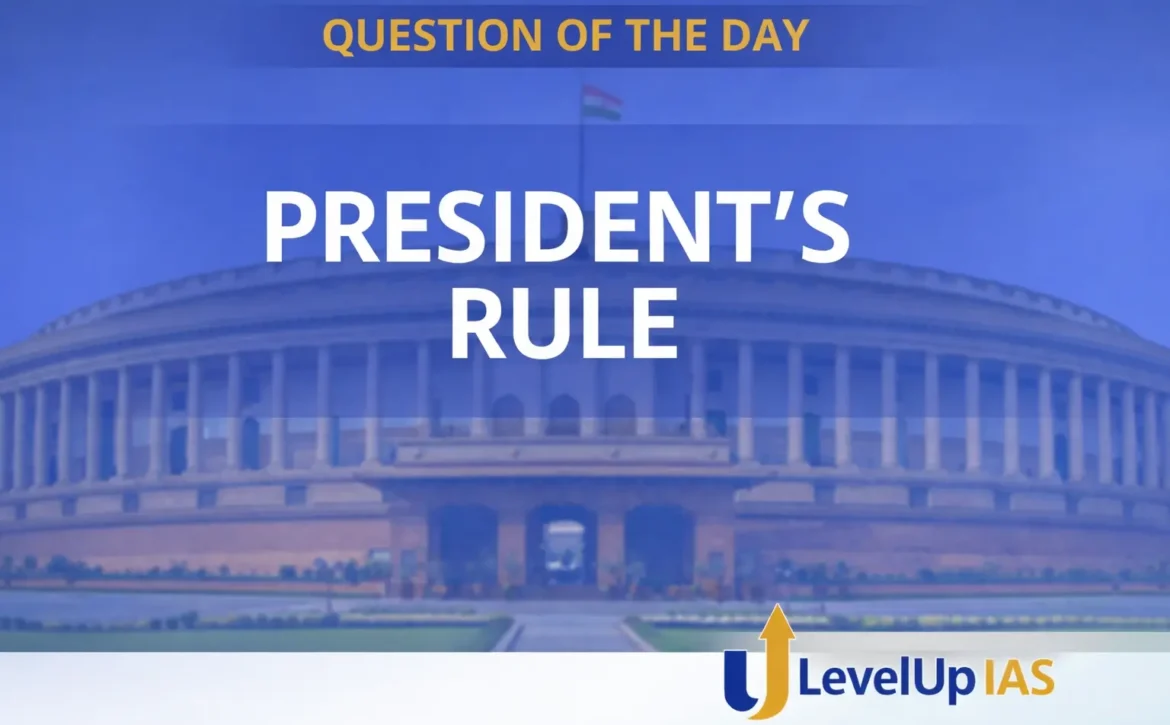
Question of the Day – PRESIDENT’S RULE
QOTD March 30,2026
Consider the following statements regarding President’s Rule in India:
- President’s Rule can be imposed under Article 356 of the Constitution.
- The President can impose it without the approval of Parliament.
- It leads to suspension of the State Legislative Assembly.
Which of the statements given above is/are correct?
(a) 1 and 3 only
(b) 1 only
(c) 2 and 3 only
(d) 1, 2 and 3
Answer: (a) 1 and 3 only
Explanation:
Statement 1 is correct
Article 356 provides for imposition of President’s Rule in case of failure of constitutional machinery
Statement 2 is incorrect
Parliamentary approval is required within two months
Statement 3 is correct
The State Assembly may be suspended or dissolved
Why in news–
The issue of President’s Rule has recently come into focus due to political instability in certain states and debates over the role of the Supreme Court of India in reviewing its imposition. Questions have been raised regarding the misuse of constitutional provisions under Article 356 of the Indian Constitution, especially in situations involving breakdown of constitutional machinery. This has revived discussions on federalism, judicial safeguards, and landmark judgments like the S.R. Bommai v. Union of India which laid down strict guidelines to prevent arbitrary use of President’s Rule.
News-How is President’s Rule imposed? | Explained – The Hindu
There are more questions from this topic that you should practice to make your concepts stronger.
Practice Questions (PQ)
PQ1.Consider the following statements:
- President’s Rule can be extended beyond one year only if a National Emergency is in operation.
- Maximum duration of President’s Rule in a state is three years.
- The Governor’s report is mandatory for imposing President’s Rule.
Which of the statements given above is/are correct?
(a) 1 and 2 only
(b) 2 only
(c) 1 and 3 only
(d) 1, 2 and 3
Answer: (a) 1 and 2 only
Explanation:
Statement 1 is correct
Extension beyond one year requires National Emergency or Election Commission certification
Statement 2 is correct
Maximum limit is three years
Statement 3 is incorrect
President can act even without Governor’s report
PQ2.Consider the following statements:
- During President’s Rule, the powers of the State Legislature are exercised by Parliament.
- The High Court of the state comes under the control of the President.
- Fundamental Rights remain enforceable during President’s Rule.
Which of the statements given above is/are correct?
(a) 1 and 3 only
(b) 2 only
(c) 1, 2 and 3
(d) 3 only
Answer: (a) 1 and 3 only
Explanation:
Statement 1 is correct
Parliament assumes legislative functions of the state
Statement 2 is incorrect
High Courts remain independent
Statement 3 is correct
Fundamental Rights are not suspended
PQ3.Consider the following statements:
- President’s Rule implies complete suspension of federalism in India.
- The proclamation of President’s Rule is subject to judicial review.
- The State Council of Ministers is dismissed during President’s Rule.
Which of the statements given above is/are correct?
(a) 2 and 3 only
(b) 1 only
(c) 1 and 2 only
(d) 1, 2 and 3
Answer: (a) 2 and 3 only
Explanation:
Statement 1 is incorrect
Federalism is not abolished; it is temporarily altered
Statement 2 is correct
Supreme Court can review the proclamation
Statement 3 is correct
State Council of Ministers is dismissed
Previous Year Question (UPSC Prelims)
Consider the following statements:
- The proclamation of President’s Rule in a state can be challenged in a court of law.
- The imposition of President’s Rule automatically dissolves the State Legislative Assembly.
Which of the statements given above is/are correct?
(a) 1 only
(b) 2 only
(c) Both 1 and 2
(d) Neither 1 nor 2
Answer: (a) 1 only
Explanation:
Statement 1 is correct
As held in the S.R. Bommai case, it is subject to judicial review
Statement 2 is incorrect
Assembly may be suspended or dissolved, not automatically dissolved