Sea Floor spreading/Conventional current Theory
Content
- Introduction
- Sea Floor Spreading Theory
- Historical Development of Sea Floor Spreading
- Causes of Sea Floor Spreading
- Mechanism of Sea Floor Spreading
- Evidence Supporting Sea Floor Spreading
- Paleomagnetism and Its Role
- Mantle Convection Currents
- Impact of Sea Floor Spreading
- FAQs
Introduction
The Sea Floor Spreading Theory is a key geological concept that explains how new oceanic crust is formed and how it gradually moves sideways across the ocean floor. Introduced by Harry Hess in 1962, this theory supplied the mechanism that Alfred Wegener’s Continental Drift Theory lacked. It explains the expansion of ocean basins, the development of mid-ocean ridges, and the recycling of old crust at trenches.
According to the US Geological Survey (USGS), mid-ocean ridges make up more than 65,000 km of undersea mountain systems, highlighting sea floor spreading as a major force governing Earth’s tectonic activity.
Sea Floor Spreading Theory
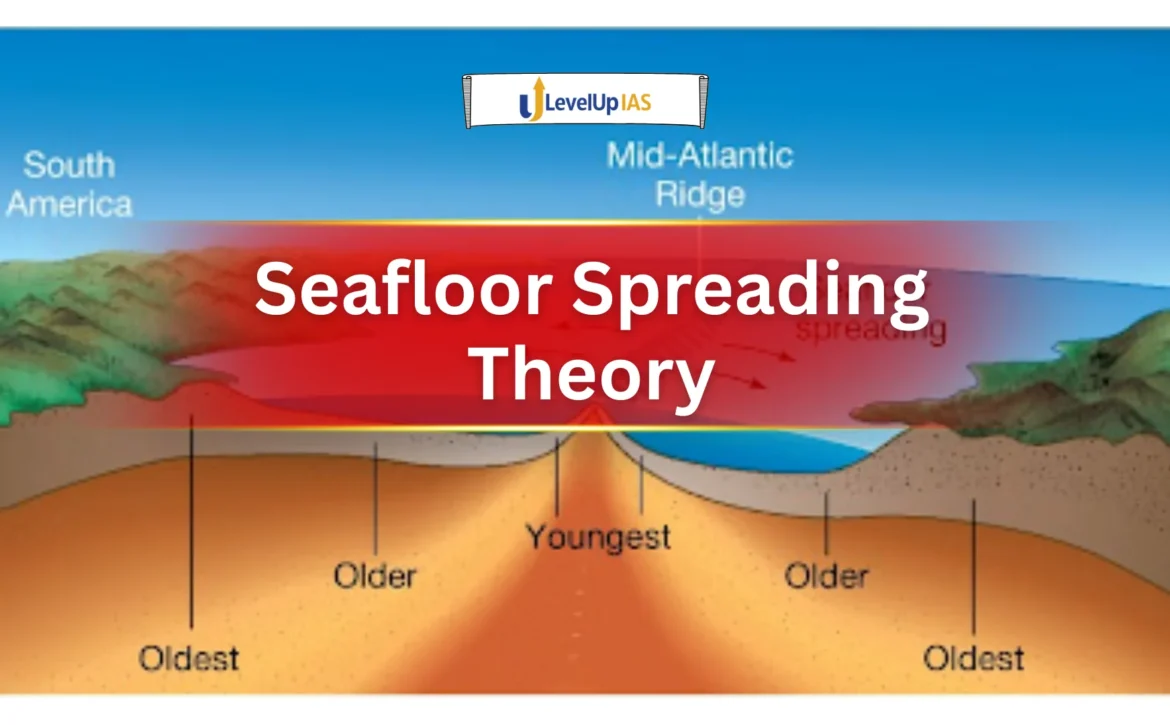
Sea floor spreading refers to the formation of new oceanic crust at mid-ocean ridges and its movement away from the ridge axis. Magma emerging from the mantle cools to form basaltic crust, which pushes older crust outward over time. Ultimately, this older crust descends back into the mantle at deep-sea trenches, completing a continuous cycle that influences plate tectonics, ocean-basin development, volcanism, and seismicity.
Historical Development of Sea Floor Spreading
The evolution of this theory resolved the long-standing mechanism missing in Wegener’s continental drift. Research bodies such as NOAA, USGS, and INCOIS have supplied substantial evidence supporting the dynamic behaviour of the ocean floor.
Key milestones include:
- 1912: Alfred Wegener proposed continental drift but could not explain its driving force.
- 1950s: Sonar mapping revealed mid-ocean ridges, trenches, and fracture zones, showing the ocean floor’s active nature.
- 1962: Harry Hess suggested that new oceanic crust forms at mid-ocean ridges and spreads outward.
- 1963: Vine and Matthews demonstrated symmetrical magnetic anomalies on either side of ridges, corresponding to geomagnetic reversals.
- Later Studies: Deep-sea drilling confirmed younger crust near ridges and older crust farther away.
Causes of Sea Floor Spreading
Sea floor spreading is driven by a combination of mantle processes, tectonic forces, and volcanic activity.
The major causes include:

- Mantle Convection Currents: Hot mantle material rises at ridges while cooler crust sinks at trenches.
- Ridge Push: Elevated ridges exert gravitational force, pushing crust outward.
- Slab Pull: Dense, older crust sinks into subduction zones, pulling the rest of the plate.
- Volcanism at Ridges: Rising magma creates new crust and promotes lateral displacement.
- Divergent Plate Boundaries: Plates move apart, allowing fresh magma to emerge.
- Heat Flow Variations: Higher heat at ridges facilitates magma upwelling.
- Gravity and Lithospheric Forces: Density and buoyancy differences move plates outward.
Mechanism of Sea Floor Spreading
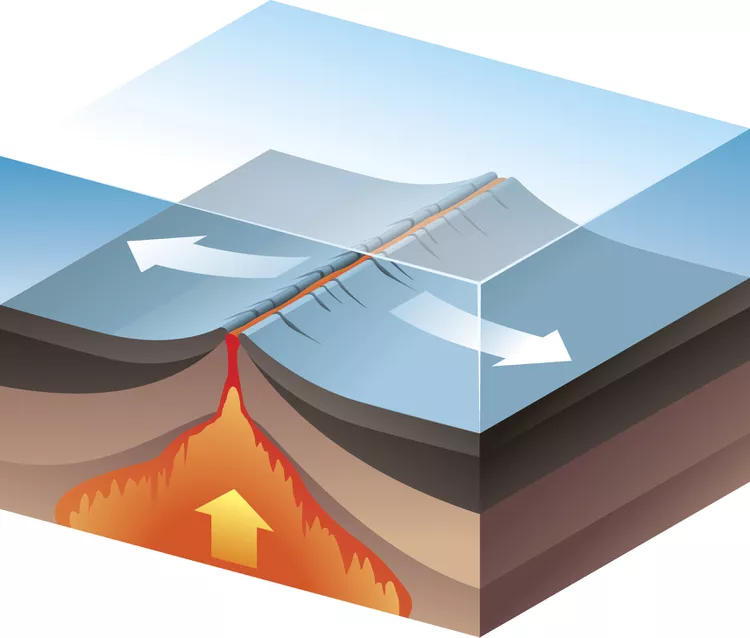
The mechanism involves a continuous process of crustal creation, lateral movement, and eventual recycling.
- Magma Upwelling: Mantle convection pushes hot material toward mid-ocean ridges, forming magma chambers.
- Formation of New Crust: Magma cools and solidifies into basaltic crust, initially thin and hot.
- Lateral Displacement: New crust moves sideways due to ridge push, gravity, and mantle flow.
- Subduction: Older crust becomes denser and is pulled into trenches, causing deep-focus earthquakes and volcanic arcs.
- Expansion of Ocean Basins: Ongoing spreading widens ocean basins over millions of years.
- Seismic and Volcanic Activity: Shallow quakes occur along ridges; deep quakes occur at trenches; volcanoes form both underwater and on islands.
Evidence Supporting Sea Floor Spreading
Multiple scientific observations support this theory.
Key evidence includes:
- Magnetic Anomalies: Symmetrical magnetic stripes on both sides of ridges reflect geomagnetic reversals.
- Age of Oceanic Crust: Radiometric dating shows crust near ridges is youngest; for example, the Atlantic Ocean floor ranges from 0–180 million years.
- Sediment Thickness: Thinner sediments near ridges and thicker deposits farther away confirm progressive crust aging.
- Heat Flow: Highest geothermal heat (~200 mW/m²) is recorded at ridges and declines outward.
- Seismic Activity: Shallow earthquakes at ridges and deep-focus ones at trenches correspond with crust formation and subduction.
- Volcanism: Underwater volcanoes at ridges and volcanic arcs at trenches support the ongoing creation and recycling of crust.
- Deep-Sea Drilling: Drilling data confirms crustal aging and sediment patterns.
Paleomagnetism and Its Role
Paleomagnetism, study of ancient magnetic signatures preserved in rocks provides strong verification for sea floor spreading.
INCOIS and NOAA surveys across Indian and global oceans have mapped magnetic anomalies that align with predicted spreading rates and directions.
- Basaltic rocks at ridges record Earth’s magnetic polarity during solidification.
- Symmetrical magnetic stripes correspond to magnetic field reversals.
- These patterns confirm that crust forms at the ridge axis and moves outward symmetrically.
Mantle Convection Currents as the Driving Force
Convection currents within the mantle serve as the engine of sea floor spreading and explain variations in spreading rates.
- The East Pacific Rise spreads at about 15 cm/year.
- The Central Indian Ridge spreads at 2–4 cm/year.
These variations reflect differences in mantle flow intensity. Hot mantle rises at ridges, creating new crust, while older, denser crust is recycled at trenches maintaining continuous plate movement.
Impact of Sea Floor Spreading
The phenomenon influences Earth’s geological and environmental systems in major ways.
Key impacts include:
- Formation and enlargement of major oceans such as the Atlantic, Indian, and Pacific.
- Driving continental drift, rift valleys, mountain building, and trench formation.
- Causing shallow earthquakes at ridges and deep-focus quakes at subduction zones.
- Generating underwater volcanoes and island arcs.
- Producing mineral resources like copper, zinc, silver, and polymetallic nodules at hydrothermal vents.
- Influencing long-term climate by altering ocean circulation and basin structure.
Sea Floor Spreading Theory UPSC
Recent studies have expanded scientific understanding of this phenomenon.
- Global Asthenosphere Imaging: New imaging reveals a global oceanic asthenosphere shaped by spreading processes.
- Magmatic Pulses in Rifting: Three major magmatic pulses have been identified that transition continents into ocean-forming ridges.
Hydrothermal Vent Observation: A rare eruption at the Tica hydrothermal vent along the East Pacific Rise has provided new insights into seafloor volcanic activity.
FAQs
1. What is the Sea Floor Spreading Theory?
Sea Floor Spreading Theory, proposed by Harry Hess, explains how new oceanic crust forms at mid-ocean ridges and moves outward due to volcanic activity.
2. Who proposed the Sea Floor Spreading Theory?
The theory was proposed by American geologist Harry Hess in 1962.
3. What evidence supports sea floor spreading?
Key evidences include magnetic striping, age of oceanic crust, heat flow patterns, and distribution of earthquakes and volcanoes.
4. How does sea floor spreading support Plate Tectonics?
It provides the mechanism for continental drift by showing that plates move due to new crust formation at ridges and subduction at trenches.
5. Where does sea floor spreading occur?
It occurs at divergent boundaries, primarily at mid-ocean ridges like the Mid-Atlantic Ridge.
Click on the question to see the Answers