Somnath Temple: A Millennium of Cultural Continuity
Content
- Latest News
- Somnath Temple
- Geography and Sacred Landscape
- Architectural Character
- Cultural Continuity
- Post-Independence National Identity
Latest News
The year 2026 marks one thousand years since the first recorded destruction of the Somnath Temple in 1026 CE. On this occasion, national-level commemorations are being held to highlight the temple’s civilisational significance and its enduring place in India’s cultural memory. The Prime Minister has described Somnath as a symbol of India’s unbroken spirit. He linked its survival to the broader narrative of faith, resilience, and historical continuity.
Somnath in India’s Sacred Tradition
Somnath, located at Prabhas Patan on the Gujarat coast, occupies a special position in Shaivite worship as the foremost of the twelve Jyotirlingas of Lord Shiva.
Ancient Hindu texts such as the Shiva Purana, Skanda Purana, and Rig Veda contain references to the sanctity of this site, indicating its importance from early times.
The region is also associated with Lord Krishna’s final earthly journey, giving Somnath a unique place in Vaishnavite traditions as well.
Over centuries, the temple has remained a major pilgrimage centre, drawing devotees from across India.
Tirtha, Geography and Sacred Landscape
- Somnath stands at the meeting point of the Kapila, Hiran, and Saraswati rivers with the Arabian Sea.
- In Indian tradition, river-sea confluences are considered highly sacred, symbolising the union of earthly and cosmic forces.
- The presence of the Tirth Stambh, indicating an uninterrupted sea route towards the southern oceanic expanse, reflects the advanced geographical awareness of ancient Indian civilisation.
- Somnath, therefore, is not just a temple but part of a larger sacred and spatial imagination of India.
Architectural Character
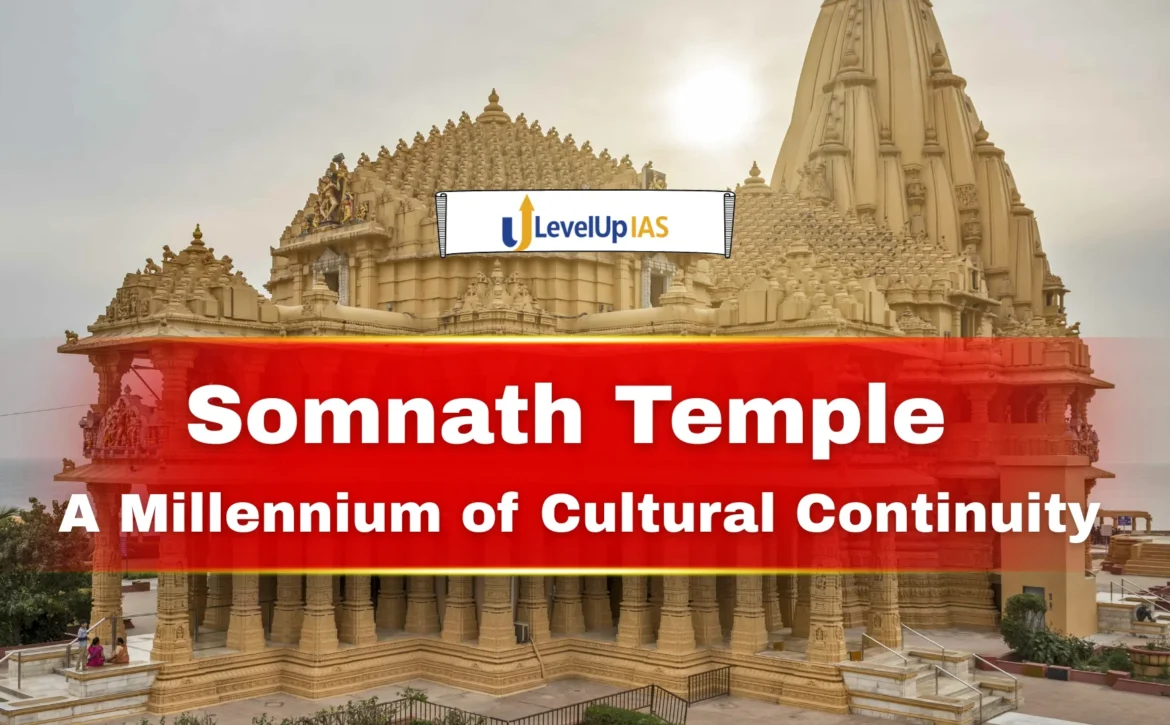
- The temple is built in the Kailasa-Mahameru Prasad architectural style, reflecting the Nagara tradition of North Indian temple construction.
- The structure consists of the Garbhagriha (sanctum), Sabhamandapa (assembly hall), and Nrityamandapa (dance hall), with a towering shikhara rising above them.
- The architectural layout reflects classical Hindu temple symbolism, where the temple is conceived as a cosmic mountain connecting the earthly realm with the divine.
A History Marked by Disruptions
Somnath’s history includes multiple episodes of destruction, beginning with the invasion of Mahmud of Ghazni in 1026 CE. Later attacks occurred during different phases of medieval history, including the Sultanate and Mughal periods. These events are documented in Persian chronicles as well as Indian historical sources.
However, what stands out is not merely the destruction, but the repeated revival of the sacred space in the collective consciousness of Indian society.
Cultural Continuity Beyond Structures
- Even during politically difficult periods, religious practices at Somnath were maintained.
- Figures such as Maharani Ahilyabai Holkar supported ritual continuity, ensuring that spiritual traditions did not disappear.
- Saints and scholars across traditions, including Swami Vivekananda and Jain Acharya Hemchandracharya, acknowledged Somnath as a living symbol of India’s cultural soul.
- Vivekananda famously viewed the temple as a reflection of India’s historical cycle of decline and renewal.
Somnath and Post-Independence National Identity
After independence, the rebuilding of Somnath was seen as a cultural statement rather than a political act. Leaders such as Sardar Vallabhbhai Patel and thinkers like K.M. Munshi viewed the temple as a symbol of India reclaiming its civilisational confidence.
The ceremonial consecration in 1951 by President Dr. Rajendra Prasad reinforced the idea that heritage and faith could coexist with modern constitutional values.