Suryastra rocket system
Content
- Latest News
- About the Suryastra Rocket System
- Key Features and Capabilities
- Advanced Technology Integration
- Strategic Significance for India
- Comparison with Existing Systems
Latest News
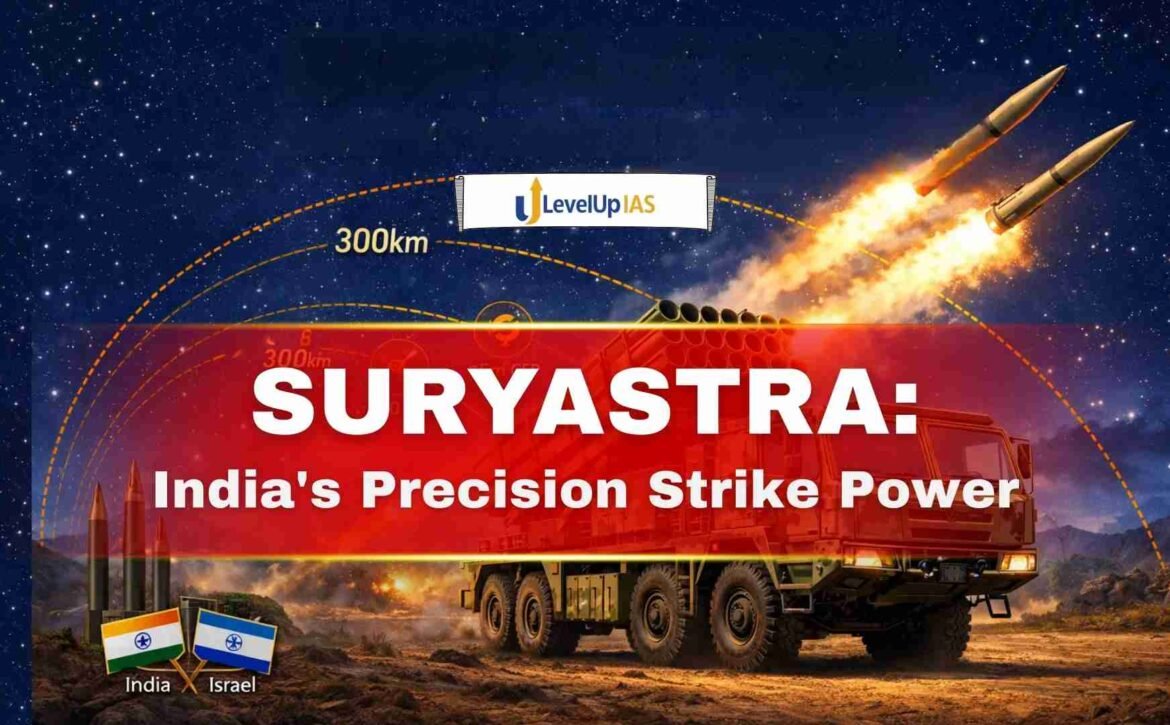
Recently, the Indian Army signed a ₹293 crore contract with private defence manufacturer NIBE Limited, in collaboration with Israel, for the supply of the Suryastra Rocket Launcher System. This development marks an important step in India’s ongoing efforts to modernise its artillery capabilities and strengthen indigenous defence production under the Atmanirbhar Bharat initiative.
About the Suryastra Rocket System
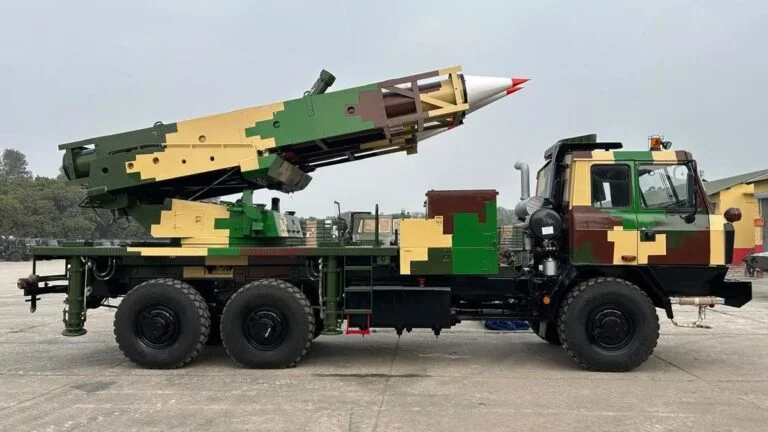
The Suryastra Rocket System is India’s first indigenous universal multi-calibre rocket launcher system. It has been developed by Pune-based NIBE Limited in collaboration with Israel’s Elbit Systems, a global leader in advanced artillery and missile technologies. The system is based on Elbit’s PULS (Precise & Universal Launching System) launcher technology, which allows flexibility in firing multiple types of rockets and munitions from a single platform.
Suryastra is designed as an advanced long-range precision strike system capable of delivering surface-to-surface attacks against high-value targets. Its induction into the Indian Army significantly enhances India’s conventional deterrence and battlefield firepower.
Key Features and Capabilities
- Range: Engages targets at 150 km and 300 km, enabling deep strikes beyond traditional artillery limits.
- Multi-Targeting: Simultaneously hits dispersed targets at varying distances for rapid battlefield dominance.
- Precision: Achieves <5m Circular Error Probable (CEP) in trials, minimizing collateral damage in line with modern precision warfare.
- Loitering Munitions: Deploys kamikaze drones up to 100 km for surveillance and opportunistic strikes.
These features make Suryastra versatile for high-intensity conflicts.
Advanced Technology Integration
The Suryastra Rocket System is equipped with a modern fire control system that integrates GPS, inertial navigation systems (INS), and digital ballistic computation. This ensures accurate targeting, real-time trajectory correction, and improved strike reliability even in challenging terrain or electronic warfare environments.
The system also features semi-automated reload mechanisms and shoot-and-scoot capability. These allow the launcher to fire, relocate quickly, and reload efficiently, thereby reducing exposure to enemy counter-battery fire. Such mobility is critical in modern high-intensity conflicts where artillery positions are rapidly targeted.
Strategic Significance for India
- The induction of Suryastra strengthens India’s long-range artillery and precision strike capabilities, particularly along sensitive borders. Its extended range enhances India’s deterrence posture by allowing deep strikes without crossing the Line of Control or international borders.
- The project also reflects growing India–Israel defence cooperation, combining Israeli technological expertise with Indian manufacturing capacity. This collaboration contributes to technology transfer and strengthens India’s domestic defence industrial base.
- From an economic and policy perspective, the contract supports Make in India and Atmanirbhar Bharat goals by promoting indigenous production and reducing dependence on foreign weapon systems.
Comparison with Existing Systems
While India already operates rocket systems such as Pinaka and Smerch, Suryastra offers enhanced range, precision, and versatility. Its ability to fire multiple munition types from a single launcher and deploy loitering munitions makes it more adaptable to modern battlefield requirements.
| System | Range (km) | CEP | Multi-Calibre | Loitering Munitions | Key Advantage |
| Suryastra | 150-300 | <5m | Yes | Yes (100 km) | Precision + versatility |
| Pinaka (MBRL) | 40-90 | 10-20m | Limited | No | Mass saturation fire |
| Smerch | 70-90 | 50-100m | No | No | Proven in exports |