The Delhi Sultanate (1206-1526 AD)

Content
- Introduction
- Mamluk Dynasty
- Khalji Dynasty
- Tughlaq Dynasty
- Sayyid Dynasty
- Lodi Dynasty
- Administration of Delhi Sultanate
- Economy and Society
- Art and Architecture
- The decline
- FAQs
Introduction
The Delhi Sultanate was a 320-year-long Islamic empire based in Delhi that ruled over large parts of South Asia. Following the Ghurid dynasty’s invasion of the subcontinent, the Delhi Sultanate was ruled by five dynasties in succession: the Mamluk dynasty (1206–1290), the Khalji dynasty (1290–1320), the Tughlaq dynasty (1320–1414), the Sayyid dynasty (1414–1451), and the Lodi dynasty (1451-1526).
It occupied large areas of modern-day India, Pakistan, and Bangladesh, as well as parts of southern Nepal. In this article, we will discuss The Delhi Sultanate (1206-1526 AD) which will be helpful for UPSC exam preparation.
Mamluk Dynasty
- The Mamluk dynasty or Slave dynasty was the first dynasty of the Delhi Sultanate.
- Qutb Ud-Din Aibak, a Turkic Mamluk slave-general of the Ghurid Empire from Central Asia, founded the Mamluk dynasty in Northern India.
- The Mamluk dynasty governed the Delhi Sultanate from 1206 until 1290.
- Mamluk means “owned” and refers to a prominent military aristocracy that developed in the Islamic Empire of the Abbasid Caliphate in the 9th century AD.
- Despite the fact that they are slaves, their masters placed a high value on them.
- The three major Sultans of the time were Qutb-Ud-din Aibak, Shams-Ud-din Iltutmush, and Ghiyas-Ud-din Balban.
- Qutb-Ud-din Aibak, the first ruler of the Slave dynasty, reigned from 1206 to 1210.
- Iltumish was the next capable ruler who ruled from 1211 to 1236.
- Ghiyasuddin Balban was the slave dynasty’s last effective emperor who ruled from 1266 to 1286.
Khalji Dynasty
- The Khalji dynasty was a Turco-Afghan dynasty ruled between 1290 to 1320 AD. It was the second dynasty of the Delhi Sultanate of India.
- This dynasty is remembered for conquests into modern-day South India and successfully repelling Mongol invasions of India.
- Jalaluddin Firuz Khilji was the first Sultan of the Khilji dynasty and ruled for six years from 1290 to 1296.
- At the age of 70, he assassinated the last descendant of the Slave Dynasty and declared himself Sultan of Delhi Sultanate.
- He was slain by his nephew Alauddin Khalji and ascended the throne.
- Following Alauddin Khilji’s death, Malik Kafur installed his 6-year-old son Shihabuddin on the throne of the Delhi Sultanate.
- Later on, Malik Kafur was also slain by the nobles.
- Mubarak Shah, another son of Alauddin, was the acting regent over his younger brother. He toppled the young prince and took the kingdom for himself.
- After him, Nasir-Ud-Din Khusrau Shah came and he ended the Khilji dynasty.
Tughlaq Dynasty
- The Tughlaq dynasty, of Turkish origin and following Islam, ruled India from 1320 to 1414 AD.
- Ghiyasuddin Tughlaq founded the dynasty, and it was subsequently led by rulers such as Muhammad-bin-Tughluq and others.
- The Tughlaqs maintained their authority for a considerable period due to strong support from allied Turks, Afghans, and South Asian Muslim warriors. However, the dynasty was also characterized by instances of cruelty, torture, and widespread rebellions, which caused its territorial control to rapidly disintegrate after 1335 AD.
- The dynasty reached its pinnacle between 1330 and 1335 AD, during a military campaign led by Muhammad Bin Tughlaq.
Sayyid Dynasty
- The Sayyid dynasty succeeded the Tughlaq dynasty as the fourth dynasty of the Delhi Sultanate and ruled until the Lodhi dynasty displaced them.
- The rulers of the Sayyid dynasty claimed descent from the Prophet Muhammad through his daughter Fatima and son-in-law Ali, a claim supported by Tarikh-i-Mubarak Shahi written by Yahya Sirhindi.
- From 1414 to 1451, they governed India for 37 years. Khizr Khan, who had served as the Governor of Multan under Firuz Shah Tughlaq, founded the dynasty. Following the death of Mubarak Shah, the second ruler, the Sayyid dynasty began to decline.
- Muhammad Shah and Alauddin Alam Shah, the subsequent rulers, proved weak, ultimately allowing Bahlol Lodhi to rise to power.
- Bahlol Lodhi invaded Delhi, and Hamid Khan, the Sayyid wazir, allied with him, facilitating the end of the Sayyid dynasty by placing Lodhi on the throne of the Delhi Sultanate.
Lodi Dynasty
- The Lodi dynasty, an Afghan dynasty, ruled the Delhi Sultanate from 1451 to 1526 and was the fifth and final dynasty of the Sultanate.
- Bahlul Khan Lodi founded the dynasty, seizing advantage of the Sayyid rulers’ weak position by capturing Punjab before entering Delhi.
- In 1451, he assumed control of Delhi and took the title “Bahlol Shah Ghazi,” effectively ending the Sharqi dynasty.
- On July 15, 1489, Bahlul Lodi was succeeded by his second son, Sikandar Lodi, who had earlier engaged in a power struggle with his elder brother Barbak Shah.
- Sikandar Lodi, a staunch Sunni ruler, demolished temples in Mathura and Naga Port and imposed Jaziya on Hindus to assert Islamic supremacy.
- He attempted to capture Gwalior Fort five times but was defeated each time by Raja Man Singh.
- After a succession struggle with his elder brother Jalal-ud-Din, Sikandar Lodi died, marking the end of his reign.
Administration of Delhi Sultanate
- During the Sultanate of Delhi, all administrative decisions were made in accordance with Muslim laws, also known as Shariat or Islamic laws.The Sultanate was divided into lqtas (regions). The leader of iqtas is known by several names, including Muqti, Wali, and Nazim.
- The provinces were divided into six sections, each led by a shiqdar, with the main function of maintaining law and order and protecting people from zamindar oppression, as well as performing military duties.
- The shiqs were further subdivided into parganas, each with its own set of officials.
- The state got five main types of revenue, according to the Shariyat, these were Uchar, Kharaj, Jaziya, Jakaq, Khamas.
- The Sultan used to convene at least twice a week to hear complaints about state officials. Qazi-i-Mumalik used to consult with the Sultan on legal matters.
- The central administration of the Delhi Sultanate followed a very systematic and well-planned administration procedure. Some important posts during the Delhi sultanate were:
- Sultan – was the head of state and had unrestricted power in all areas of state activity.
- Naib – held a position comparable to that of the Sultan.
- Wazir – state’s Prime Minister and oversaw the financial department.
- Diwan-i- Risalat – Department of Religious Affairs.
- Ariz-i-Mumalik oversaw the army. Each soldier’s descriptive role was kept in his office.
- The Iqtadari were a distinct type of land distribution and administrative system that developed during the Sultanate of Iltutmish.
- The entire empire was divided into several large and small tracts of land called Iqtas under this system.
Economy and Society under the Delhi Sultanate
Economy under the Delhi Sultanate
The Delhi Sultanate witnessed significant economic development, marked by expansion in trade, industry, and infrastructure.
- Trade and Commerce: Trade flourished both internally and externally. Textiles, particularly cotton and silk, were major commodities exported to China and West Asia, while imports included horses, ivory, and spices.
- Currency and Financial System: The silver tanka served as the standard currency, facilitating trade. Land revenue, known as kharaj, was the main source of state income. Non-Muslims also paid jizya, while Muslims contributed zakat (Khams or Ghaninah) to assist the econmically vulnerables. Alauddin Khilji increased land revenue from one-sixth to one-half of the produce, reflecting the state’s heavy fiscal demands.
- Infrastructure and Communication: Roads connected major cities like Delhi, Lahore, and Sonargaon, and a post relay system was established with horse riders to maintain administrative and commercial communication.
- Industries: Delhi, Lahore, Multan, and Lakhnauti became centers for textiles, metalwork, and paper-making. Paper-making technology, introduced from China via Arabs, helped administrative efficiency and cultural development.
Social Life during the Delhi Sultanate
Society during this period was marked by religious stratification and evolving social norms.
- Religious and Social Divisions: Society was divided primarily into Hindus and Muslims. Muslims were further stratified into nobility and chiefs, who enjoyed a luxurious lifestyle and gradually became cultural patrons. Political alliances between Turkish rulers and Hindu Rajputs were common.
- Administration of Justice: Qazis and Muhtasibs assisted nobles in judicial and administrative functions, with Mehtasibs monitoring adherence to Shariah law.
- Women and Social Customs: The Purdah system became widespread among upper-class women, while lower-class women retained relatively more freedom. Practices such as sati and prohibitions on widow remarriage were prevalent, though widows could inherit property.
- Cultural Tensions: Disparities in social customs, religious beliefs, and cultural practices created a tense social environment, limiting mutual understanding and integration between communities.
Art and Architecture During Delhi Sultanate
The Turks introduced the use of arch and the dome on a large scale in their architecture.
- The arch and dome eliminated the need for a large number of pillars to support the roof, allowing the construction of large halls with good visibility.
- They combined geometrical and floral designs with panels of inscriptions containing Quranic verses. The combination of these decorative elements was known as Arabesque.
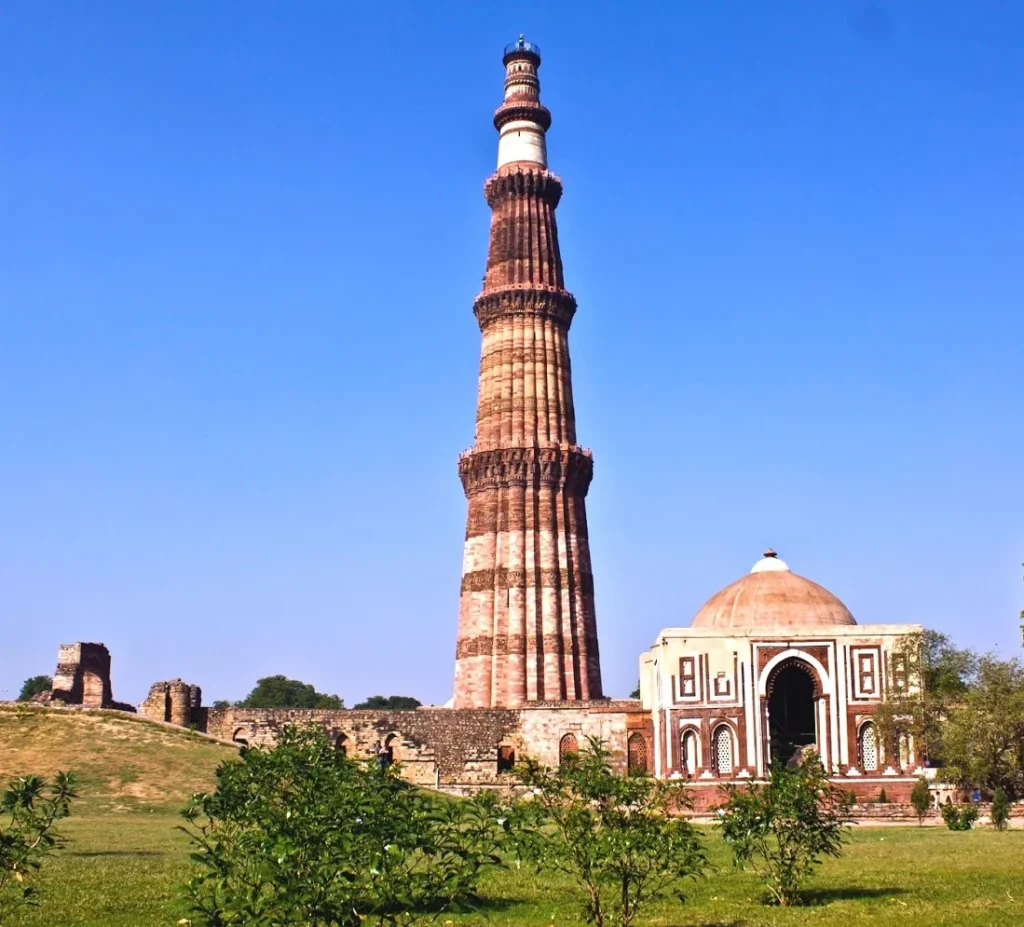
- Qutub Minar was built by Qutub-ud-Din Aibak and completed by Iltutmish. It is a 73-meter-high tower which was built in the memory of Sufi Saint Qutub-ud-Din Aibak.
- The Qutub Minar complex includes the Quwat-us-Islam Mosque, a 7-meter-high iron pillar, Iltutmish’s tomb, Alai-Darwaza, and the Alai Minar.
- Alauddin Khilji constructed a new fort and the imperial township of Siri. He built the Mahal Hazar Satun, the palace of a thousand pillars, the Hauz-i-Illahi, a water tank, and the Jamait Khana mosque at the Dargah of Nizamuddin Auliya in Siri.
- Lodhi Garden in Delhi is one of the finest examples of Indo-Islamic architecture containing the Tomb of Sikandar Lodi, Shisha Gumbad and Bara Gumbad.
The decline of Delhi Sultanate
Autocratic Rule and Centralization of Power
The Delhi Sultanate was fundamentally autocratic, with the Sultans exercising absolute authority. While the Sultans held ultimate power, the Amirs controlled significant aspects of the administration, leading to a dual concentration of authority. The rulers largely excluded ordinary people from participation in governance, creating a widening gap between themselves and the populace. This disconnect grew deeper under weak and ineffective Sultans, accelerating the gradual disintegration of central authority.
Religious Intolerance and Social Division
The Sultanate’s rulers often pursued religiously partisan policies, fostering social divisions between Hindus and Muslims. The preferential treatment of Muslims and marginalization of Hindus created resentment and mutual distrust, weakening social cohesion. The influence of the Ulema and orthodox Muslims in state affairs further entrenched these divisions, as the administration favored Islamic principles over inclusive governance. The lack of cooperation from the Hindu majority undermined the Sultanate’s stability.
Economic Weakness and Financial Instability
Economic strength is the foundation of a stable state, but the Delhi Sultanate lacked a secure financial base. Although the rulers amassed wealth through plunder, temple raids, and taxation, large expenditures on maintaining a standing army and repelling Mongol invasions strained the treasury. Poverty fiscal management, combined with Muhammad Tughluq’s impractical schemes, including ill-conceived taxation and currency experiments, further depleted state resources. Without financial stability, the Sultanate could not maintain a resilient administration or military.
Conclusion
The Delhi Sultanate period started in the 12th century and marked a change in Indian society. People were broadly classified as Hindus or Muslims based on their religion. The sultanate is notable for its integration of the Indian subcontinent into a global cosmopolitan culture. This period of architectural excellence witnessed the evolution and development of Indo-Islamic Architecture. The Delhi Sultanate ended in 1526, when Babur defeated the forces of the last Lodi sultan, Ibrahim Lodi, in the First Battle of Panipat, establishing the Mughal Empire. For three centuries, the Mughals ruled the region.
FAQs
1. What was the Delhi Sultanate?
The Delhi Sultanate was a medieval Islamic polity that ruled large parts of North India from 1206 to 1526 AD, with its capital at Delhi.
2. Who founded the Delhi Sultanate?
The Delhi Sultanate was founded by Qutbuddin Aibak in 1206 AD after the decline of Ghurid authority in India.
3. What were the major dynasties of the Delhi Sultanate?
The Sultanate consisted of five dynasties:
Slave (Mamluk), Khalji, Tughlaq, Sayyid, and Lodi dynasties.
4. Why is Alauddin Khalji considered an important ruler?
Alauddin Khalji strengthened the Sultanate through military expansion, market control measures, revenue reforms, and price regulation, ensuring a strong centralized state.
5. What were Muhammad bin Tughlaq’s major administrative experiments?
Muhammad bin Tughlaq introduced ambitious but failed policies such as token currency, transfer of capital, and taxation in the Doab, leading to administrative instability.
Click on the question to see the Answers