The Marathas and the Deccan
Content
- Introduction
- Background
- Rise of the Maratha
- Administrative System
- Expansion after Shivaji
- Rise of the Peshwas
- Third Battle of Panipat
- Anglo-Maratha Wars
- Decline of Marathas
- FAQs
Introduction
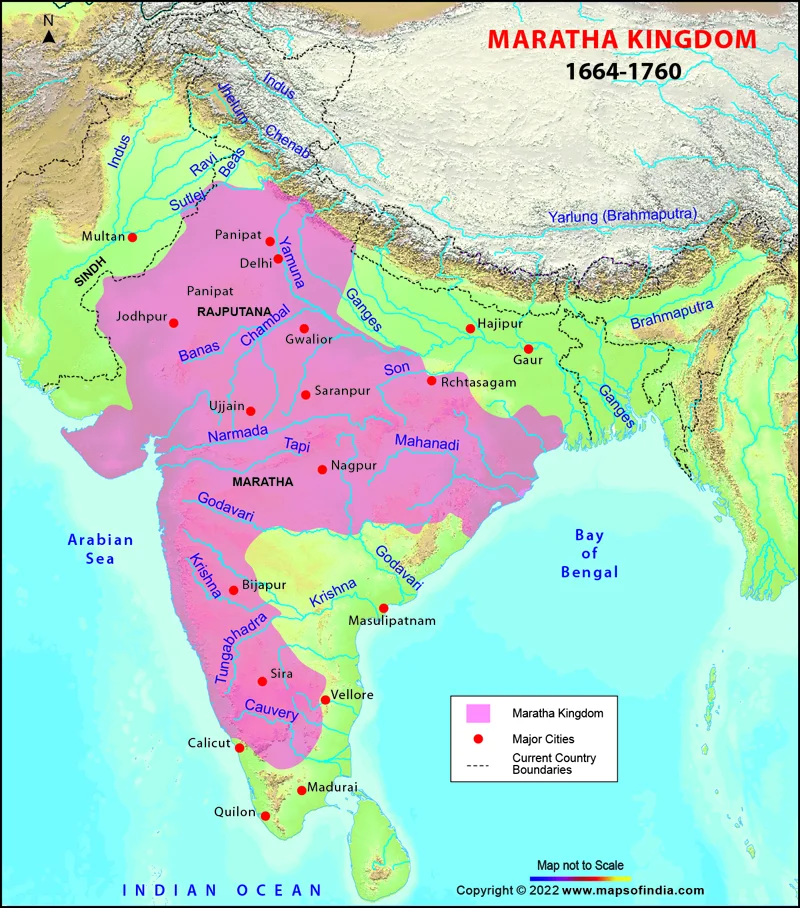
The Maratha Empire emerged in the 17th century in the Deccan region and became one of the most powerful political forces in India during the eighteenth century. Founded by Shivaji, the Maratha state challenged Mughal authority and gradually expanded across large parts of the Indian subcontinent. After the decline of the Aurangzeb-led Mughal Empire, the Marathas became the dominant political power in India.
By the mid-18th century, the Maratha Confederacy exercised influence over vast territories including Malwa, Gujarat, Bundelkhand, and parts of northern India, even controlling the politics of the Mughal court in Delhi. However, internal divisions, military setbacks, and conflicts with the British East India Company eventually led to their decline in the early nineteenth century.
Background of the Rise of Maratha Power
The rise of Maratha power must be understood in the broader context of political, social, and geographical developments in the Deccan.
1. Decline of the Deccan Sultanates: Before the rise of the Marathas, the Deccan region was dominated by the Ahmadnagar, Bijapur, and Golconda Sultanates. Continuous wars among these states weakened their authority and created political instability.
2. Mughal Expansion in the Deccan: The Mughal Empire under Akbar and later rulers attempted to extend their control over the Deccan. However, Mughal administration faced difficulties due to distance, geography, and local resistance.
3. Geographic Advantages: The rugged terrain of the Western Ghats and Deccan plateau provided natural protection and allowed the Marathas to adopt guerrilla warfare tactics.
4. Social and Cultural Factors: The Bhakti movement, especially the teachings of saints such as Tukaram and Ramdas, helped create a sense of regional unity and identity among the Marathas.
These factors collectively created conditions favourable for the emergence of Maratha power under Shivaji.
Rise of the Maratha State under Shivaji
The foundation of Maratha political power was laid by Shivaji, who is widely regarded as the architect of the Maratha state.
- Born in 1630 at Shivneri Fort, Shivaji was the son of Shahaji Bhonsle, a military commander who served under the Deccan Sultanates.
- Shivaji was strongly influenced by his mother Jijabai, who instilled in him a vision of establishing Hindavi Swarajya, or self-rule for the people of the region.
- Shivaji began his career by capturing several forts from the Bijapur Sultanate, which at the time controlled large parts of the Deccan.
- His early successes included the capture of Torna Fort in 1646, which marked the beginning of Maratha territorial expansion. Over the following years, Shivaji consolidated his control over several strategic forts and gradually established an independent power base.
- One of the most famous episodes of Shivaji’s career was his confrontation with the Bijapur general Afzal Khan in 1659. Shivaji defeated Afzal Khan at the Battle of Pratapgad, which significantly enhanced his reputation and expanded his influence in the Deccan.
- Shivaji also came into conflict with the Mughal Empire. His growing power attracted the attention of the Mughal emperor Aurangzeb, who sought to curb Maratha expansion. In 1665, the Mughal commander Mirza Raja Jai Singh forced Shivaji to sign the Treaty of Purandar, under which Shivaji temporarily surrendered several forts.
- Shivaji later visited the Mughal court in Agra but was placed under house arrest. His dramatic escape from Agra became a legendary episode in Indian history and further strengthened his reputation.
In 1674, Shivaji was formally crowned as Chhatrapati at Raigad, symbolizing the establishment of an independent Maratha kingdom.
Administrative System under Shivaji
Shivaji established a well-organized administrative structure to govern his expanding state. His administration combined traditional Indian institutions with practical reforms aimed at strengthening central authority.
- The central administration was assisted by a council of ministers known as the Ashta Pradhan. This council consisted of eight officials responsible for different aspects of governance, including finance, foreign affairs, military affairs, and justice. The most important official among them was the Peshwa, who acted as the prime minister.
- In revenue administration, Shivaji introduced several reforms to protect the interests of peasants and ensure efficient collection of taxes. Land revenue was assessed on the basis of land measurement, and efforts were made to reduce the exploitation of cultivators by intermediaries.
- The military organization under Shivaji was also highly effective. He maintained a disciplined army composed of infantry and cavalry and relied heavily on guerrilla warfare tactics. Hill forts played a crucial role in Maratha defense strategy, and Shivaji developed a network of fortified positions across the Deccan. He also recognized the importance of maritime security and established a small but significant navy along the Konkan coast.
Expansion after Shivaji
- After Shivaji’s death in 1680, the Maratha state faced severe challenges. His successor Sambhaji continued resistance against the Mughal Empire but was eventually captured and executed by Aurangzeb in 1689.
- Following Sambhaji’s death, the leadership of the Maratha resistance passed to Rajaram and later to Tarabai, who continued the struggle against Mughal forces.
- Aurangzeb personally led campaigns in the Deccan for nearly three decades in an attempt to destroy the Maratha state.
- However, despite enormous military resources, the Mughal Empire failed to subdue the Marathas. Instead, the prolonged war exhausted Mughal finances and contributed to the weakening of the empire.
After Aurangzeb’s death in 1707, the Marathas quickly regained strength and began expanding their influence beyond the Deccan.
Rise of the Peshwas
During the eighteenth century, real political authority in the Maratha state gradually shifted from the Chhatrapati to the Peshwas, who became the effective rulers of the Maratha Confederacy.
- The first important Peshwa was Balaji Vishwanath, who served under the Maratha ruler Shahu. Balaji Vishwanath strengthened the administrative structure of the Maratha state and negotiated with the Mughal Empire to secure the right to collect Chauth and Sardeshmukhi from several Deccan provinces.
- His successor Baji Rao I was one of the most dynamic leaders in Maratha history. Baji Rao believed that the declining Mughal Empire offered an opportunity for Maratha expansion across northern India. Through a series of successful campaigns, he extended Maratha influence into Malwa, Gujarat, and Bundelkhand. His military strategy relied on rapid cavalry movements and surprise attacks, which proved highly effective against slower Mughal forces.
- During this period, the Maratha state evolved into a confederacy, in which powerful regional chiefs governed different territories while recognizing the authority of the Peshwa. Important Maratha families included the Holkars of Indore, the Scindias of Gwalior, the Gaekwads of Baroda, and the Bhonsles of Nagpur.
Third Battle of Panipat and its Impact
The expansion of Maratha influence into northern India eventually brought them into conflict with the Afghan ruler Ahmad Shah Abdali. This conflict culminated in the Third Battle of Panipat in 1761.
- The battle was one of the largest and bloodiest conflicts of the eighteenth century. Despite their military strength, the Marathas faced logistical difficulties and lacked strong alliances with several regional powers in northern India. Abdali’s forces ultimately defeated the Maratha army.
- The defeat at Panipat resulted in heavy casualties and the loss of several important Maratha leaders. Although the Marathas later recovered and regained influence in many regions, the battle marked a turning point that weakened their ability to dominate northern India.
Anglo-Maratha Wars
The growing power of the British East India Company eventually brought the Marathas into direct conflict with British colonial expansion.
- The First Anglo-Maratha War (1775-1782) arose from disputes over succession to the Peshwa position. Although the conflict ended with the Treaty of Salbai and temporarily restored peace, it revealed the increasing involvement of the British in Indian politics.
- The Second Anglo-Maratha War (1803-1805) occurred during a period of intense rivalry among Maratha chiefs. The British took advantage of these divisions and defeated several Maratha forces, gaining control over important territories.
- The Third Anglo-Maratha War (1817-1818) finally destroyed Maratha political power. The British defeated the remaining Maratha leaders and abolished the office of the Peshwa.
Decline of the Maratha Empire
The decline of the Maratha Empire resulted from a combination of internal weaknesses and external pressures.
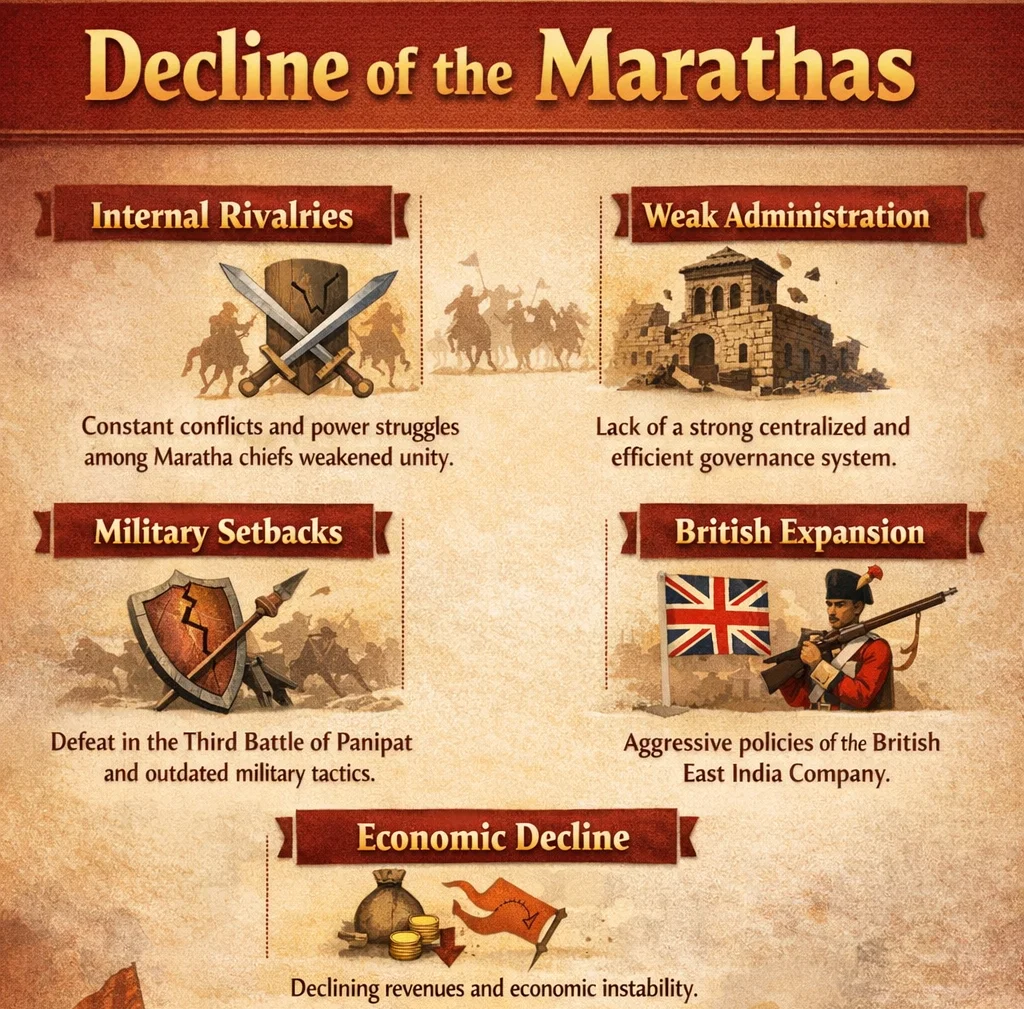
- One of the major problems was the lack of political unity within the Maratha Confederacy. Powerful regional chiefs often pursued their own interests, which weakened central authority.
- Another important factor was the absence of a strong centralized administrative structure capable of managing a vast empire. The decentralized nature of Maratha rule made coordination difficult during times of crisis.
- Military limitations also contributed to their decline. The Marathas relied heavily on cavalry warfare and did not modernize their army along European lines, while the British possessed superior artillery, disciplined infantry, and advanced military organization.
- Finally, the rise of the British East India Company as a powerful political and military force in India gradually overshadowed the Marathas. In 1818, the last Peshwa Baji Rao II surrendered to the British, marking the end of Maratha political dominance.
Conclusion
The Maratha Empire played a crucial role in shaping the political history of eighteenth-century India. Beginning as a regional power under Shivaji, the Marathas eventually filled the political vacuum created by the decline of the Mughal Empire and emerged as one of the most powerful forces in the Indian subcontinent.
Although their rule ultimately came to an end with the expansion of British colonial power, the Marathas remain an important example of indigenous state formation, military innovation, and resistance to imperial authority in early modern India.
FAQs
Q1. Who were the Marathas in the Deccan?
The Marathas were a powerful warrior community from the Deccan region who rose to prominence in the 17th century under the leadership of Shivaji and established the Maratha Empire.
Q2. Why did the Marathas emerge as a strong power in the Deccan?
Several factors contributed to their rise, including strong local leadership, knowledge of the rugged Deccan terrain, effective guerrilla warfare tactics, and the weakening of regional powers like the Deccan Sultanates and the Mughal Empire.
Q3. What role did Shivaji play in the rise of the Marathas?
Shivaji organised the Maratha military, built a network of hill forts, introduced efficient administration, and challenged Mughal authority in the Deccan.
Q4. What were the key features of Maratha administration?
The Maratha administration included systems such as Ashta Pradhan (council of eight ministers), efficient revenue collection, and military organisation based on cavalry and fortified hill strongholds.
Q5. How did the Marathas challenge Mughal dominance in the Deccan?
Through guerrilla warfare, strategic fort control, and constant military pressure, the Marathas weakened Mughal authority in the region, especially during the reign of Aurangzeb.
Click on the question to see the Answers