Understanding Geo-engineering
General Studies Home Page
Table of Contents
- Introduction
- Methods to Reduce Sunlight Reaching Earth
- Carbon Capture and Storage (CCS) & Carbon Dioxide Removal (CDR)
- Limitations and Challenges
- Geopolitics of Geo-Engineering
- Way Forward
- Conclusion
- FAQs
Introduction
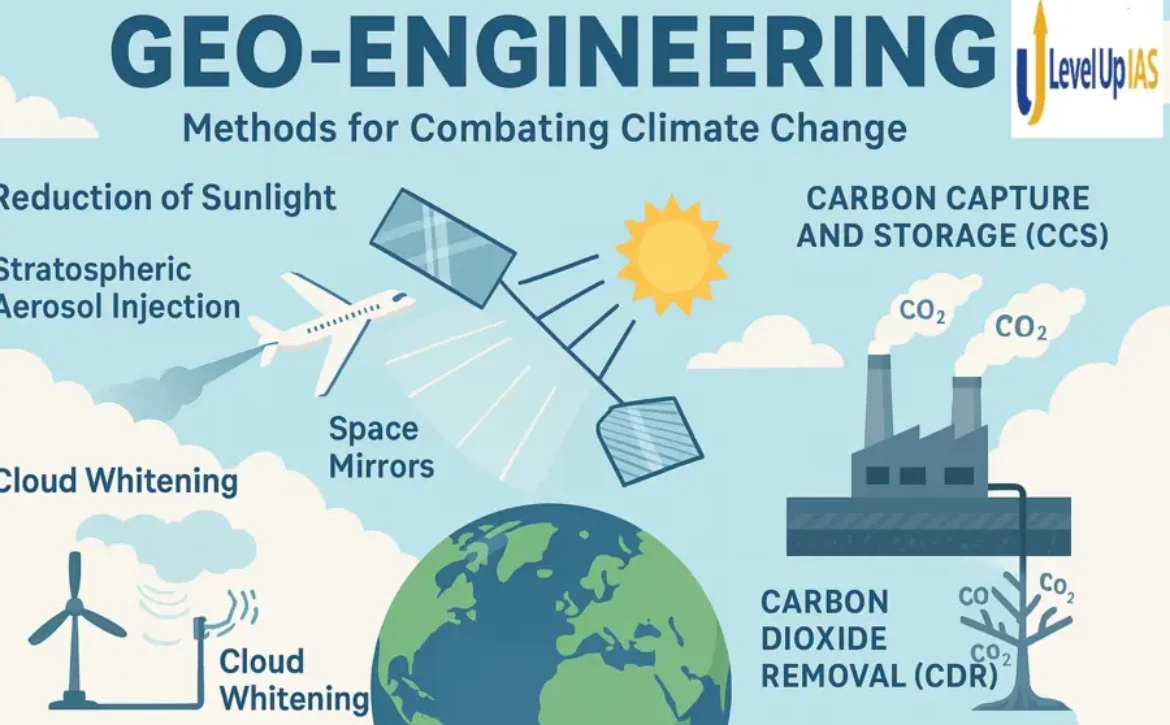
Geo-engineering is a theoretical concept aimed at modifying and cooling the environment to counter global warming. It involves:
- Reducing sunlight reaching Earth.
- Absorbing CO2 through advanced Carbon Capture Technologies.
- With the global community striving for a Net Zero target by 2050, geo-engineering technologies are expected to play a critical role in climate mitigation.
Methods to Reduce Sunlight Reaching Earth
- Stratospheric Aerosol Injection (SAI): Injecting sulphur or hydrogen sulphide into the atmosphere to mimic volcanic eruptions and scatter sunlight.
- Space Mirrors: Deploying large mirrors in space to deflect solar radiation.
- Cloud Whitening: Using wind-powered motors to spray water into the sky, increasing cloud reflectivity.
Carbon Capture and Storage (CCS) & Carbon Dioxide Removal (CDR)
- CCS/CCUS: Captures CO2 at emission sources before release into the atmosphere.
- CDR Approaches:
- Natural: Afforestation and reforestation.
- Technological: Direct air capture (machines mimicking trees), artificial “fake trees” that absorb CO2 and store it in solid form.
- IPCC AR6 Insight: There is no pathway to limit warming to 1.5°C without CDR.
Limitations and Challenges
- Technological Constraints: CCS and CDR lack large-scale feasibility despite decades of research.
- High Costs & Energy Needs: Transport and long-term storage of carbon remain problematic.
- Land Use Issues: Afforestation, reforestation, and BECCS compete with food and water security.
- Ocean Iron Fertilization: Risk of eutrophication; restricted under the Convention on Biological Diversity.
- Stratospheric Aerosol Injection: Highly controversial due to unpredictable climate impacts.
- Equity Concerns: R&D dominated by North America and Western Europe, raising fairness and justice issues.
Geopolitics of Geo-Engineering
- Policy Gaps: Limited global policy support and inadequate R&D spending.
- Power Imbalance: Developed nations dominate governance frameworks, sidelining developing countries.
- Representation Issues: Concerns about inclusivity in decision-making for future geo-engineering governance.
Way Forward
- Policy Support: Strengthen national and international backing for R&D.
- Global Collaboration: Learn from industrialized nations and involve global industries.
- Inclusive Governance:
- Align with UNFCCC principles of common but differentiated responsibilities.
- Ensure accountability, oversight, and transparency.
- Promote equitable representation of developing nations.
Conclusion
Geo-engineering offers potential solutions to climate change but faces technological, ethical, and governance challenges. For UPSC aspirants, understanding CCS, CDR, and the geopolitics of climate governance is crucial to framing answers on Net Zero 2050 and global climate policy.
FAQs
Q1. What is geo-engineering and why is it important for achieving Net Zero 2050?
Geo-engineering refers to large-scale interventions aimed at cooling the Earth and reducing greenhouse gases. It is considered crucial for achieving the Net Zero 2050 target as it includes methods like Carbon Capture and Storage (CCS), Carbon Dioxide Removal (CDR), and sunlight reduction techniques to mitigate global warming.
Q2. How does Stratospheric Aerosol Injection (SAI) help in reducing global warming?
Stratospheric Aerosol Injection (SAI) involves releasing sulphur or hydrogen sulphide into the atmosphere to mimic volcanic eruptions. These particles scatter sunlight, reducing the amount of solar radiation reaching Earth and thereby lowering global temperatures.
Q3. What is the difference between Carbon Capture and Storage (CCS) and Carbon Dioxide Removal (CDR)?
• CCS/CCUS: Captures CO2 directly at emission sources (like power plants) before it enters the atmosphere.
• CDR: Removes CO2 already present in the atmosphere through natural methods (afforestation, reforestation) or technological approaches (direct air capture, artificial trees).