Understanding the Constitutional Morality
General Studies Home Page
Table of Contents
- Introduction
- Origin of Constitutional Morality
- Significance of Constitutional Morality
- Judicial Affirmation of Constitutional Morality
- Criticisms of Constitutional Morality
- Conclusion
- FAQs
Introduction
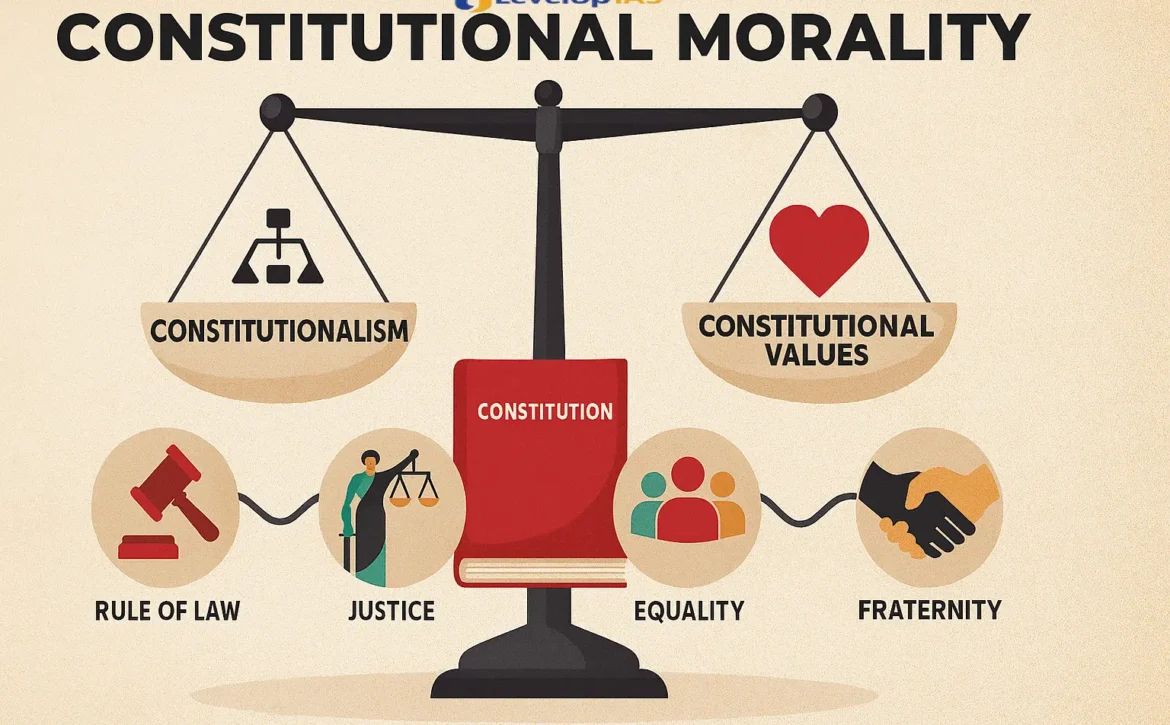
Constitutional Morality refers to adherence to the spirit and principles of the Indian Constitution rather than mere literal observance of its text. It emphasizes that all constitutional actors — government, legislature, judiciary, and citizens — must act in accordance with the values of justice, equality, liberty, and fraternity, even when explicit legal provisions are absent.
In recent years, the Supreme Court of India (SC) has expanded its meaning to assert that Constitutional Morality must triumph over Public/Societal Morality. This ensures that fundamental rights cannot be denied based on popular opinion, social customs, or religious traditions.
Origin of Constitutional Morality
George Grote (British Historian): Defined Constitutional Morality as “paramount reverence for the forms and procedures of the Constitution.”He stressed that rules alone cannot ensure constitutional longevity; citizens must treat constitutional values as sacred, even amidst political differences.
Dr. B.R. Ambedkar (Constituent Assembly, 1948): Highlighted that “Constitutional Morality is not a natural sentiment. It has to be cultivated.” He warned that democracy in India is only a “top-dressing on an essentially undemocratic soil,” requiring conscious effort to nurture constitutional values.
Significance of Constitutional Morality
- Rule of Law: Ensures supremacy of the Constitution; even those in power are subject to law.
- Counters Majoritarianism: Protects minority rights when majority decisions violate constitutional spirit.
- Transformative Tool: Example — Navtej Singh Johar case (2018) decriminalized homosexuality by prioritizing constitutional morality over societal morality.
- Good Governance: Acts as a check on administrative power, ensuring restraint and fidelity to constitutional purposes.
- Social Justice: Aligns government policies with the constitutional goal of creating a socially just society.
Judicial Affirmation of Constitutional Morality
- Naz Foundation vs Govt of NCT Delhi (2009): Delhi HC decriminalized homosexuality, invoking constitutional morality against social morality.
- K.S. Puttaswamy vs Union of India (2017): SC upheld Right to Privacy as a fundamental right, stressing constitutional morality in data collection.
- India Young Lawyers Association vs State of Kerala (2018): SC struck down the Sabarimala temple ban on women, stating “patriarchy in religion cannot trump constitutional morality.”
- Navtej Singh Johar vs Union of India (2018): SC decriminalized homosexuality, declaring “constitutional morality cannot be martyred at the altar of social morality.”
- NCT of Delhi vs Union of India (2018): SC reminded that real power lies with elected representatives, not the LG, reinforcing democratic principles.
Criticisms of Constitutional Morality
- Vagueness & Judicial Overreach: Not explicitly defined in the Constitution, giving judges wide discretion.
- Limits Freedom of Religion: Critics argue that judgments like Sabarimala impose modern constitutional morality on ancient religious practices.
Challenges to Constitutional Morality in India
- Rise of Populism & Nationalism → Narrow definitions of citizenship.
- Decline of trust in institutions → Weakens constitutional values.
- Spread of misinformation via social media → Confuses public morality vs constitutional morality.
- Polarization in society → Hampers consensus-building.
- Judicial delays → Slow enforcement of constitutional morality.
- Social inequalities → Obstruct equality and justice.
Constitutionalism vs Constitutional Morality
Constitutionalism refers to adherence to the Constitution as the supreme law and framework for governance. It emphasizes limiting government power through checks and balances.
Key Features:
1. Supremacy of the Constitution
2. Rule of Law
3. Separation of Powers
4. Checks and Balances
5. Judicial Review
Constitutional Morality refers to the ethical and moral commitment to constitutional values beyond legal provisions. Promotes respect for diversity, inclusivity, and protection of minority rights.
Key Features:
1. Adherence to Constitutional Values
2. Fostering Democratic Principles
3. Social Justice & Equity
4. Upholding Individual Rights
5. Evolving with Society
Conclusion
Constitutional Morality ensures rule of law, protection of rights, and equitable governance. Hence forming the bedrock of democracy. From Ambedkar’s vision of administrative restraint to a tool of social reform, it has evolved for the welfare of the people in multiple ways especially under the guidance and activism of the Indian judiciary. Therefore, it lives up to the ethos of the grand law of the land by transforming the constitutional guarantees into tangible justice, fostering inclusion and equality.
FAQs
Q1. Who introduced the concept of Constitutional Morality in India?
Dr. B.R. Ambedkar in the Constituent Assembly (1948).
Q2. How is Constitutional Morality different from Constitutionalism?
Constitutionalism = structural adherence; Constitutional Morality = ethical adherence to values.
Q3. Which landmark case highlighted Constitutional Morality over societal morality?
Navtej Singh Johar vs Union of India (2018).