UNESCO: Key Initiatives, Norms and India’s Strategic Engagement
Content
- Introduction
- Origin, mandate and structure
- Vision
- Major Initiatives
- India and UNESCO
- India-UNESCO Collaborative Initiatives
- Latest Developments
- FAQs
Introduction
UNESCO is a specialised agency of the United Nations that seeks to build peace through cooperation in education, science, culture and communication. In recent years it has also emerged as a key norm‑setter on issues like artificial intelligence ethics, digital platforms and heritage protection in conflict zones.
For International Relations (IR), UNESCO offers a textbook illustration of how ideas, norms and soft power shape state behaviour beyond traditional military and economic instruments.
Origin, mandate and structure
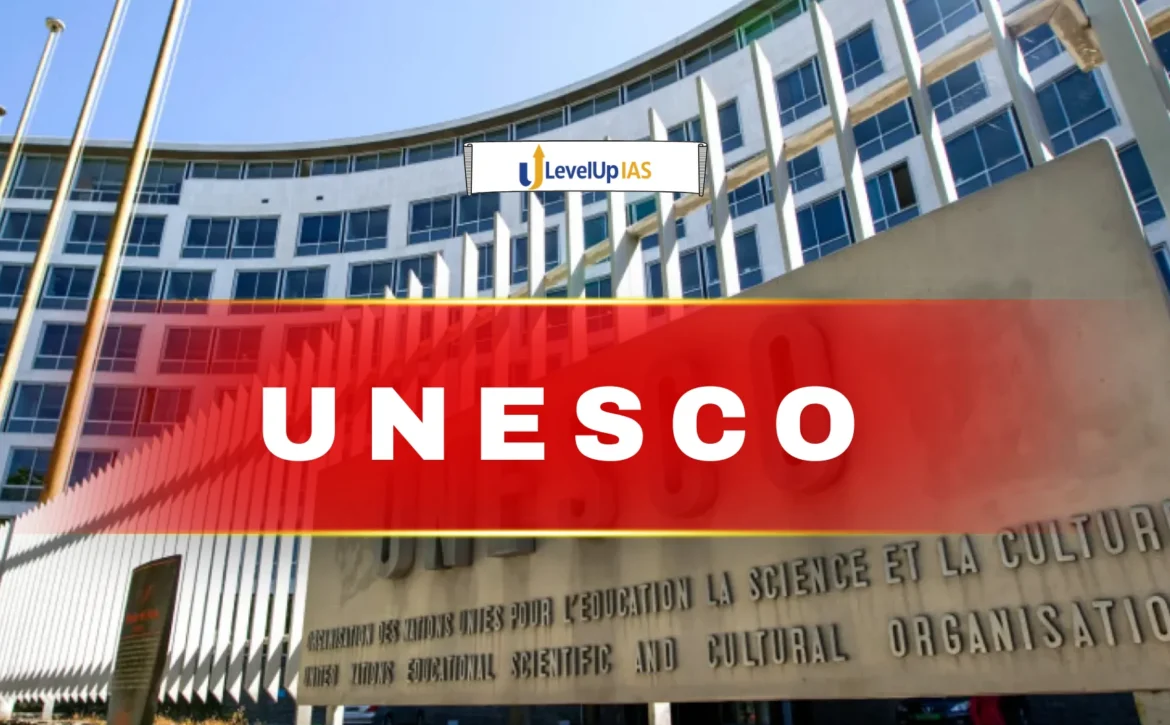
The United Nations Educational, Scientific and Cultural Organization (UNESCO) is a specialised agency of UN. It aimed at promoting world peace and security through international cooperation in education, arts, sciences, and culture
- UNESCO was founded in 1945 as the successor to the League of Nations’ International Committee on Intellectual Cooperation
- It has 193 member states and 11 associate members, as well as partners in the non-governmental, intergovernmental, and private sector
- Headquartered at the World Heritage Centre in Paris
- The UNESCO’s founding mission is to advance peace, sustainable development and human rights by facilitating collaboration and dialogue among nations
- It pursues this objective through five major program areas:
- Education
- natural sciences
- social/human sciences
- culture and
- communication/information
- It pursues this objective through five major program areas:
- UNESCO is governed by the General Conference, composed of member states and associate members. It meets biannually to set the agency’s programmes and the budget.
- It also elects members of the Executive Board, which manages UNESCO’s work, and appoints every four years a Director-General, who serves as UNESCO’s chief administrator
UNESCO: Vision
UNESCO builds peace through education, science, culture and communication, rooted in the belief that “wars begin in the minds of men, it is in the minds of men that the defences of peace must be built.”
- Education: Develops tools for global citizenship free of hate; leads SDG 4 and Education 2030 Framework (Incheon Declaration), ensures quality education access for all.
- Culture: Protects heritage and cultural dignity to bond nations; key conventions include 1970 Illicit Traffic, 1972 World Heritage, 2001 Cultural Diversity/Underwater Heritage, 2003 Intangible Heritage, 2005 Cultural Expressions.
- Science: Promotes STI policies, national reforms, capacity-building and performance indicators for development and cooperation.
- Communication: Defends freedom of expression; protects journalists; fights hate speech, disinformation via awareness, runs MOST, Youth, Culture of Peace programmes for dialogue, democracy and citizenship.
Major UNESCO Initiatives
| Initiative / Programme | Primary Focus | Objectives |
| World Heritage Convention | Protection of cultural and natural heritage of “outstanding universal value”. | Identify, protect, and preserve sites of global significance, promote international cooperation in conservation, support capacity-building and awareness. |
| Man and the Biosphere Programme (MAB) | Reconciling biodiversity conservation with sustainable development and human livelihoods. | Establish biosphere reserves as models for sustainable practices, foster research, education, and monitoring, balance ecological protection with socio-economic development. |
| UNESCO Global Geoparks (IGGP) | Geological heritage linked with education, geotourism, and local development. | Safeguard geoheritage, promote geotourism and education, integrate geoscience with community development and cultural values. |
| Local and Indigenous Knowledge Systems (LINKS) | Integration of Indigenous and local knowledge in biodiversity governance. | Document and valorise traditional knowledge, support its inclusion in policy and science, advance equitable participation in environmental decision-making. |
| UNESCO Biodiversity Initiative | Support to global biodiversity governance frameworks. | Coordinate science-policy interfaces, align with conventions like CBD, promote knowledge-sharing for conservation and sustainable use. |
India and UNESCO: Historical Engagement and Current Role
India holds a foundational position in UNESCO as a founder member, ratifying its Constitution on 4 November 1946 even under colonial rule, reflecting early commitment to global cultural and educational cooperation.
- Leadership Role: Played pivotal part in shaping UNESCO priorities across education, science and culture; continuously re-elected to Executive Board since 1946, including 2021-25 term.
- Convention Membership: Party to 19 UNESCO conventions, covering heritage, education and IP rights; recent ratifications include 2003 Intangible Cultural Heritage, 2005 Cultural Expressions and 2005 Doping in Sports conventions.
- UNESCO Mission in India: Focuses on quality education/lifelong learning, science for sustainable development; ethical challenges, cultural diversity/peace, inclusive knowledge societies via information/communication.
India-UNESCO Collaborative Initiatives
India actively partners with UNESCO on targeted projects addressing education, heritage preservation, media ethics, and cultural sustainability, aligning with national development priorities and global SDGs.
- #KeepGirlsInSchool movement: UNESCO New Delhi collaborates with P&G-Whisper to integrate puberty education modules into school curricula; trains teachers; engages education authorities to prevent girls’ dropouts and support their potential.
- Special Area Heritage Plan (SAHP) for Jaipur: Post-2019 World Heritage inscription, UNESCO works with Jaipur Municipal Corporation on first South Asian urban heritage protection mechanism (710 ha area) to preserve Outstanding Universal Value.
- Media Action Against Rape (MAAR): Joint analysis of rape reportage practices, interviews journalists to map challenges. Develops country-specific guidelines for ethical reporting, journalism education, and violence prevention.
- Rural Craft and Cultural Hubs in West Bengal: Supports SDG 8 via ICH transmission. Mobilises practitioners for documentation/training. Builds entrepreneurial skills, links to government schemes, sensitises youth on rural heritage for economic inclusion.
- Indian National Commission for Cooperation with UNESCO (INCCU): Government body under Ministry of Education (formerly HRD); advises on UNESCO matters; Minister of Education serves as President.
Latest UNESCO Developments with India (2025)
India marked significant milestones in UNESCO collaborations during 2025, amplifying its cultural diplomacy and heritage conservation efforts amid global recognitions.
- Education Reports: UNESCO launched “Bhasha Matters” (16 Dec 2025) on mother-tongue/multilingual education, and earlier 2024/2025 reports on culture/arts education aligning with NEP 2020.
- Deepavali Inscription: Diwali inscribed on UNESCO’s Representative List of Intangible Cultural Heritage (10 Dec 2025), celebrating its cultural, spiritual and communal significance.
- Hosting 20th ICH Session: India hosted the 20th Intergovernmental Committee for Safeguarding Intangible Cultural Heritage at Red Fort, New Delhi (8-13 Dec 2025), first-time hosting with discussions on nominations including Diwali.
- World Heritage Additions: Maratha Military Landscapes inscribed as India’s 44th site. Total tentative list reaches 69 with 7 new natural sites added (Sep 2025), including Deccan Traps, St Mary’s Island Basalt Columns, Meghalayan Age Caves, Naga Hill Ophiolite, Erra Matti Dibbalu, Tirumala Hills, Varkala Cliff.
- Memory of the World Register: Bhagavad Gita Manuscripts and Natyashastra by Bharat Muni added, bringing India’s total to 14 entries.
- Creative Cities Network: Lucknow designated City of Gastronomy for Awadhi cuisine and Ganga-Jamuni traditions, India’s second after Hyderabad.
FAQs
1. What is UNESCO and why was it established?
UNESCO (United Nations Educational, Scientific and Cultural Organization) was established in 1945 to promote peace and security by fostering international cooperation in education, science, culture, and communication.
2. What are the core mandates of UNESCO?
UNESCO’s core mandates include promotion of education for all, protection of cultural and natural heritage, advancement of scientific cooperation, safeguarding of intangible cultural heritage, and strengthening freedom of expression.
3. What are UNESCO’s major normative instruments?
UNESCO’s key norms include the World Heritage Convention (1972), Convention for Safeguarding Intangible Cultural Heritage (2003), Convention on Cultural Diversity (2005), and education-related frameworks such as Education 2030.
4. How does UNESCO contribute to global governance?
UNESCO contributes through standard-setting, monitoring compliance with conventions, capacity building, and providing intellectual leadership in education, culture, science, and ethics.
5. What is India’s historical association with UNESCO?
India became a member of UNESCO in 1946 and has actively participated in its governance, conventions, and global initiatives related to heritage conservation, education reforms, and scientific cooperation.
Click on the question to see the Answers