Union Budget 2026-27
Content
- Introduction
- Economic and Fiscal Context
- Pillars of the Budget 2026-27
- Budgetary Allocations
- Significance and Implications
Introduction
The Finance Minister presented the Union Budget 2026–27 in Parliament on 1 February 2026. It marked the government’s fiscal roadmap for the financial year. This is President ninth consecutive budget under her stewardship and articulates the government’s economic priorities while consolidating earlier reforms and charting future development pathways. The Budget emphasises growth with fiscal discipline, infrastructure-led expansion, manufacturing competitiveness, inclusive social development, and global integration of the Indian economy.
The proposals in the Budget are intended to catalyse India’s ongoing transformation towards achieving Viksit Bharat by 2047. By addressing structural bottlenecks, deepening reforms, and aligning fiscal resources with strategic national objectives.
Economic and Fiscal Context
Before delving into specific announcements, it is important to understand the macro-economic and fiscal backdrop against which the Budget has been framed:
- Growth outlook: India continues to maintain robust economic growth, with an estimated real GDP growth of around 7 per cent, underpinned by stable macroeconomic fundamentals and resilient domestic demand.
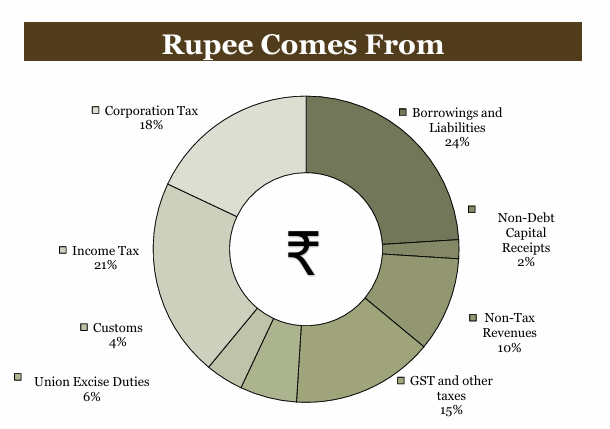
- Fiscal consolidation: The Budget projects a fiscal deficit target of 4.3 percent of GDP for FY27. Continuing the trajectory of gradual consolidation while prioritising capital formation and social welfare.
- Debt management: The central government is set to reduce its debt as a share of GDP, reflecting improved revenue buoyancy and controlled expenditure.
Capital expenditure: A central pillar of the Budget is the heightened public capital expenditure outlay. This aims to translate fiscal resources into long-term economic capacity.
Pillars of the Budget 2026-27
The Budget’s architecture revolves around a few key pillars that represent its long-term development strategy. Each pillar includes policy priorities, programs, and resource allocation frameworks designed to reinforce India’s growth trajectory.
1. Infrastructure and Connectivity: Growth Multipliers
- The Budget places a heavy emphasis on infrastructure investment as a growth engine, with public capital expenditure raised to ₹12.2 lakh crore for FY27. Which is reflecting an increase over previous years and underlining the government’s commitment to asset creation and regional integration.
- A significant announcement is the creation of seven high-speed rail corridors, linking major urban and economic centres. These are expected to not only reduce travel time but also catalyse regional economic clusters and urban expansion.
- New dedicated freight corridors, inland waterways, and logistics infrastructure are aimed at reducing logistics costs. It will also improve supply chain efficiency, and enhancing connectivity between industrial hinterlands and ports.
- The government unveiled the Infrastructure Risk Guarantee Fund to attract private capital into large, long-gestation infrastructure projects. It is by offering partial credit guarantees, thereby mitigating risk for private investors.
- Expansion of national waterways and port infrastructure is targeted to make freight movement greener and more efficient. It will be supporting the seamless movement of goods across the economy.
Taken together, these measures are structured to reduce supply-side constraints, bring down cost-push inflation, and generate employment across skill levels.
2. Manufacturing and Strategic Sectors
The Budget reflects a sustained push to nurture manufacturing ecosystems that are globally competitive and technologically advanced.
- The government introduced the India Semiconductor Mission 2.0 to strengthen the domestic semiconductor supply chain. Focusing on producing semiconductor equipment, materials, full-stack Indian IP, and enhancing research and design capabilities.
- The Electronics Components Manufacturing Scheme has had its outlay increased massively to ₹40,000 crore. Which indicates a long-term commitment to making India a key production hub in global electronics value chains.
- The government plans to establish dedicated Rare Earth Corridors in Kerala, Odisha, Andhra Pradesh, and Tamil Nadu. It is to develop mining, processing, and manufacturing of rare earth permanent magnets, critical for clean energy, EVs, and defence industries.
- A Biopharma SHAKTI mission, with an outlay of ₹10,000 crore over five years, aims to position India as a global biopharma manufacturing hub. This includes the establishment of accredited clinical trial sites, capacity expansion of the National Institute of Pharmaceutical Education and Research, and strengthening regulatory frameworks.
- The government announced high-precision tool rooms and Container Manufacturing Schemes. It is aimed at deepening industrial value chains and building self-reliant capabilities in capital and intermediate goods.
These strategic initiatives signal a shift from low-end assembly to value addition, technological depth, and export competitiveness.
3. MSMEs and Entrepreneurship
Micro, Small & Medium Enterprises (MSMEs) are recognised as vital engines of jobs and inclusive growth.
- The Budget reinforces an MSME-centric framework with a ₹10,000 crore SME Growth Fund and an additional top-up to the Self-Reliant India Fund. Targeting equity support for small enterprises that are scaling operations and integrating into global supply chains.
- The government addresses liquidity and working capital challenges for MSMEs through enhanced use of the Trade Receivables Discounting System (TReDS). It will be enabling smoother cash flow and improved financing accessibility.
- The government also announced support through Corporate Mitras, a network of professionals tasked with helping MSMEs. It will navigate regulatory compliance and financial reporting, reducing compliance costs for smaller firms.
This three-pronged strategy is expected to boost productivity, formalisation, and integration of MSMEs with larger market ecosystems.
4. Agriculture, Rural Growth and Supply Chain Resilience
Budget 2026-27 reflects a nuanced shift in agricultural strategy from price support models to producer income enhancement and market diversification.
- The government announced support for technology-enabled agricultural extension services. And diversification into high-value crops such as coconut, cashew, sandalwood, and specialty nuts. These measures are intended to improve farmers’ incomes and reduce volatility.
- Logistics and export support for agricultural products aim to strengthen linkages between farm production and global markets. Which is contributing to stronger rural incomes and resilience against demand shocks.
- Expansion of primary and rural road networks, cold storage, and agro-processing clusters underlines the government’s focus on reducing post-harvest losses and improving market access.
5. Fiscal Discipline, Tax Reform and Compliance
The Budget reiterates India’s commitment to fiscal prudence while introducing modern tax reforms intended to simplify, rationalise and reduce the compliance burden:
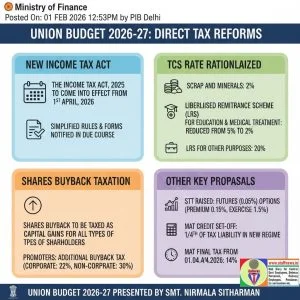
- A new Income Tax Act, 2025 is set to come into effect from April 2026, representing a major overhaul of tax laws with a focus on simplification, trust-based compliance, and reduced litigation.
- The Budget continued provisions for a higher rebate limit under the personal tax regime, effectively making incomes up to ₹12-12.75 lakh practically tax-free, sustaining efforts to increase disposable income for the middle class.
- Efforts to rationalise penalties, decriminalise minor defaults, and streamline assessment and penalty processes aim to reduce tax litigation and improve ease of doing business.
- Targeted tax incentives, such as tax holidays for cloud service providers operating through India-based data centres, are intended to attract long-term investment in digital infrastructure.
By balancing simplification with revenue sustainability, the Budget seeks to foster a predictable and efficient tax environment.
6. Human Capital: Education, Health and Skills
Human capital development is central to ensuring long-term productivity and inclusive growth.
- Investment in education and skilling initiatives, including expansions in higher education access and skill development programmes aligned with industry needs, is highlighted as foundational for employability and innovation.
- Health initiatives include strengthened regional healthcare infrastructure, improved trauma care facilities, and a focus on mental health outcomes, reflecting an integrated approach to physical and social well-being.
- Expansion of caregiving and hospitality skills, and industry-academia partnerships are expected to support sectors where India has comparative advantage and high employment multipliers.
The government portrays investment in people as a long-term strategy to boost participation in formal economic activities.
Budgetary Allocations: Sectoral Highlights
While the Budget supports broad macro ambitions, specific sectoral allocations and policy measures reflect targeted action:
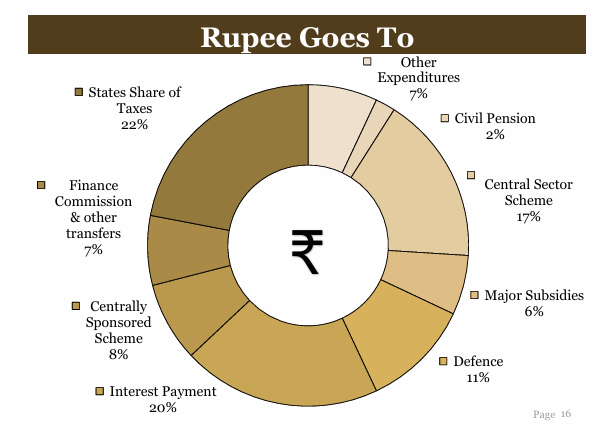
- Defence: Allocation significantly enhanced to approximately ₹7.85 lakh crore, with substantial capital outlays for modernisation, equipment acquisition, and strategic capability enhancement.
- Railways: Major capital infusion to expand corridors, high-speed rail connectivity, and freight logistics infrastructure.
- Urban and Rural Water: Greater emphasis on Jal Jeevan Mission continuity and enhanced water infrastructure is part of sustaining quality of life improvements.
- Social Welfare: Schemes for tribal development and support for families of former ULFA members reflect inclusive outreach in regional and social development agendas.
These allocations show a balance between strategic national priorities and targeted social upliftment.
Significance and Implications
- Growth and Jobs: With sustained capital expenditure, infrastructure spending, and industrial incentives, the budget aims to catalyse job creation and productivity improvements across sectors.
- Manufacturing and Self-Reliance: Strategic investments in semiconductors, rare earths, pharmaceuticals, and capital goods stake a claim on global value chains for intermediate and advanced manufacturing.
- Fiscal Discipline: Continued consolidation provides confidence to markets, lowers borrowing costs, and signals commitment to long-term fiscal sustainability.
- Human Capital and Inclusion: Education, skill development and healthcare investments underpin a vision of inclusive and human-centric growth.