
Universe and The Solar System

Content
- The Universe
- Composition of the Universe
- Galaxy
- The Solar System
- The Sun
- Other objects in the solar system
- Formation of Planets
- Earth and its Properties
- The Big Bang Theory
The universe is an immense expanse of open space that encompasses everything from the smallest particles to the most gigantic galaxies. The Solar System is a collection of planets located within the Milky Way galaxy, which itself is a component of the broader Universe. This planetary system is approximately 4.6 billion years old.
This article will clarify the concepts of the Universe and the Solar System, both of which are crucial for the Geography syllabus of the UPSC Exam.
The Universe
- All the existing matter, energy, and space, including stars, planets, galaxies, and every form of cosmic structure, together constitute what we call the Universe. The term “Universe” is derived from the Latin word “universum,” a term used by the ancient Romans to refer to the entire world and the cosmos as a unified whole.
- The Universe encompasses everything that exists, ranging from the largest formations like Galactic Mega Clusters to the tiniest subatomic particles invisible to the naked eye. It is the totality of space, time, matter, and energy, bound together by the laws of physics.
- According to scientific consensus, based on modern astronomical observations and cosmological studies, the age of the Universe is estimated to be approximately 13.79 billion years as of 2015. This estimation is primarily derived from measurements of the cosmic microwave background radiation and the rate of cosmic expansion.
- The Universe is composed of an enormous number of galaxies, each containing billions of stars and planetary systems. Studies using optical and radio telescopes suggest that the visible Universe alone contains nearly 100 billion galaxies, though the actual number could be far greater when accounting for regions beyond the observable limit.
- When it comes to understanding the origin of the Universe, the most widely accepted scientific explanation is the Big Bang Theory. This theory proposes that the Universe began as an extremely hot, dense point roughly 13.8 billion years ago, and has been expanding and cooling ever since, giving rise to the vast and complex cosmic structures we observe today.
Composition of the Universe
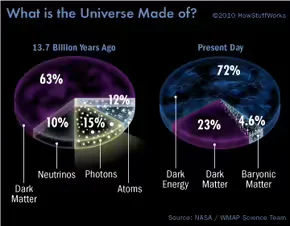
- Dark Energy (73%):Scientists describe dark energy as a mysterious form of energy that spreads uniformly throughout space and exhibits anti-gravitational properties.
- Dark Matter (23%): We can’t see matter since it doesn’t emit visible radiation, but it can be detected gravitationally.
- Hydrogen & Helium Gas (4%): Hydrogen and helium are the most abundant elements in the universe.
- Stars (0.5%): A brightly shining ball made largely of hydrogen and helium gas. Our Sun is a celestial body.
- Neutrino (0.3%): Scientists define a neutrino as a small particle with no charge and very little mass, produced when nuclear particles collide energetically.
- Heavy elements (0.03%): It includes planets, etc.
Galaxy
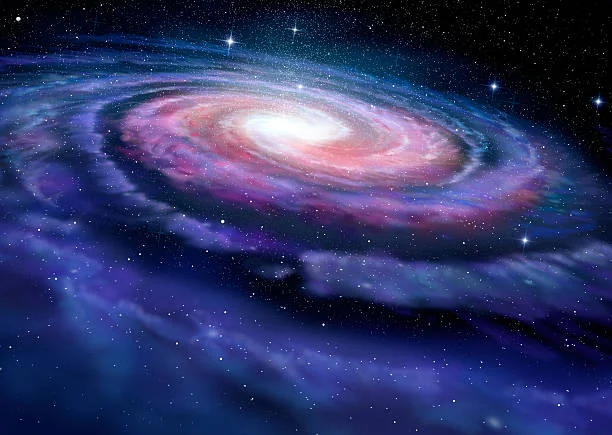
- Millions or billions of stars and planets, held together by gravity, make up a galaxy.
- One of these galaxies is our Milky Way. This galaxy contains the planet Earth.
- We call it the Milky Way because it resembles a river of milky light flowing across the sky.
- It takes the form of a spiral.
- Andromeda is the closest galaxy to our own.
- Andromeda is a spiral galaxy 2.5 million light-years away from Earth.
The Solar System
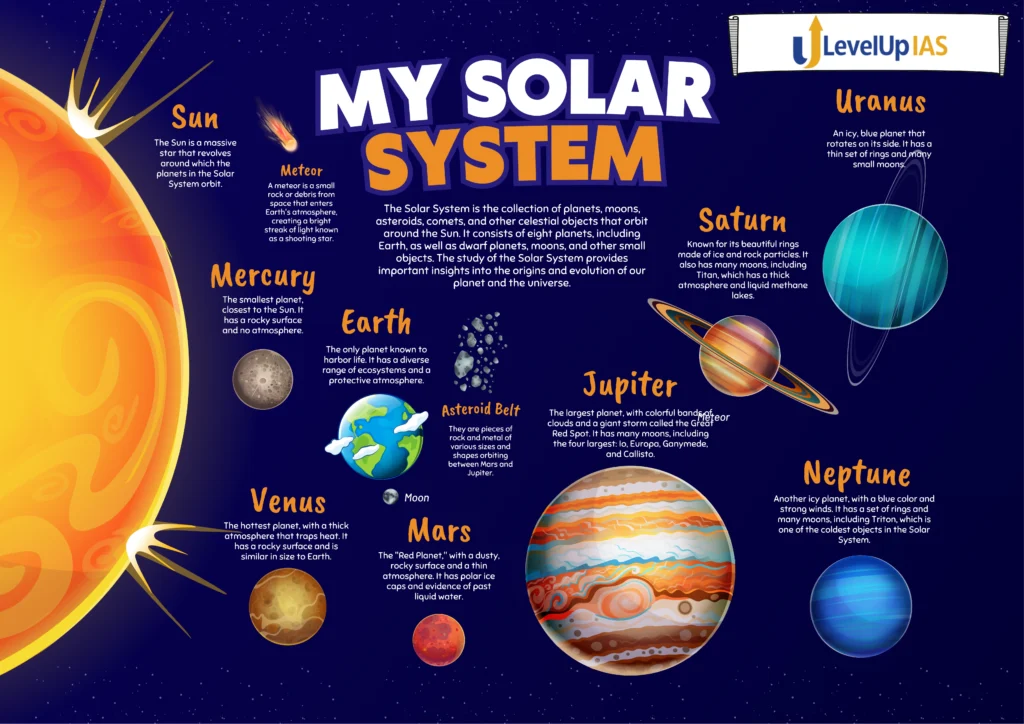
- The solar system is enormous, with a diameter of at least 100 Astronomical Units (15 trillion km). Several experts estimate that our Solar System is over 4.6 billion years old.
- The enormous gravitational force of the sun holds it together, keeping planets and asteroids in orbit around it. The earth is the densest of all the planets in our solar system.
- The nine known planets and their moons, as well as smaller objects orbiting the sun known as comets, asteroids, and meteoroids, make up the solar system’s largest and most important components.
Formation of Solar System
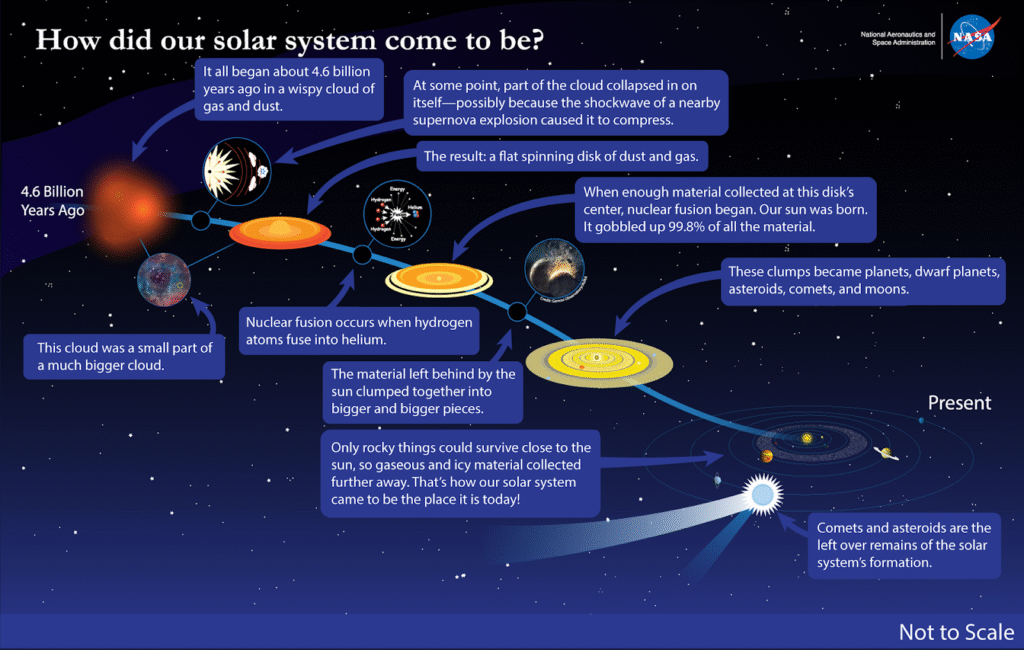
- Supernova Explosion: Scientists believe a disturbance, possibly the explosion of a nearby star called a supernova—triggered a cloud of gas and dust in space to form the Solar System.
- This explosion sent shockwaves into space, compressing the gas and dust cloud.
- Formation of Nebula: Gravity drew the gas and dust together, forming a solar nebula, as the cloud began to collapse.
- Nuclear Fusion: At the dense center of this nebula, the sun’s nuclear flames erupted. In the churning currents of the vast cloud, the planets were created.
- Clumps of material to Planets: Mercury, Venus, Earth, and Mars all began as rock globes orbiting the Sun. It was impossible to capture them since they were too small and had weak gravitational fields.
- The enormous planets Jupiter and Saturn, which are far from the sun and have powerful gravitational fields, did, nevertheless, draw and hold thick gaseous atmospheres of Hydrogen and Helium.
The Sun
- Our solar system’s largest object is the sun. It is roughly 109 times the size of Earth.
- The Sun has a diameter of 1,392,000 kilometres. It comprises 99.8% of the mass of the solar system.
- The sun is a star with a surface temperature of 60000 degrees Celsius. It is largely made up of hydrogen gas, with a minor quantity of helium thrown in for good measure.
- The Sun is the solar system’s closest star. It belongs to the Milky Way galaxy. It’s thought to be more than 4 billion years old.
- The Sun is a yellow dwarf, a medium-sized star. As it rotates around the galaxy, the Sun spins gently on its axis.
- The Earth would be a dead sphere of rock and ice if it were not for the Sun. The Sun warms our globe, influences our weather, and provides energy to plants, which provides food and energy for life on Earth.
- The Sun’s energy reaches the Earth and other planets in all directions. The planet absorbs less energy as it gets further away from the Sun.
Other Objects in the Solar System
Asteroids
- Asteroids: Asteroids are rocky and metallic objects that orbit the Sun but aren’t large enough to be termed planets. Minor planets are what they’re called.
- The majority of the asteroids in our solar system orbit the Sun between Mars and Jupiter’s orbits. The “asteroid belt” is a term used to describe this region.
- A few asteroids are getting closer to the Sun.
- Asteroid belt: The asteroid belt is a doughnut-shaped cluster of asteroids orbiting the Sun between Mars and Jupiter’s orbits, closer to Mars’ orbit.
Meteors, Meteoroids and Meteorites
- Meteoroids: Aside from asteroids, the Sun is also orbited by smaller rocks and dust particles. These particles of rock or dust make their way into the atmosphere.
- Meteors: Meteoroids come into contact with a lot of friction as they pass through the atmosphere, which causes them to heat up and burn out.
- Almost all the material is vaporized in Earth’s atmosphere, leaving a bright trail fondly called “shooting stars.”
- Meteorites: Some are so massive that a piece of it falls to Earth as a meteorite. It is a piece of debris that collides with the Earth. When it collides with the ground, it can create a hole or crater.
- The hole gets bigger as the meteorite gets bigger. Scientists believe that Lonar Lake in Maharashtra formed due to one such impact.
Satellites
- Satellites: Satellites are celestial objects that orbit planets and are part of the solar system. The Moon is the Earth’s satellite. Some satellites, like Ganymede (which orbits Jupiter), are larger than Mercury and have atmospheres.
- Artificial satellites: Artificial satellites, which are man made, are also an important part of the solar system.
- These satellites orbit the Earth far closer than the moon, which is the Earth’s natural satellite.
- Aryabhata is India’s first artificial satellite.
- India has launched a number of other satellites, including INSAT, IRS, and EDUSAT.
Comets
- Comets: Comets are small icy objects with irregular shapes. They usually come from the Kuiper Belt, which is located beyond Neptune in the solar system’s far reaches.
- When these objects approach the sun, the ice evaporates, leaving behind a lovely tail.
- Some of these comets return on a regular basis, such as Halley’s Comet, which returns every 76 years.
- The Halley’s Comet will be next seen in 2061.
Constellation
- A constellation is a group of stars in the night sky that form an imagined shape.
- It aids in the navigation of maritime vessels at night because they are visible in a fixed direction at a specific time of year.
- Constellations such as Orion, Big Dipper, Great Bear, and Cassiopeia are examples.
Formation of Planets
- At least 4.6 billion years ago, gravity caused discs of dust and gas orbiting the Sun to collapse and clump together, forming the planets.
- This disc, known as the solar nebula, was primarily made up of hydrogen and helium, with minor amounts of other elements.
- We divide planets into two categories: terrestrial and extra-terrestrial.
- Mercury, Venus, Earth, and Mars are rocky planets that are largely formed of solid rock and metal.
- Jupiter, Saturn, Uranus, and Neptune are gas giants that are largely made up of gases like hydrogen, helium, and methane.
- In comparison to rocky planets, these gas giants are enormous.
Earth and its Properties
- About 4.5 billion years ago, a solidified cloud of dust and gases left over from the Sun’s formation coalesced to form Earth, like the other planets.
- Almost every discipline of natural science has contributed to improving our knowledge of the major events in Earth’s history, which ongoing geological changes and biological developments have marked.
- The study of the record of the earth’s magnetic field using magnetic fields preserved in rocks, silt, or archaeological materials is known as Palaeomagnetism.
- Geomagnetism, also known as the geomagnetic field, is the study of all aspects of the Earth’s magnetic field which surrounds our planet in the magnetosphere.
- Earth has numerous characteristics that distinguish it from other planets and planetary bodies in the solar system and the Milky Way galaxy.
- Along with Venus, Mercury, and Mars, it is one of four rocky planets and the fifth largest planet after Neptune, Uranus, Saturn, and Jupiter.
- With a density of 5.52 grams per cubic inch, Earth is the densest large body in the solar system.
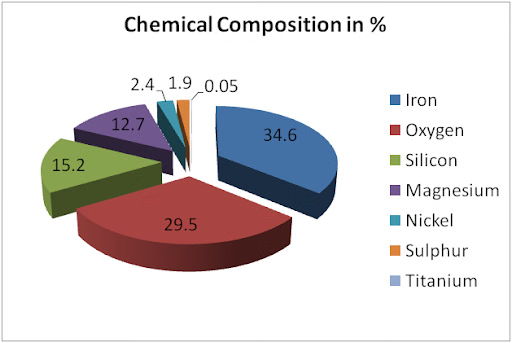
- 34.6 percent iron, 29.5 percent oxygen, 15.2 percent silicon, 12.7 percent magnesium, 2.4 percent nickel, 1.9 percent sulfur, and 0.05 percent titanium make up this alloy.
- The availability of water and oxygen are two distinguishing characteristics of the Earth.
- Water comprises around 71% of the Earth’s surface, with the majority of that water being in the oceans.
- Plants create oxygen, which makes up around a fifth of Earth’s atmosphere.
- The temperature, pressure, and density of the Earth’s interior gradually rise with depth.
- A specific Earth material may act as a brittle solid, distort like plastic, or melt and become liquid depending on the temperature and depth.
Big Bang Theory – Origin of Universe
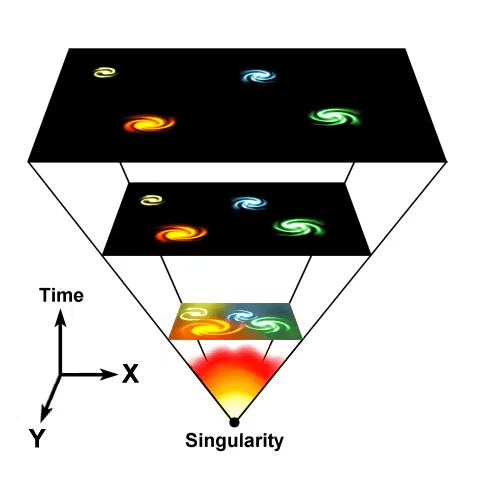
The Big Bang Theory is the prevailing cosmological model for the universe’s birth. It states that 13.8 billion years ago, all of space was contained in a single point of very high-density and high-temperature state from which the universe has been expanding in all directions ever since.
1. Understanding the Concept
Astronomer Fred Hoyle first used the term ‘Big Bang’ in 1949, although he intended it as a criticism.
The theory suggests that the Universe started from one concentrated mass which exploded and began expanding. Interestingly, this expansion is still happening, galaxies continue to move away from each other, as confirmed by Hubble’s observations.
2. Stages in the Evolution of the Universe
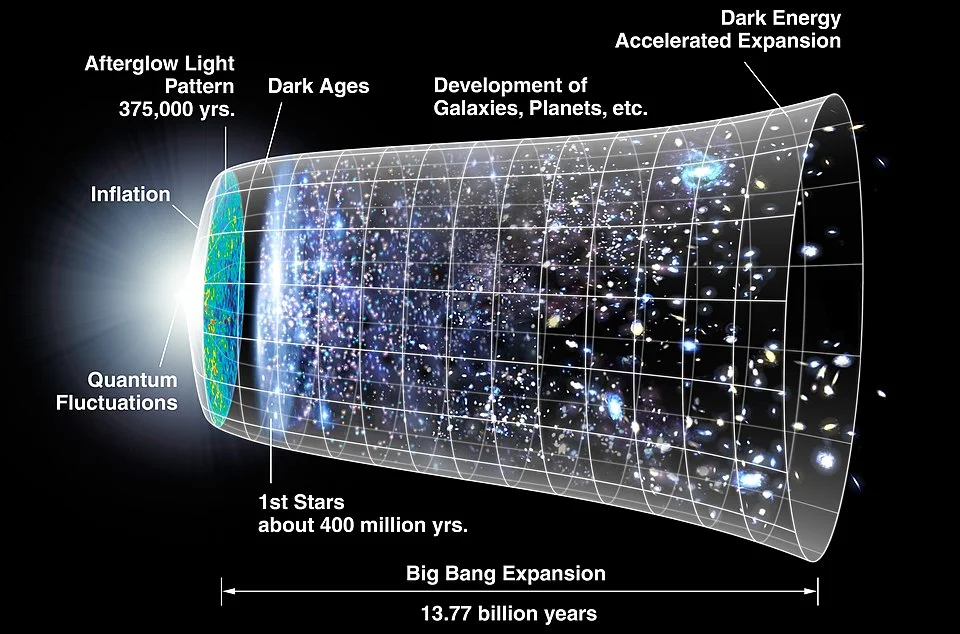
- Singularity: The beginning point, where matter and energy were compressed into an infinitely dense form.
- Rapid Inflation: Within a fraction of a second, the Universe expanded faster than the speed of light.
- Formation of Particles: As it cooled, tiny particles like protons and neutrons began to form.
- Creation of Atoms: After nearly 3,80,000 years, atoms like hydrogen and helium formed, allowing light to travel freely.
- Formation of Galaxies: Gradually, these gases combined under gravity to form stars and galaxies, shaping the Universe as we know it.
3. Evidence Supporting the Big Bang
- Hubble’s Law: Galaxies are moving away, proving that the Universe is expanding.
- Cosmic Microwave Background Radiation (CMB): Penzias and Wilson discovered this faint radiation, which represents the leftover heat from the Big Bang.
- Composition of Light Elements: The observed abundance of hydrogen and helium perfectly matches the predictions of the Big Bang model.
4. Major Contributors
- Edwin Hubble – Observed redshift and expansion of the Universe.
- George Gamow – Theoretically explained formation of elements after the Big Bang.
- Arno Penzias and Robert Wilson – Detected CMB radiation, providing strong proof for the theory.
5. Limitations of the Big Bang Theory
- Origin Unexplained:
The Big Bang Theory describes how the Universe expanded but fails to explain what triggered the explosion or what existed before it. The true origin of the Universe remains unknown. - Singularity Problem:
Modern physics cannot fully explain the concept of an infinitely dense and hot singularity. Under such extreme conditions, the laws of relativity and quantum mechanics fail to hold. - Horizon Problem:
The Universe has a uniform temperature everywhere, even though distant regions could never have interacted. The Big Bang alone cannot justify this uniformity. - Flatness Problem:
The observed geometry of the Universe is almost perfectly flat. Such precise balance seems improbable without fine-tuning, which the Big Bang model doesn’t clarify. - Dark Matter and Dark Energy:
The theory doesn’t explain the existence or behavior of dark matter and dark energy, which together form about 95% of the Universe’s composition. - Lack of Direct Evidence:
While the cosmic microwave background (CMB) and galactic redshift support the expansion of the Universe, scientists still lack direct observational evidence of the exact initial moment of the Big Bang.
FAQs
1. What is the Universe according to the UPSC syllabus?
The Universe refers to the vast expanse that includes all matter, energy, planets, stars, galaxies, and the physical laws governing them—an important foundation for Geography and Science & Tech topics
2. How did the Universe originate?
The most accepted scientific explanation is the Big Bang Theory, which states that the Universe began about 13.8 billion years ago from a single, extremely dense point and has been expanding ever since.
3. What is the Solar System and what are its major components?
The Solar System consists of the Sun, eight planets, dwarf planets, moons, asteroids, comets, meteoroids, and interplanetary dust—all revolving around the Sun due to gravitational force.
4. Which topics related to the Solar System are important for UPSC Prelims?
Planet characteristics, order of planets, rotation–revolution differences, asteroid belts, comets, dwarf planets, and recent space missions are highly important.
5. What is the difference between a galaxy and the Solar System?
A galaxy is a massive collection of stars, planets, gas, and dust bound by gravity. The Solar System is just a tiny part of the Milky Way Galaxy, containing the Sun and its orbiting bodies.
Click on the question to see the answer

