
Mains Articles
Understanding UPSC GS Syllabus: A Step-by-Step Guide for Beginners
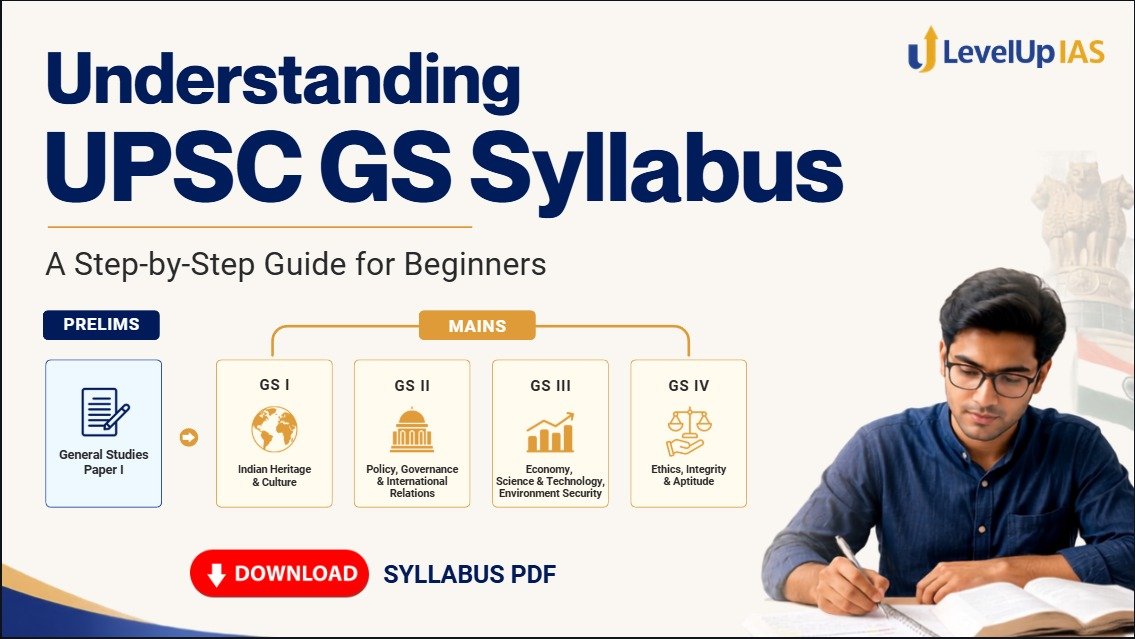
For every UPSC beginner, the first big question is simple: “Where should I start?” The answer is also simple: start with the UPSC GS syllabus. The UPSC GS syllabus acts like a roadmap. Without understanding the syllabus, aspirants often study too much, revise too little, and fail to connect topics with the actual exam demand.
The UPSC Civil Services Examination is not only about hard work. It is about direction, clarity, and smart preparation. Before buying books, joining classes, making notes, or watching lectures, an aspirant must understand what UPSC actually demands through its General Studies papers.
In this blog, we will understand the UPSC GS syllabus step by step, especially for beginners who are starting their UPSC CSE preparation from scratch.
What is the UPSC GS Syllabus?
The UPSC GS syllabus refers to the General Studies portion of the Civil Services Examination, which the UPSC provides in its Notification every year. General Studies is asked in both Prelims and Mains as prescribed in the notification. It covers a wide range of subjects including History, Geography, Polity, Economy, Environment, Science & Technology, Ethics, Society, Governance, Internal Security, International Relations, and Current Events of National and International Importance.
For beginners, the syllabus may look overwhelming at first. But once you divide it paper wise and topic-wise, it becomes much easier to understand.
The GS syllabus is important because it helps you decide:
What to study
What to avoid
How to connect static subjects with current affairs
How to prepare for both Prelims and Mains together
How to revise in a structured manner
This is why every serious UPSC aspirant should begin their preparation by reading the syllabus multiple times.
Click here to download the syllabus.

Step 1: Understand UPSC Prelims GS – I
In UPSC Prelims, General Studies Paper I is the main paper that decides whether you qualify for Mains. It is an Objective exam which has 100 Questions.
The UPSC General Studies topics for Prelims include:
Indian History and National Movement
Indian and World Geography
Indian Polity and Governance
Economic and Social Development
Environment, Ecology, Biodiversity and Climate Change
General Science
Current Events of National and International Importance
For Prelims, the syllabus is broad and often vague, which makes the paper highly unpredictable. UPSC can frame questions from almost anywhere within the larger theme of the syllabus. That is why Prelims preparation is not just about memorising facts, but also about building conceptual clarity, understanding core themes, applying elimination techniques, and choosing the most accurate option under pressure.
A beginner should not treat Prelims as a separate exam. Many topics overlap with the Mains, so preparation should be integrated from the beginning.
Step 2: Understand GS in UPSC Mains
For UPSC Mains, the syllabus is more detailed, structured, and clearly defined compared to Prelims. This makes the nature of questions relatively more predictable, as UPSC usually frames questions around the broader themes mentioned in the syllabus.
Here, the focus is not just on knowing facts but on presenting a well-structured answer with conceptual clarity, multidimensional analysis, examples, current affairs linkage, and balanced conclusions. Since the demand for the paper is clearer, a student can prepare topic-wise, practise answer writing, and improve with regular evaluation.
General Studies is divided into four papers: GS Paper I, GS Paper II, GS Paper III, and GS Paper IV. Each paper tests a different dimension of your understanding.
Unlike Prelims, Mains is descriptive. Here, UPSC checks your ability to analyse, connect, present, and write balanced answers.
GS Paper I: History, Society and Geography
GS Paper I includes Indian Heritage and Culture, Modern Indian History, World History, Indian Society, and Geography.
Important areas include:
Indian Art and Culture
Modern Indian History
Freedom Struggle
Post-Independence Consolidation
World History
Indian Society
Role of Women
Globalisation
Communalism, Regionalism and Secularism
Physical Geography
Indian and World Geography
For beginners, GS Paper I should be studied through stories, timelines, maps, and examples. History becomes easier when you connect events with causes and consequences. Geography becomes easier when you use maps and diagrams regularly.
GS Paper II: Polity, Governance and International Relations
GS Paper II includes Constitution, Polity, Governance, Social Justice, and International Relations.
Important topics include:
Indian Constitution
Parliament and State Legislatures
Executive and Judiciary
Federalism
Constitutional and Statutory Bodies
Government Policies
Welfare Schemes
Health, Education and Human Resources
NGOs, SHGs and Civil Society
India and its Neighbourhood
Bilateral and Global Groupings
International Organizations and Institutions
This paper is highly dynamic in nature, as current affairs have a significant role in this paper. A good understanding of the Constitution must be supported by current examples. For example, if you study federalism, you should also connect it with recent Centre-State issues. If you study welfare schemes, you should connect them with implementation challenges.
GS Paper III: Economy, Environment, Science, Security and Disaster Management
GS Paper III is one of the most current affairs oriented papers. It includes Economy, Agriculture, Science and Technology, Environment, Disaster Management, Internal Security, and related issues, and most of these topics are recurring in newspaper everyday.
Important topics include:
Indian Economy
Inclusive Growth
Budgeting
Agriculture
Food Processing
Land Reforms
Infrastructure
Science and Technology
IT, Space, Robotics, Biotechnology
Environment and Conservation
Disaster Management
Internal Security
Cyber Security
Border Management
For beginners, this paper can feel technical. The best approach is to first understand basic concepts and then connect them with current affairs. For example, while studying inflation, link it with RBI policy, food prices, global crude oil prices, and government measures.
GS Paper IV: Ethics, Integrity and Aptitude
GS Paper IV is different from other GS papers. It checks your values, decision-making, emotional intelligence, and administrative attitude.
Important topics include:
Ethics and Human Interface
Attitude
Aptitude and Foundational Values
Emotional Intelligence
Contributions of Moral Thinkers
Public Service Values
Probity in Governance
Case Studies
For beginners, Ethics should not be left for the last stage. It requires examples, real-life understanding, and answer-writing practice. You need to develop your own value-based thinking. Case studies are an important part of this paper, so regular practice is necessary.
Step 3: Connect Static Syllabus with Current Affairs

UPSC Current Affairs Program
One of the biggest mistakes beginners make is studying static subjects and current affairs separately. UPSC does not ask isolated questions. It asks connected questions.
For example:
Polity connects with current bills, judgments, and governance issues.
The economy connects with budget, inflation, employment, and growth.
Environment connects with climate change, biodiversity, and international agreements.
International Relations connects with global conflicts, treaties, and India’s foreign policy.
So, while reading newspapers or current affairs magazines, always ask: “Which part of the UPSC GS syllabus does this topic belong to?”
This habit will make your preparation more exam-oriented.
Step 4: Use PYQs to Understand UPSC Demand
Previous Year Questions are the best guide for understanding the real nature of the exam. Reading the syllabus alone is not enough. You must also see how UPSC frames questions from each topic.
UPSC previous year question papers
For example, after reading a topic like federalism, check previous Mains questions on Centre-State relations. After studying the environment, check Prelims questions on biodiversity, climate change, and protected areas.
PYQs help you understand:
Important areas
Question trends
Depth of study in a topic required
Repeated themes
Prelims-Mains linkage
A smart aspirant uses PYQs from the beginning, not just before the exam.
Step 5: Understand the GS Foundation Syllabus
A good GS Foundation syllabus should cover both Prelims and Mains in an integrated manner. It should not only complete subjects but also build conceptual clarity, current affairs linkage, answer-writing skills, revision planning, and test practice.
An ideal GS Foundation syllabus should include:
Complete coverage of History, Geography, Polity, Economy, Environment, Science and Technology, Ethics, Society, Governance and International Relations
Regular current affairs integration
Prelims MCQ practice
Mains answer-writing practice
PYQ discussion
Revision modules
Mentorship and doubt support
Beginners should choose a foundation plan that does not just teach topics but also teaches how to study, revise, and apply those topics in the exam.
Make a Beginner Friendly Study Plan
Understanding the UPSC GS syllabus is only the first step. The next step is execution.
A beginner can follow this simple approach:
First, read the complete syllabus once.
Download from this link
Second, divide it into subjects.
Third, start with basic books and classes.
Fourth, connect each topic with PYQs.
Fifth, revise regularly.
Sixth, practise MCQs and answer writing.
Seventh, keep current affairs linked with static subjects.
Do not try to master everything in one reading. UPSC preparation is a layered process. Every revision improves understanding.
Conclusion
The UPSC GS syllabus is not just a document. It is the foundation of your entire UPSC journey. For beginners, it provides direction, clarity, and confidence. Once you understand the syllabus properly, you stop studying randomly and start preparing strategically.
Whether it is Prelims or Mains, static subjects or current affairs, answer writing or revision, everything begins with the syllabus. A serious aspirant should keep the syllabus on the study table, revise it regularly, and use it as a filter for every book, lecture, note, and current affairs topic.
If you are starting your UPSC CSE preparation, do not rush blindly. First, understand the UPSC General Studies topics, decode the GS Foundation syllabus, analyse PYQs, and then build your preparation step by step.
The journey is long, but with the right understanding of the syllabus, your preparation becomes focused, disciplined, and result-oriented.
FAQs on the UPSC GS Syllabus
1. What is included in the UPSC GS syllabus?
Ans. The UPSC GS syllabus includes subjects like History, Geography, Polity, Economy, Environment, Science and Technology, Ethics, Society, Governance, International Relations, and Current Affairs. These topics are asked in both the Prelims and Mains stages of the UPSC Civil Services Examination.
2. How should beginners start preparing the UPSC GS syllabus?
Ans. Beginners should first read the complete UPSC GS syllabus carefully, then divide it subject-wise. Start with Basic NCERTs and standard books, connect each topic with previous year questions, and revise regularly. A structured GS Foundation syllabus can help beginners prepare for the Prelims and Mains in an integrated manner.
3. Are UPSC General Studies topics the same for Prelims and Mains?
Ans. Many UPSC General Studies topics overlap in Prelims and Mains, but the approach is different. Prelims requires objective understanding and MCQ practice, while Mains requires analytical thinking, answer writing, examples, and structured presentation.
4. Why is the UPSC GS syllabus important for UPSC CSE preparation?
Ans. The UPSC GS syllabus acts as a roadmap for UPSC CSE preparation. It helps aspirants understand what to study, what to avoid, how to connect current affairs with static subjects, and how to prepare in an exam-oriented manner.
5. How much time does it take to complete the GS Foundation syllabus?
Ans. On average, it may take 10 to 12 months to complete the GS Foundation syllabus properly, including classes, self-study, revision, Prelims MCQ practice, Mains answer writing, and current affairs integration. However, the timeline depends on the aspirant’s consistency and study plan.
Related reads.
How to Read NCERTs for UPSC: Subject-Wise Strategy & Notes Making
22 Jun 2026 10 min
PSIR Topper's Answer Copies
22 Jun 2026 1 min
Sociology Optional PYQs (2009-2024)
22 Jun 2026 1 min
Philosophy Optional PYQs
22 Jun 2026 1 min
PSIR Optional PYQs
22 Jun 2026 1 min
History Optional PYQs (2009-2025) – Free PDF & Video
22 Jun 2026 1 min
Put it into practice
Reading is step one.
Turn what you've just read into exam-ready answers with mentor-led practice and our structured test series.