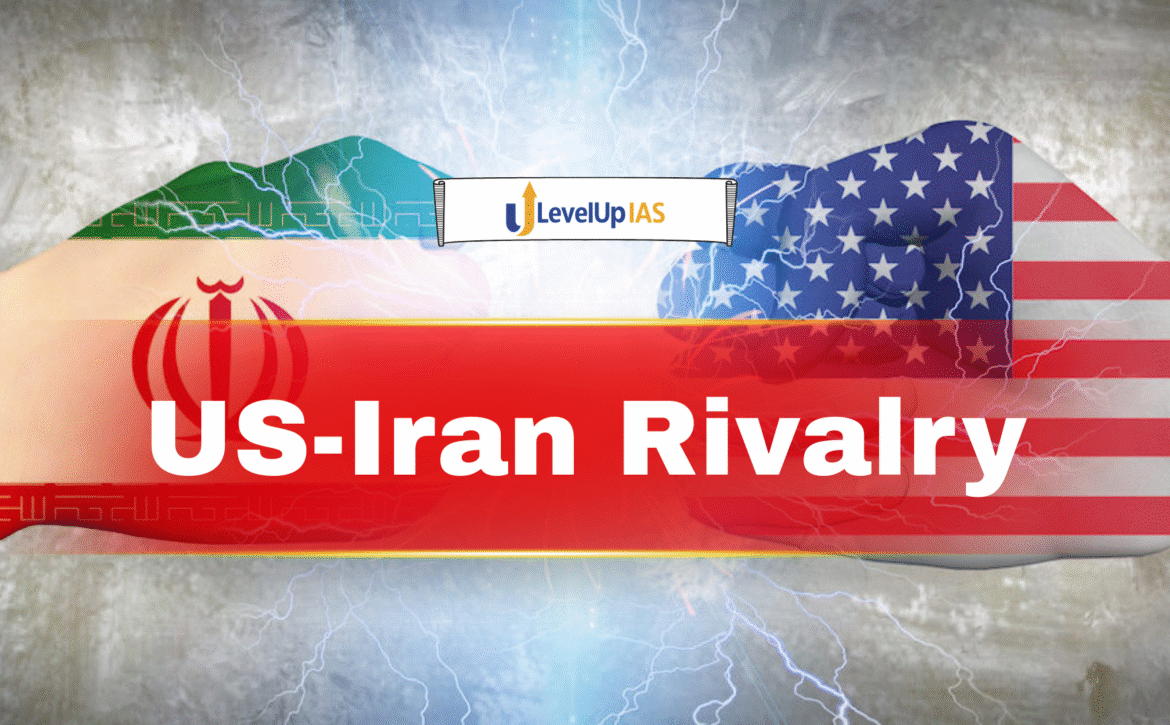
US-Iran Rivalry
Content
- Latest News
- Background
- Key Areas of Rivalry
- Recent Developments
- Impact of the Rivalry
- India’s Engagement with Iran
- India’s Strategic Dilemma
- Way Forward
Latest News
Relations between the United States and Iran continue to remain tense due to Iran’s expanding nuclear activities, persistent US sanctions, and rising geopolitical tensions in West Asia. Recent developments such as Iran’s growing alignment with China and Russia, its role in regional conflicts, and concerns over the security of energy routes have brought the US-Iran rivalry back into focus.
The situation has direct implications for regional stability, global energy markets, and India’s strategic interests, especially regarding Chabahar Port and energy security.
Background of US-Iran Relations
- The roots of hostility can be traced back to the 1953 coup in Iran, when the US and the UK supported the removal of Prime Minister Mohammad Mosaddegh after he attempted to nationalise Iran’s oil industry. This intervention created long-term resentment within Iranian society and weakened democratic institutions.
- Following the coup, the US backed the Shah of Iran, whose authoritarian rule and close alignment with Western powers further alienated large sections of the Iranian population.
- The 1979 Islamic Revolution led by Ayatollah Khomeini ended the monarchy and established a theocratic republic, resulting in the complete breakdown of diplomatic relations with the United States.
- Since then, US-Iran relations have been marked by mutual distrust, ideological differences, and the frequent use of economic and political pressure tools.
Key Areas of Rivalry
Nuclear Programme
- Iran’s nuclear programme remains the most sensitive issue in its relationship with the US. While Iran maintains that its nuclear activities are meant for peaceful energy generation and medical purposes, the US and its allies suspect that the programme could eventually lead to the development of nuclear weapons.
- The Joint Comprehensive Plan of Action (JCPOA) signed in 2015 temporarily eased tensions by placing limits on Iran’s uranium enrichment in exchange for sanctions relief.
- However, the US withdrawal from the agreement in 2018 weakened the deal and led Iran to gradually expand its nuclear activities. By 2025-26, concerns have grown about the reduced transparency of Iran’s nuclear programme and the limited access of international inspectors.
Regional Influence
- Iran has expanded its influence across West Asia by supporting armed groups in countries such as Lebanon, Gaza, Iraq, Syria, and Yemen. These groups are often opposed to US and Israeli interests in the region.
- The United States views Iran’s regional activities as destabilising, while Iran argues that it is protecting its security and resisting foreign interference.
- The ongoing Gaza conflict and tensions in the Red Sea region have further intensified the rivalry, as Iran is seen as indirectly supporting forces that challenge US and Israeli positions.
Sanctions and Economic Pressure
- The US continues to impose strict sanctions on Iran’s banking, energy, and defence sectors. These measures have significantly reduced Iran’s oil exports and access to international financial systems.
- As a result, Iran’s economy has faced high inflation, currency depreciation, and slow growth.
- Despite these challenges, Iran has managed to adapt by strengthening trade relations with countries that are less influenced by Western sanctions, particularly China and Russia.
Recent Developments Strengthening Iran’s Position
- Iran’s diplomatic rapprochement with Saudi Arabia, brokered by China, has reduced regional isolation and signalled a shift towards greater dialogue in West Asia.
- Membership in organisations such as BRICS and the Shanghai Cooperation Organisation has provided Iran with new platforms for political and economic engagement beyond the Western-dominated system.
- Iran has also deepened its strategic cooperation with Russia and China in areas such as energy, defence, and infrastructure, helping it withstand the impact of US-led sanctions.
- With some of the world’s largest reserves of oil and natural gas, Iran continues to play a significant role in global energy security, particularly during periods of geopolitical uncertainty.
Impact of the Rivalry
- The persistent hostility between the US and Iran contributes to instability across West Asia, affecting countries like Syria, Iraq, Yemen, and Gaza.
- Any military escalation involving Iran poses risks to key maritime routes such as the Strait of Hormuz, through which a large share of the world’s oil supply passes.
- Iran’s nuclear progress also raises concerns about nuclear proliferation in the region, which could trigger a wider arms race.
India’s Engagement with Iran
- India considers Iran strategically important due to its location, energy resources, and role in connecting South Asia with Central Asia and Afghanistan.
- The development of Chabahar Port remains a key pillar of India-Iran cooperation, as it offers an alternative trade route that bypasses Pakistan.
- India and Iran also maintain engagement through multilateral platforms such as BRICS and the Shanghai Cooperation Organisation, which allow continued diplomatic dialogue despite US sanctions.
India’s Strategic Dilemma
- The United States has consistently discouraged countries, including India, from importing Iranian oil or expanding economic ties with Tehran.
- As a result, India has significantly reduced its oil imports from Iran, affecting its energy diversification strategy.
- At the same time, India seeks to preserve its long-term strategic interests in Iran, especially connectivity projects like Chabahar, without damaging its growing partnership with the US.
Way Forward
- For the US and Iran, renewed diplomatic engagement on the nuclear issue and regional security could help prevent further escalation and reduce uncertainty in West Asia.
- For India, the focus should be on maintaining balanced diplomacy by seeking limited sanctions exemptions for strategic projects, expanding cooperation in non-sensitive areas, and continuing dialogue with both Washington and Tehran.
The US-Iran rivalry remains a central feature of West Asian geopolitics. While sanctions and strategic competition continue to shape relations, Iran’s growing ties with non-Western powers and regional diplomatic efforts are altering the balance of influence. For India, careful and pragmatic diplomacy will be essential to protect national interests while navigating an increasingly complex international environment.