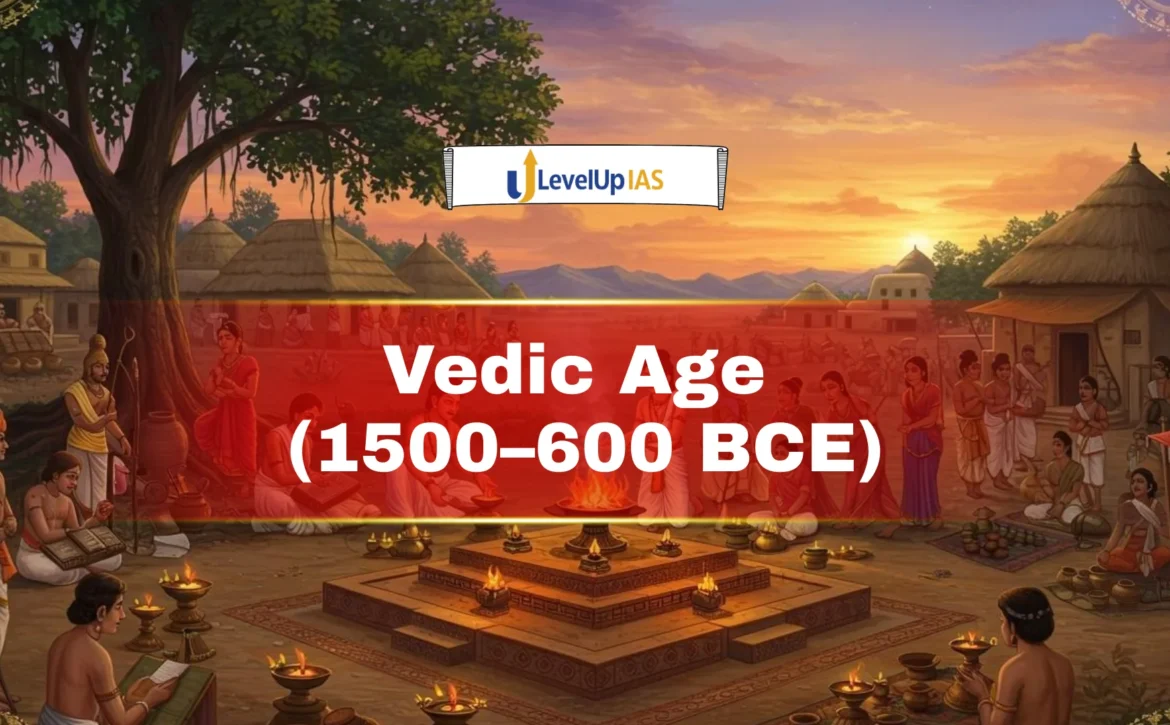
Vedic Age (1500–600 BCE)
Content
- Introduction
- Meaning and Nature of the Vedas
- The Four Vedas
- Who were the Vedic Aryans?
- Geographical Boundaries of Vedic Aryans
- Vedic Period (1500-600 BC)
- Political Life of the Vedic Period
- Social Life of the Vedic Period
- Religious Life of the Vedic Period
- FAQs
Introduction
The Vedic Civilization, also known as the Vedic Culture or Vedic Period, marked the formative phase of Indian society. It extended roughly from 1500 BCE to 600 BCE. The composition of the Vedas, which serve as the foundational scriptures of Hinduism, characterizes this period. This period laid the intellectual, spiritual, and socio-political basis for later Indian civilization.
The Vedas encapsulate the wisdom, science, tradition, and philosophy of early Indian thought. They represent an oral tradition that transmitted cosmic and spiritual knowledge through generations. And they are considered both scriptural texts and cultural repositories of ancient India.
Meaning and Nature of the Vedas
- The Sanskrit root ‘Vid’, meaning ‘to know’, gives rise to the word ‘Veda’, which refers to sacred knowledge or divine wisdom.
- The Vedas are the oldest literary works in Indo-European languages and are regarded as the earliest source of Hindu philosophy, ritual, and spirituality.
- Traditionally, there are four Vedas, collectively known as the ‘Samhitas’, since they represent the compiled oral recitations of the time.
The Four Vedas
| Veda | Key Features |
| Rigveda | – Oldest of all Vedas, divided into ten books (mandalas). – Contains hymns to various deities and includes the Gayatri Mantra and Purusha Sukta. – Priest: Hotri, responsible for recitation of hymns. |
| Yajurveda | – A manual for Adhvaryu priests performing sacrificial rituals. – Written mainly in prose. – Divided into Shukla (White) and Krishna (Black) Yajurveda. |
| Samaveda | – Shortest of all four Vedas. – Consists mostly of Rigvedic verses arranged for chanting. – Priest: Udgatri, responsible for singing hymns. |
| Atharvaveda | – Latest among the four. – Contains magical spells, charms, and rituals for healing and protection. – Includes several hymns similar to those in the Rigveda. |
Structure of Each Veda
| Part | Description |
| Samhitas | – Oldest section containing mantras, hymns, and prayers addressed to deities. |
| Brahmanas | – Prose texts explaining rituals, ceremonies, and sacrifices with details of their significance. |
| Aranyakas | – “Forest texts” meant for hermits; interpret rituals symbolically and philosophically. |
| Upanishads | – Philosophical speculations discussing Atman (self) and Brahman (universal soul). – About 108 Upanishads, of which 13 are most important. |
Who were the Vedic Aryans?
The Vedic Aryans were the creators of the Vedic hymns. Scholars in the nineteenth century perceived the Aryans as a distinct race. Initially, the Aryans appear to have originated from the Steppes that extend from southern Russia to Central Asia.
A faction of them migrated from this region to northwest India, where they became known as Indo-Aryans or simply Aryans. Historians regard the Aryans as a linguistic collective speaking languages that belong to the Indo-European family. Traditional historians and archaeologists differentiate them from the Harappans, who were non-Aryan and preceded this era.
Migration of Aryans
Archaeologists have made efforts to connect several post-Harappan cultures with the Aryans. Scholars frequently associate the Painted Grey Ware with Aryan artisanship.
- Archaeologists derive proof of migrations from the Andronovo Culture, located in southern Siberia, which thrived in the second millennium BC.
- From this region, people traveled north of the Hindukush mountains and subsequently entered India.
- Development of Aryan Language: The new arrivals came in various waves, and a significant outcome of this interaction was that the Vedic version of the Aryan language became dominant throughout Northwestern India. The texts crafted in this language are commonly referred to as the Vedic Texts.
Geographical Boundaries of Vedic Aryans
The early Vedic Aryans inhabited the region known as sapta-sindhu, which translates to the land of seven rivers. This area corresponds to the entirety of Punjab along with adjacent Haryana, but the geography of the Rigveda also encompassed the Gomal plains, southern Afghanistan, and southern Jammu and Kashmir.
- The seven rivers included:
- Sindhu,
- Vitasta (Jhelum),
- Asikni (Chenab),
- Parushni (Ravi),
- Vipash (Beas),
- Shutudri (Sutlej),
- Sarasvati.
In the Later Vedic period, they progressively migrated eastward and began to settle in eastern U.P. (Kosala) and northern Bihar (Videha).
Vedic Period (1500-600 BC)
- In terms of literature and the development of social and cultural aspects, Vedic texts illustrate two distinct phases of growth.
- The Rigvedic era, also referred to as the Early Vedic period, aligns with the composition of the Rigvedic hymns, which occurred between 1500 BC and 1000 BC.
- The subsequent phase, known as the Later Vedic period, is dated from 1000 BC to 600 BC.
Sources of the Early Vedic Period
- Literary Sources: The primary literary sources encompass the four Vedas: Rigveda, Samaveda, Yajurveda, and Atharvaveda. Scholars recognize the Rigveda as the oldest text among these.
- The Rigvedic Samhita contains ten books or ‘Mandalas,’ and scholars regard Books II to VII as the earliest, specifically aligned with the Early Vedic Phase.
- Archaeological Sources: Recent excavations conducted in Punjab, Uttar Pradesh, and northern Rajasthan, along the Indus and Ghaggar rivers over the past 40 years, have revealed numerous post-Harappan/Chalcolithic settlements in these areas.
Sources of the Later Vedic Period
- Literary Sources: Books I, VIII, IX, and X are viewed as later incorporations into the Rigvedic Samhita. The other Vedic texts belonging to the Later Vedic phase include these later additions, especially the 10th Mandala of the Rigveda Samhita, along with the Samaveda, Yajurveda, and Atharvaveda Samhitas.
- Archaeological Sources: The literary texts frequently refer to regions in Western U.P., Haryana, and Rajasthan.
The Rigveda mentions “ayas,” which may denote iron. But archaeological findings associate iron with the Later Vedic period.
Political Life of the Vedic Period
The political structure of the Early Vedic era lacks a clear hierarchy; nonetheless, developments during this time led to the emergence of a socio-political hierarchy, which became evident with the creation of the Varna system in the ‘Later Vedic phase’. Society in the Early Vedic period was primarily egalitarian and regulated by tribal values and customs.
| Features | Early Vedic Period | Later Vedic Period |
| Social Unit | – The chief social unit was known as Jana (tribe). | – The concept of Janapada (settled territory) emerged. – Texts of the period used the term Rashtra for the first time to denote a kingdom or territory. |
| Chief / King | – Each Jana was headed by a Rajan, whose main function was to protect the tribe and cattle from enemies. | – The Rajan became the protector of the territory where his people had settled, emphasizing territorial kingship instead of tribal leadership. |
| Post of Chief | – The post was not hereditary; tribal assemblies from among clansmen used to select. | – Kingship became hereditary. – Elaborate coronation rituals such as Vajapeya and Rajasuya established royal supremacy. |
| Administration | – The Rajan was assisted by tribal assemblies mentioned in the Rigveda, Sabha, Samiti, Vidatha, Gana, and Parishad. – Sabha: Council of select clan members. – Samiti: General assembly of the tribe. – Decision‑making was participatory. | – The Sabha gained precedence over the Samiti in political relevance. – Administrative structure became more formal, reflecting the needs of expanding kingdoms. |
| Taxes and Revenue | – People voluntarily contributed Bali, a token offering given on special occasions. – These were not regular taxes. | – Bali, Bhaga, and Shulka gradually evolved into regular tributes and taxes collected systematically. |
| Army | – The Sena (army) consisted of able‑bodied tribesmen mobilized temporarily during wars. | – A more organized army developed, maintained by the taxes of the people. – The concept of a standing military force began to emerge. |
| Status of Brahmins | – Large yajnas (sacrifices) were conducted by Purohitas (priests). – Priests received substantial gifts from chiefs and gained social prestige. | – The Brahmanas grew in influence as rituals became elaborate. – Their status rose equal to that of the gods. – The officiating Brahmins were rewarded through Dana (gifts) and held high spiritual authority. |
Social Life of the Vedic Period
The social structure of the Early Vedic Period, which was founded on clan affiliations and was generally egalitarian, evolved into a more intricate system in the later Vedic period. In contrast to early Vedic society, which did not have caste divisions, later Vedic society was organized according to the Varna system.
| Features | Early Vedic Period | Later Vedic Period |
| Family | – The family (kula) was part of a larger group called vis or clan. – One or more clans formed a jana (tribe), which was the largest social unit. – The family was the fundamental unit of society. | – The family continued as the basic social unit. – With several generations living together, families expanded into joint families. |
| Varna System | – No varna system existed; society was largely based on occupation and merit. – Equality prevailed among tribesmen. | – Emergence of the four varnas: Brahmanas, Kshatriyas, Vaishyas, and Shudras, marking the beginning of social stratification. |
| Status of Women | – Despite being a patriarchal society, women enjoyed an important and respected status. – They could acquire education, participate in assemblies, and even compose hymns (e.g., Apala, Viswavara, Ghosa, Lopamudra). – They had freedom in marriage and could choose partners. | – Women’s position declined; they became subordinate to men and were excluded from decision‑making. – Participation in assemblies was restricted, and child marriages began to appear. |
| Varna‑Ashrama System | – No mention of the ashrama system in this phase. | – The concept of four stages of life evolved: Brahmacharya (student), Grihastha (householder), Vanaprastha (hermit), and Sannyasa (ascetic).- When combined with the varna system, it formed the Varna‑Ashrama Dharma, shaping Hindu social philosophy. |
| Tribal Conflicts | – Increasing population and demand for pasture lands caused constant inter‑ and intra‑tribal conflicts. – Major event: the Battle of the Ten Kings (Dasharajna) mentioned in the Rigveda. | – The nature of conflicts changed from tribal disputes to territorial wars for land acquisition and agrarian resources. |
| Marriage | – Monogamy was common, though chiefs sometimes practised polygamy. – Marriages were conducted with consent and mutual respect. | – Polygamy among wealthy elites persisted, but monogamy remained ideal and socially preferred. |
| Social Groups / Occupations | – Occupations were flexible and rarely hereditary. – Varna originally denoted colour or distinction between Vedic and non‑Vedic people. – Society was egalitarian and fluid. | – Occupational groups hardened with the varna hierarchy. – Birth gradually began to determine one’s vocation and social position. |
Religious Life of the Vedic Period
The verses of the Rigveda represent the spiritual beliefs of the Vedic civilization. They worshipped the natural elements surrounding them, such as wind, water, rain, thunder, and fire, which they could not control, and endowed nature with divine attributes imagined in human shapes.
| Features | Early Vedic Period | Later Vedic Period |
| Rigvedic Gods / Deities | – Male deities such as Indra, Agni, Varuna, Mitra, Dyaus, Pushan, Yama, and Soma were in domination. – Female deities like Ushas (Dawn), Sarasvati (River Goddess), and Prithvi (Earth) occupied secondary roles in the pantheon. – Indra was the most frequently praised god; Agni acted as the messenger between humans and gods. – Worship was based on nature forces and elemental powers, symbolizing gratitude and cosmic order rather than fear. | – Vishnu and Rudra (later identified as Shiva), minor deities in the Rigveda, gained prominence and devotion. – The focus gradually shifted from nature worship to personal gods and abstract principles. – Pushan, originally protector of cattle, came to be seen as the deity of the Shudras. – Growth of ritual complexity and increased dominance of priests (Brahmanas) in religious life. |
| Yajnas (Sacrifices) | – Central to religion; performed with hymns, prayers, and offerings recited by priests (Purohitas). – For securing prosperity, victory, and fertility.- Contributed to the study of mathematics, astronomy, and anatomy due to precise ritual procedures. – Simpler rituals accessible to common tribesmen. | – Yajnas became elaborate and royal,notably Ashvamedha, Rajasuya, and Vajapeya. – Performed to assert political power and royal legitimacy. – Rituals grew esoteric and priest‑dominated, distancing the masses. – Rising dissatisfaction with excessive ritualism led to philosophical introspection, culminating in the Upanishadic doctrines emphasizing the unity of Atman (soul) and Brahman (ultimate reality). |
Religious Life during the Vedic Period
The religious life of the Vedic people evolved significantly from the Early Vedic (Rigvedic) phase to the Later Vedic phase.
In the early phase, people focused on simple nature worship and expressed gratitude toward divine forces, while in the later phase, they increasingly practiced rituals and philosophical thinking, ultimately developing the ideas of the Upanishads.
1. Rigvedic Gods (Deities)
Early Vedic Period:
- Religion was primarily naturalistic; divine powers were personified forms of natural forces.
- Prominent male deities included Indra (rain and war), Agni (fire), Varuna (cosmic order), Mitra, Dyaus, Yama, Pushan, and Soma.
- Female deities such as Ushas (dawn), Sarasvati (river goddess), and Prithvi (earth) held a secondary place in the pantheon.
- Indra was the chief deity mentioned most frequently in the Rigveda.
- Worship emphasized prayers, chants, and offerings, aimed at securing prosperity and protection.
Later Vedic Period:
- New deities gained prominence as society grew more complex. Vishnu (preserver) and Rudra or Shiva (destroyer) emerged as powerful gods.
- The focus shifted from elemental nature worship to personal and moral deities.
- Pushan, earlier protector of cattle, came to be associated with the Shudras.
- Priests (Brahmanas) became dominant, and religious life revolved around ritual precision rather than personal faith.
2. Yajnas (Sacrifices)
Early Vedic Period:
- Yajnas or sacrifices formed the central part of worship and were performed by priests (Purohitas) through hymns and offerings.
- People tried to please the gods, ensure victory, rain, health, and welfare through these rituals.
- Simpler ceremonies involving fire altars encouraged collective participation.
- The meticulous performance of rituals contributed to the growth of mathematical and scientific knowledge, particularly in measurement and anatomy.
Later Vedic Period:
- Growing dissatisfaction with priestly dominance paved the way for an introspective and philosophical shift, leading to Upanishadic thought that emphasized spiritual realization over ritual performance.
- Sacrifices became highly elaborate and royal in nature. Major rituals included Ashvamedha (horse sacrifice), Rajasuya (royal consecration), and Vajapeya (chariot race rite).
- These yajnas symbolized political authority and social hierarchy, with kings employing priests to assert divine approval.
- Ritualism became excessive, restricting common people’s participation.
FAQs
1. What is meant by the Vedic Age?
The Vedic Age refers to the period from 1500–600 BCE when the Vedas were composed, marking the early development of Indo-Aryan culture in India.
2. What are the two phases of the Vedic Age?
The Vedic Age is divided into:
Early Vedic (Rig Vedic) Period: 1500–1000 BCE
Later Vedic Period: 1000–600 BCE
3. What are the main sources of information on the Vedic Age?
The Vedas, Brahmanas, Aranyakas, Upanishads, and later Smriti literature, along with archaeological evidence.
4. What was the political system in the Early Vedic period?
A tribal, semi-nomadic polity with assemblies like Sabha and Samiti, a limited-power king (Rajan), and kinship-based governance.
5. How was society structured in the Vedic Age?
Society was patriarchal, organised around families and clans, and gradually saw the emergence of Varna hierarchy in the Later Vedic period.
Click on the question to see the Answers