Vijayanagar Empire
Content
- Introduction
- Foundation of the Empire
- Dynasties and Important Rulers
- Administration of the Empire
- Economy of the Empire
- Society under the Empire
- Art and Architecture
- Decline of the Empire
- FAQs
Introduction
The Vijayanagara Empire was one of the most powerful and culturally vibrant empires in South India, established in the 14th century. It emerged as a major political force in response to the decline of earlier kingdoms like the Hoysalas and Kakatiyas and the expansion of the Delhi Sultanate in the Deccan. The empire not only ensured political stability in South India but also played a crucial role in preserving and promoting indigenous culture, religion, and architecture.
Foundation of the Vijayanagara Empire
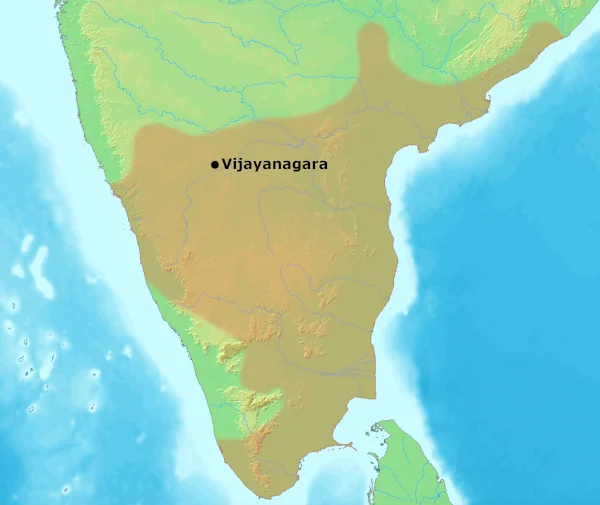
- The Vijayanagara Empire was founded in 1336 CE by Harihara I and Bukka Raya I, the brothers belonging to the Sangama dynasty. They were initially feudatories of the Kakatiya kingdom and later associated with the Kampili state before establishing their independent rule.
- The foundation of the empire is closely linked with the guidance of the saint Vidyaranya, who inspired the rulers to revive Hindu political power in South India. The capital city, Vijayanagara (present-day Hampi), was established on the southern bank of the Tungabhadra River. Its location was strategically chosen due to natural fortification provided by rocky terrain and the river, making it defensible against invasions.
Thus, the empire emerged as a political and cultural bulwark against northern invasions and gradually expanded to cover most of South India.
Dynasties and Important Rulers
The Vijayanagara Empire was ruled by four successive dynasties: Sangama, Saluva, Tuluva, and Aravidu.
Sangama Dynasty
- The Sangama dynasty was the founding dynasty and laid the administrative and territorial foundations of the empire.
- Harihara I established the core administrative system and consolidated territories formerly under the Hoysalas. Bukka Raya I expanded the empire significantly by defeating the Madurai Sultanate and extending control up to Rameswaram.
- Subsequent rulers like Harihara II strengthened the empire further by expanding towards the eastern and western coasts. Deva Raya I and Deva Raya II were important rulers who modernised the army and promoted cultural growth.
- Deva Raya II, in particular, is often regarded as one of the most capable rulers of the dynasty, with his empire extending across large parts of South India.
Saluva Dynasty
- The Saluva dynasty came to power during a period of political instability. Its founder, Saluva Narasimha Deva Raya, focused on stabilizing the empire and defending it from external threats, particularly the Gajapati rulers of Odisha.
Although the dynasty was short-lived, it played a transitional role in preserving the empire from disintegration.
Tuluva Dynasty
- The Tuluva dynasty marked the golden phase of the Vijayanagara Empire. It was founded by Tuluva Narasa Nayaka, and its most famous ruler was Krishnadevaraya (1509–1529).
Krishnadevaraya is regarded as the greatest ruler of the empire. His reign witnessed:
- Military successes against the Bahmani Sultanates and Gajapatis
- Administrative efficiency and welfare measures
- Cultural and literary flourishing
He was a great patron of literature and is associated with the Ashta Diggajas, a group of eight eminent Telugu scholars. He himself authored literary works such as Amukthamalyada. Under his rule, the empire reached its political, economic, and cultural zenith.
Aravidu Dynasty
- The Aravidu dynasty was the last ruling dynasty of the Vijayanagara Empire. After the Battle of Talikota (1565), the empire weakened significantly, although it continued to exist in a reduced form from capitals such as Penukonda and Chandragiri.
- The last ruler, Sri Ranga III, marked the end of the empire in the 17th century.
Administration of the Vijayanagara Empire
The Vijayanagara Empire had a well-structured and efficient administrative system, combining elements of centralization with local autonomy.
Nature of Kingship:
The king, known as the Raya, was the supreme authority in executive, legislative, and judicial matters. He was regarded as the protector of dharma and the ultimate source of justice. Succession was generally hereditary, although disputes were common.
Administrative Divisions:
The empire was divided into several administrative units such as Rajya (province), Mandala, Nadu, Sthala, and village.
Provincial governors, often royal princes or trusted nobles, enjoyed considerable autonomy. They maintained their own courts, armies, and even issued coins in some cases.
Nayankara (Amara-Nayaka) System:
One of the most important features of administration was the Amara-Nayaka system.
Under this system, military chiefs called Nayakas were granted land (amaram) in return for maintaining troops and providing military services to the king. These Nayakas collected revenue from their territories and ensured local administration.
This system helped in maintaining a large standing army but also led to decentralization and later contributed to the decline of central authority.
Revenue System:
Land revenue was the primary source of income and was generally fixed at about one-sixth of the produce. The state invested heavily in irrigation through tanks, canals, and dams, which improved agricultural productivity.
Military Organization:
The Vijayanagara army was well-organized and included infantry, cavalry, elephants, and artillery. The rulers imported horses from Arabia and Persia to strengthen their cavalry. The empire also employed foreign archers and soldiers, reflecting a pragmatic approach to military organization.
Economy of the Vijayanagara Empire
The economy of the Vijayanagara Empire was robust and diversified, resting on a strong agrarian base supported by extensive irrigation systems.
- The rulers invested heavily in tanks, canals, and reservoirs, particularly in the semi-arid Deccan region, which ensured stable agricultural output. Crops such as rice, pulses, sugarcane, and cotton were widely cultivated, generating both subsistence and surplus.
- Land revenue formed the principal source of income and was systematically assessed based on soil fertility and productivity. The administration maintained a balance between central control and local participation, with village institutions and intermediaries playing a role in revenue collection. The Amara-Nayaka system further linked land revenue with military obligations, integrating fiscal and defence structures.
- Trade and commerce significantly contributed to economic prosperity. The empire maintained active maritime trade with Persia, Arabia, and Southeast Asia through well-developed port networks. Exports included textiles, spices, and precious stones, while imports especially horses were crucial for maintaining a strong cavalry.
- Urban centres like Vijayanagara (Hampi) emerged as major commercial hubs, described by foreign travellers as exceptionally wealthy and vibrant.
Overall, the Vijayanagara economy combined agricultural strength, commercial expansion, and urban growth, making it one of the most prosperous economies of medieval India.
Society under the Vijayanagara Empire
- Vijayanagara society was structured yet dynamic, reflecting both traditional hierarchies and functional mobility. While the varna system remained influential, occupational diversity allowed various groups traders, artisans, soldiers, and administrators to play significant roles in society.
- Brahmins enjoyed high status and were often associated with education, religion, and administration. At the same time, the rise of Nayakas as powerful military and administrative elites indicates that political power was not confined to traditional social groups. This reflects a degree of flexibility within the social order.
- The status of women varied across classes. Women in elite families participated in cultural and sometimes administrative activities, while social practices such as child marriage and sati indicate the persistence of patriarchal norms. The institution of devadasis highlights the integration of women in temple-based cultural life.
- Religion played a central role, with rulers patronising Hindu traditions, particularly Vaishnavism and Shaivism. However, the empire exhibited religious tolerance, as seen in the presence of diverse communities including Muslims and Jains. The Bhakti movement further contributed to social cohesion by promoting devotion and reducing rigid social barriers.
Thus, Vijayanagara society was hierarchical yet adaptable, shaped by tradition as well as evolving socio-political realities.
Art and Architecture
Art and architecture under the Vijayanagara Empire represent a high point of medieval South Indian culture, marked by both continuity and innovation. The architectural style drew upon earlier traditions such as Chola and Hoysala while introducing distinct features.
- Temple architecture dominated the cultural landscape. A key characteristic was the prominence of towering gopurams, which served as monumental gateways to temple complexes. These structures were richly decorated with sculptures depicting mythological and religious themes. The use of mandapas or pillared halls, often intricately carved, added both functional and aesthetic value to temple design.
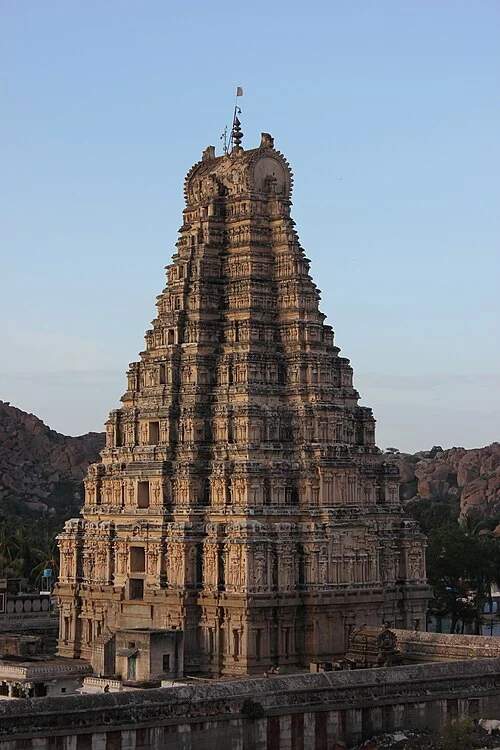
- The craftsmanship reached remarkable levels, as seen in structures like the Vittalaswamy Temple, known for its musical pillars, and the Virupaksha Temple. Granite was widely used, giving durability and a distinct visual identity to the architecture.

- Secular architecture also flourished, with palaces and public buildings displaying a blend of indigenous and Indo-Islamic elements. Structures such as the Lotus Mahal and Elephant Stables reflect this cultural synthesis through features like arches and domes.
- Urban planning in Vijayanagara was advanced, with fortified enclosures, well-organised streets, markets, and water management systems. This reflects not only artistic excellence but also administrative sophistication.
Overall, Vijayanagara architecture represents a fusion of religious devotion, artistic skill, and urban planning.
Decline of the Vijayanagara Empire
- The decline of the Vijayanagara Empire was the result of both internal weaknesses and external pressures, culminating in the Battle of Talikota (1565). The defeat by a coalition of Deccan Sultanates led to the destruction of the capital and marked a turning point in the empire’s history.
- Internally, the Amara-Nayaka system, which had earlier strengthened the empire, gradually led to decentralisation. Nayakas became increasingly autonomous, weakening central authority and reducing administrative cohesion. Succession disputes and the absence of strong rulers after Krishnadevaraya further destabilised the political structure.
- Externally, the rise of powerful Deccan Sultanates posed continuous challenges. Their eventual alliance against Vijayanagara exposed the empire’s vulnerabilities. The fall of the capital disrupted economic networks and administrative systems, accelerating the process of decline.
- Although the Aravidu dynasty continued to rule from alternative capitals, the empire lost its political and economic dominance. Regional powers emerged, and the once-powerful empire gradually fragmented.
Thus, the decline of Vijayanagara highlights how decentralisation, weak leadership, and sustained external threats can undermine even a strong empire.
Conclusion
The Vijayanagara Empire stands as a significant example of economic prosperity, social complexity, and cultural achievement in medieval India. Its contributions to architecture and administration remain enduring, while its decline offers important lessons on the challenges of maintaining imperial unity.
FAQs
Q1. What was the Vijayanagar Empire?
The Vijayanagar Empire was a major South Indian kingdom established in 1336 by Harihara I and Bukka Raya I on the banks of the Tungabhadra River.
Q2. Who was the greatest ruler of the Vijayanagar Empire?
Krishnadevaraya (1509–1529) is considered the greatest ruler, known for military expansion, efficient governance, and patronage of art and literature.
Q3. What were the main dynasties of the Vijayanagar Empire?
The empire was ruled by four dynasties: Sangama, Saluva, Tuluva, and Aravidu.
Q4. What were the key features of Vijayanagar administration?
Administration was centralised with a strong military, efficient revenue system, and the Nayankara system, where local chiefs managed territories in return for military service.
Q5. What led to the decline of the Vijayanagar Empire?
The empire declined after the Battle of Talikota, where a coalition of Deccan Sultanates defeated Vijayanagar forces.
Click on the question to see the Answers