Weimar Triangle Meeting 2026
Content
- Why in News
- What is the Weimar Triangle?
- Historical Evolution
- Significance
- Why India’s Involvement Matters
- Current Geopolitical Context
- Implications for India’s Foreign Policy
- Conclusion
Why in News
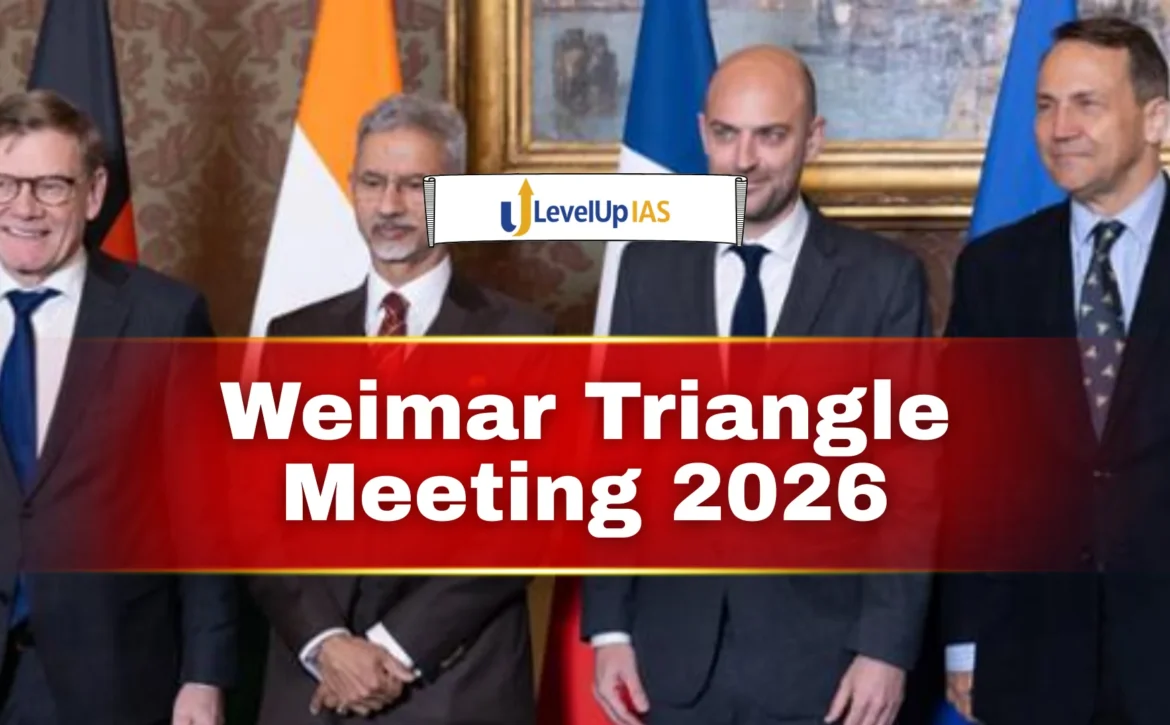
In January 2026, Subrahmanyam Jaishankar, India’s External Affairs Minister, participated in a Weimar Triangle foreign ministers’ meeting alongside counterparts from France, Germany, and Poland, marking India’s first ever engagement within this European trilateral diplomatic format at the foreign minister level. The meeting, held in Paris, focused on shared concerns related to the Ukraine conflict, EU-India relations, and cooperation in the Indo-Pacific, signalling an expanding diplomatic footprint for India within European strategic dialogues.
What is the Weimar Triangle?
The Weimar Triangle is a regional political grouping consisting of France, Germany and Poland, established in August 1991 in the German city of Weimar.
Originally conceived to foster political dialogue and cooperation at a time of major geopolitical shifts in Europe, particularly to support Poland’s integration into NATO and the European Union.
The Weimar Triangle facilitated coordination on key EU foreign policy and security issues.The grouping has no formal institutional structure instead, it functions through periodic summitry and diplomatic consultations among heads of government, foreign ministers, and European affairs ministers.
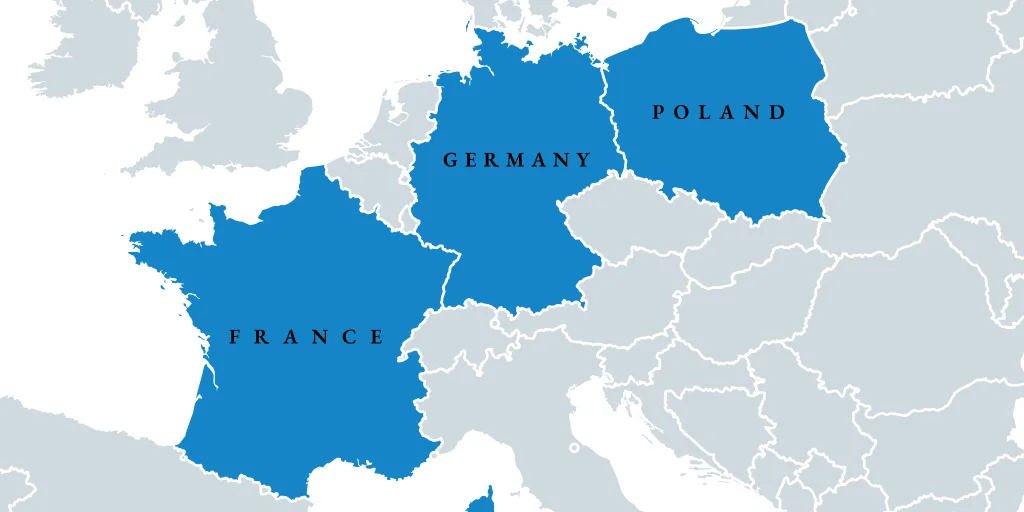
It historically served as a platform for Franco-German-Polish cooperation in post-Cold War European integration processes and continues to evolve in response to contemporary security challenges.
Historical Evolution of the Weimar Triangle
| Item | Details |
| Formation | 28–29 August 1991, Weimar, Germany |
| Members | France, Germany, Poland |
| Original Objective | Promote Franco-German-Polish dialogue; support Poland’s integration into NATO & EU |
| Key Functions | Political coordination on EU foreign policy, security cooperation |
| Recent Focus | Russia-Ukraine conflict; European security; relations with external partners |
This grouping became relevant when Europe was re-shaping itself after the end of the Cold War. France and Germany, as Western European powers, together with Poland, a Central/Eastern European state used this format to bridge divergent security priorities and strengthen European unity.
Significance of January 2026 Meeting
The inclusion of India in the Weimar Triangle meeting marks a major diplomatic milestone:
1. First Formal Engagement with India
For the first time, a non-European country, India, was invited to engage at the foreign minister level within the Weimar Triangle context. India’s participation reflects growing acknowledgment by key European powers of New Delhi’s role in global geopolitics and its relevance to Europe’s security calculus.
2. Focus on Ukraine and Security
A central agenda of the 7 January meeting was the ongoing Russia-Ukraine war and how Europe, working with partners, can advance diplomatic solutions that uphold international law. Representatives emphasised collective efforts, with India’s presence reinforcing a broader coalition of like-minded democracies focused on peace, stability, and international norms.
3. EU-India Relations
India and European states have been negotiating deeper economic ties, including an ambitious India-EU Free Trade Agreement (FTA). Behind the scenes of the Weimar engagement, participants also exchanged views on how to enhance EU-India cooperation on technology, trade, and strategic autonomy signalling convergence on multiple international agenda items.
4. Indo-Pacific Security Dialogue
The Weimar ministers and India discussed cooperation in the increasingly contested Indo-Pacific theatre. With European states expressing stronger interest in the region’s stability, India’s involvement points to convergent perspectives on maritime security, freedom of navigation, and a rules-based order in the Indo-Pacific.
Why India’s Involvement Matters
Recognising India’s Strategic Weight
India’s invitation underscores European recognition of India as a key security and economic partner beyond traditional bilateral engagements. As Europe recalibrates its foreign policy amidst global volatility, including rising geopolitical competition, shifting US priorities, and persistent Russia-Ukraine tensions, India’s strategic autonomy and position in the Indo-Pacific enhance the value of such cooperation.
Bridging Regional Integration
Historically, the Weimar Triangle acted as a bridge between Western and Central/Eastern Europe. India’s participation broadens this bridging function to connect European strategic discourse with broader global concerns, particularly those from the Global South. Such engagement enhances Europe’s external partnerships while enabling India to contribute to European security perspectives.
Support on Contemporary Trade Issues
At the 2026 talks, Poland and other members implicitly backed India’s diplomatic stance on global trade challenges such as Russian oil import policies in the context of Western sanctions architecture adding a layer of nuanced support for India’s positioning in international economic debates.
The Weimar Triangle in the Current Geopolitical Context
Reacting to Russian Aggression
Since the outbreak of Russia’s war against Ukraine in 2022, Europe’s strategic coordination has become paramount. The Weimar Triangle, due to its political influence within the EU context, has been involved in shaping collective European responses, sanctions coordination, and diplomatic pressure on Moscow. India’s rising voice on conflict resolution and diplomacy aligns with these efforts, highlighting shared interests in stability and respect for sovereign borders.
Complement to EU and NATO Frameworks
While NATO and EU foreign policy mechanisms provide broad security structures, the Weimar Triangle has often served as a pre-consultation format that feeds into larger policy stances. This informal cooperation helps streamline member states’ foreign policy priorities before larger institutional negotiations, and India’s inclusion signals openness to shared perspectives on security challenges.
Weimar+ and Expanded Formats
The evolution of Weimar cooperation has seen discussions on expanded diplomatic formats such as “Weimar+” which considers broader European participation beyond the original three in response to changing transatlantic and European strategic dynamics. India’s involvement suggests a potential trend where non-European democracies engage more directly with Europe’s strategic dialogues on shared geopolitical issues.
Implications for India’s Foreign Policy
Enhancing Indo-Europe Strategic Alignment
India’s participation in the Weimar Triangle underscores a multi-vector foreign policy, where New Delhi enhances its ties with major European powers without compromising strategic autonomy. Such engagements foster diplomatic depth ahead of broader India-EU negotiations on trade, technology, and security cooperation.
Balancing Relations with Global Powers
As tensions between Europe and other actors, including the United States and Russia, continue, India’s involvement positions it as an independent mediator and strategic interlocutor in global security forums. Bridging dialogues between Europe and the Global South strengthens India’s global governance credentials.
Broadening Diplomatic Outreach
This engagement reflects New Delhi’s aim to diversify its international partnerships beyond traditional neighbours and major Western powers, reinforcing India’s role as an influential voice in shaping multilateralism and cooperative security structures.
Conclusion
The January 2026 Weimar Triangle meeting represents a significant evolution in the triangular diplomatic format by incorporating India’s perspective into discussions traditionally confined to European powers. By engaging on issues ranging from the Ukraine conflict to Indo-Pacific security and EU-India cooperation, the meeting highlights converging interests in global stability and international law.
As geopolitical fault lines shift, India’s deeper engagement with European strategic frameworks signals an emerging trajectory where cooperative diplomacy expands beyond regional boundaries to build inclusive dialogues on peace and global governance.