India Semiconductor Mission 2.0

Content
- Why in News?
- Background
- India Semiconductor Mission (ISM) 2.0
- Key Objectives
- Key Features
- Electronics Components Manufacturing Scheme
- Budgetary Support
- Significance
- Challenges
Why in News?
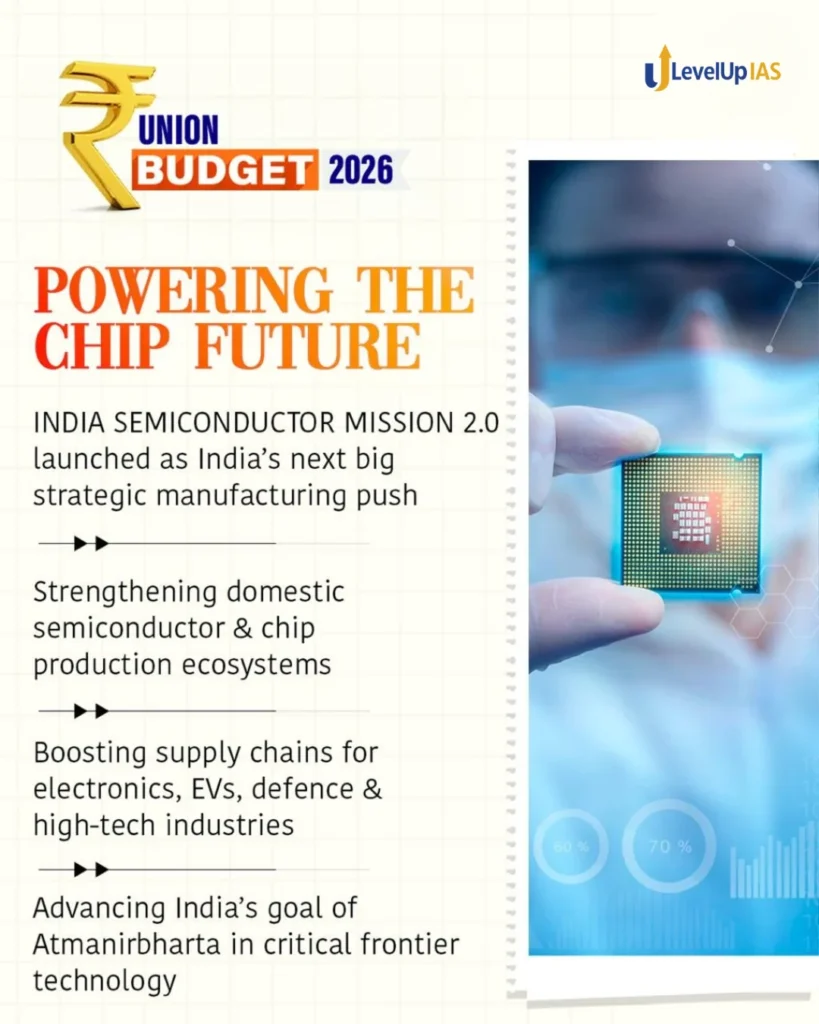
In the Union Budget 2026-27, the Government of India announced the launch of India Semiconductor Mission (ISM) 2.0. It is as part of its broader push to strengthen the electronics and information technology ecosystem. The mission aims to deepen domestic semiconductor capabilities. Focus is on equipment, materials, full-stack Indian intellectual property (IP), and resilient supply chains, building upon the foundations laid under ISM 1.0.
Background: India’s Semiconductor Imperative
- Semiconductors form the backbone of modern economies, powering sectors. Such as electronics, telecommunications, automobiles, defence systems, renewable energy technologies, artificial intelligence, and data centres.
- India, despite being a major consumer of electronic goods and a global leader in software services, has historically depended on imports for semiconductor chips, equipment, and advanced materials.
- Global disruptions during the COVID-19 pandemic exposed the strategic vulnerability created by such dependence. Subsequent geopolitical tensions and the weaponisation of supply chains further deepened these risks.
- Against this backdrop, India launched India Semiconductor Mission (ISM) 1.0. Which focused on semiconductor fabrication, design incentives, and ecosystem creation. ISM 2.0 represents the next phase, shifting emphasis from only fabrication to end to end value-chain strengthening, including upstream and midstream segments.
What is India Semiconductor Mission (ISM) 2.0?
India Semiconductor Mission 2.0 is a government-supported, industry-led initiative aimed at creating a self-sustaining semiconductor ecosystem in India. It seeks to move beyond assembly and fabrication towards equipment manufacturing, materials development, indigenous design IP, and secure supply chains, thereby positioning India as a credible global semiconductor hub.
For FY 2026-27, the government has allocated ₹1,000 crore specifically for ISM 2.0. Signalling a targeted but strategic push focused on capability building rather than only fiscal subsidies.
Key Objectives of ISM 2.0
The mission is designed with multiple interconnected objectives:
- Production of Semiconductor Equipment and Materials
ISM 2.0 places strong emphasis on developing domestic capabilities in semiconductor grade equipment and raw materials. Which are critical bottlenecks globally and are currently dominated by a few countries. - Development of Full-Stack Indian Intellectual Property (IP)
The mission seeks to promote indigenous chip design, system-level architecture, and full stack IP creation. It will be reducing reliance on foreign technology and licensing. - Strengthening Semiconductor Supply Chains
By localising key stages of the value chain, ISM 2.0 aims to enhance supply chain resilience. Which reduces exposure to external shocks, export controls, and geopolitical risks. - Industry-led Research and Training Ecosystem
A core focus is on establishing industry driven research and training centres. It will be ensuring that technological development is aligned with market needs. - Skilled Workforce Development
The mission recognises the shortage of semiconductor-ready talent and aims to create a strong pipeline of engineers, technicians, and researchers trained in advanced semiconductor technologies.
Key Features of ISM 2.0
- Shift from Fabrication-Centric to Ecosystem Centric Approach
Unlike earlier initiatives that focused largely on fabrication units, ISM 2.0 adopts a holistic view covering equipment, materials, design, and skills. - Industry Led Model
Research, innovation, and training centres under ISM 2.0 will be industry-led, ensuring practical relevance and faster translation of research into manufacturing outcomes. - Building on ISM 1.0 Gains
ISM 1.0 expanded India’s semiconductor design base and initiated fabrication projects. ISM 2.0 leverages these gains to move up the value chain. - Targeted Public Investment
Instead of broad subsidies, the mission uses focused public funding to crowd in private investment and technology partnerships.
Linkage with Electronics Components Manufacturing Scheme (ECMS)
The launch of ISM 2.0 coincides with the expansion of the Electronics Components Manufacturing Scheme (ECMS):
- ECMS was launched in April 2025 and has already received investment commitments double its original target, indicating strong industry response.
- In Budget 2026-27, the outlay for ECMS has been increased to ₹40,000 crore, signalling continued emphasis on domestic electronics manufacturing.
- ISM 2.0 complements ECMS by ensuring the availability of critical semiconductor inputs, thereby strengthening India’s electronics value chain from components to finished products.
Broader Budgetary Support to the IT and Electronics Ecosystem
ISM 2.0 is part of a wider policy package aimed at reinforcing India’s technology-driven growth model:
- New Safe Harbour Provisions for IT/ITeS
The Budget introduces simplified and predictable tax norms by clubbing IT services, IT-enabled services, KPO, and contract R&D under a single category with a uniform safe harbour margin of 15.5%. - Higher Threshold for Safe Harbour
The eligibility threshold has been raised from ₹300 crore to ₹2,000 crore, significantly expanding coverage. - Automated, Rule-based Approval Process
The authorities will process safe harbour approvals without direct tax officer intervention, reducing compliance burden and uncertainty. - Data Centre and Cloud Infrastructure Push
A tax holiday till 2047 for foreign cloud service providers using Indian data centres underscores India’s ambition to become a global digital infrastructure hub closely linked to semiconductor demand.
Significance of ISM 2.0
- Strategic and Economic Security
By reducing import dependence in a critical sector, ISM 2.0 enhances India’s strategic autonomy and national security. - Boost to Manufacturing and Innovation
Indigenous equipment and IP development will strengthen domestic manufacturing and encourage innovation driven growth. - Employment and Skill Creation
Semiconductor ecosystems generate high quality jobs across design, research, manufacturing, and maintenance. - Global Positioning
ISM 2.0 supports India’s aspiration to emerge as a reliable partner in global semiconductor supply chains amid geopolitical realignments.
Challenges and Concerns
- High Capital and Technology Barriers
Semiconductor equipment and materials require sustained investment and long gestation periods. - Talent Constraints
Bridging the skill gap between academia and industry remains a critical challenge. - Global Competition
India faces stiff competition from established semiconductor hubs with deeper technological maturity.
Way Forward
For ISM 2.0 to succeed, sustained policy support, effective industry academia collaboration, global technology partnerships, and alignment with education and skilling initiatives will be essential. Integrating ISM 2.0 with broader manufacturing, digital infrastructure. And innovation policies can help India move from a semiconductor consumer to a semiconductor ecosystem builder.