Bab el-Mandab Strait
Content
- Why in News?
- Location and Geographical Features
- Strategic and Economic Importance
- Relevance in Current Geopolitics
- Challenges and Way Forward
- Conclusion
Why in News?
The Bab el-Mandeb Strait has come into focus amid escalating tensions involving the United States, Israel, and Iran, with concerns that any disruption in this region could severely impact global trade and energy flows.
Location and Geographical Features
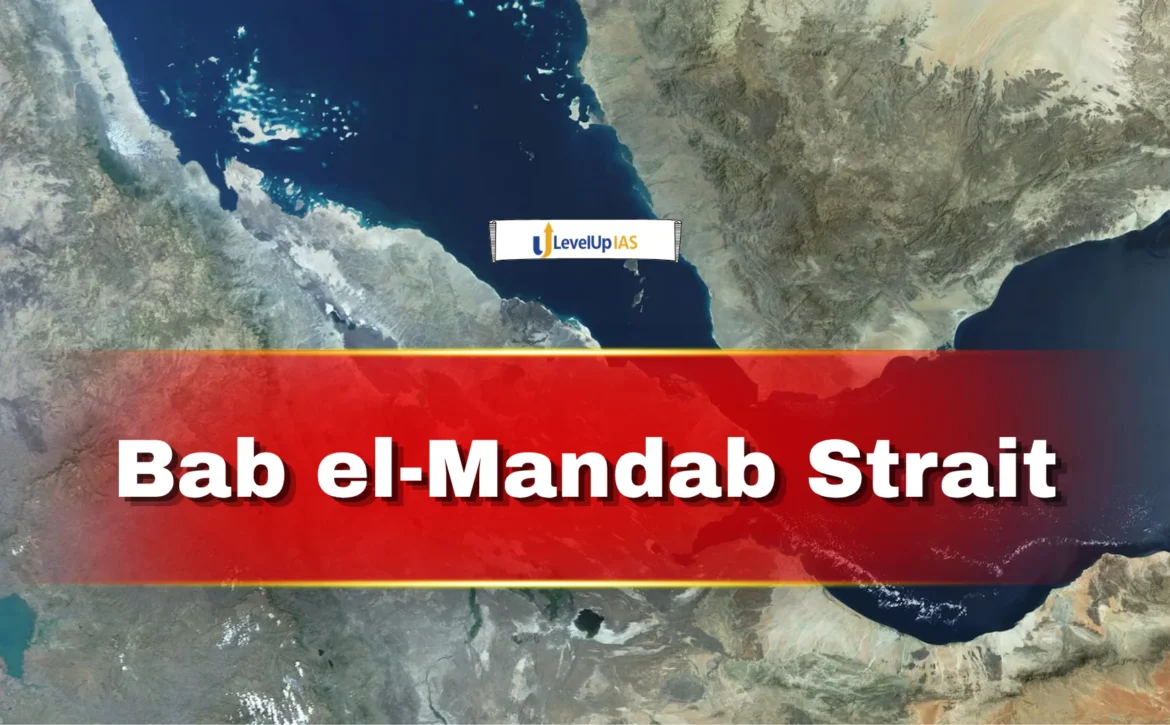
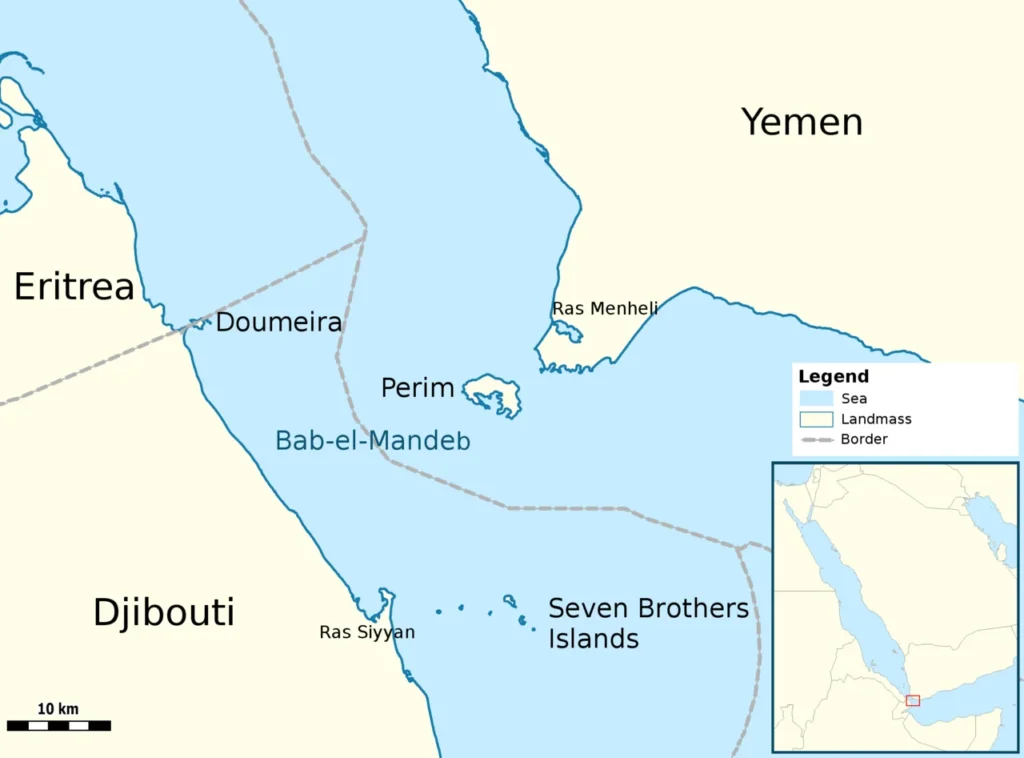
The Bab el-Mandeb Strait is a narrow maritime passage connecting the Red Sea with the Gulf of Aden, and thereby linking the Mediterranean Sea (via the Suez Canal) to the Indian Ocean. It lies between Yemen on the Asian side and Djibouti and Eritrea on the African side.
The strait is divided into two channels by Perim Island, with the western channel being deeper and more suitable for large vessels. Due to its narrow width and heavy maritime traffic, it is considered a critical global chokepoint.
Strategic and Economic Importance
- The Bab el-Mandeb Strait holds immense importance as it forms a vital link in global maritime trade. A significant portion of cargo moving between Europe, Asia, and Africa passes through this route, making it indispensable for international commerce. It serves as a gateway to the Suez Canal, thereby connecting major economic regions.
- The strait is equally crucial for energy security, as a large volume of crude oil and liquefied natural gas shipments from West Asia transit through it. Any disruption can lead to sharp increases in global oil prices and supply chain instability.
- From a geopolitical perspective, the region is highly sensitive due to its proximity to conflict zones such as Yemen. The involvement of state and non-state actors, including armed groups, has increased the vulnerability of shipping routes. As a result, the strait has become a focal point of naval deployments and strategic competition.
Relevance in Current Geopolitics
- Recent developments have heightened the strategic significance of the strait. The ongoing tensions in West Asia have raised fears of attacks on commercial shipping, particularly by non-state actors operating from nearby regions.
- Such disruptions could force ships to reroute via longer routes like the Cape of Good Hope, increasing transportation costs and affecting global supply chains. The situation highlights how regional conflicts can have global economic repercussions, especially when they involve critical maritime chokepoints.
- For India, the Bab el-Mandeb Strait is crucial due to its dependence on maritime trade and energy imports. A substantial share of India’s trade with Europe passes through this route. Any instability can lead to increased shipping costs, delays, and energy insecurity.
- It also has implications for India’s broader maritime strategy, including its engagement in the Indo-Pacific and its commitment to ensuring secure sea lanes of communication.
Challenges and Way Forward
- The major challenge associated with the Bab el-Mandeb Strait is its vulnerability to geopolitical conflicts, piracy, and potential blockades. Its narrow geography makes it particularly sensitive to disruptions, which can have cascading effects on global trade.
- To address these concerns, there is a need for enhanced international maritime cooperation, including coordinated naval patrols and intelligence sharing. Countries must also focus on diversifying supply chains and strengthening alternative trade routes to reduce overdependence on such chokepoints.
For India, expanding naval presence and deepening strategic partnerships in the region will be essential to safeguard its economic and security interests.
Conclusion
The Bab el-Mandeb Strait is a vital artery of global trade and energy movement, whose importance has been underscored by recent geopolitical developments. Its stability is crucial not only for regional security but also for the smooth functioning of the global economy, making it a key topic for UPSC from both geographical and strategic perspectives.
Visit LevelUp IAS- Click Here