
General
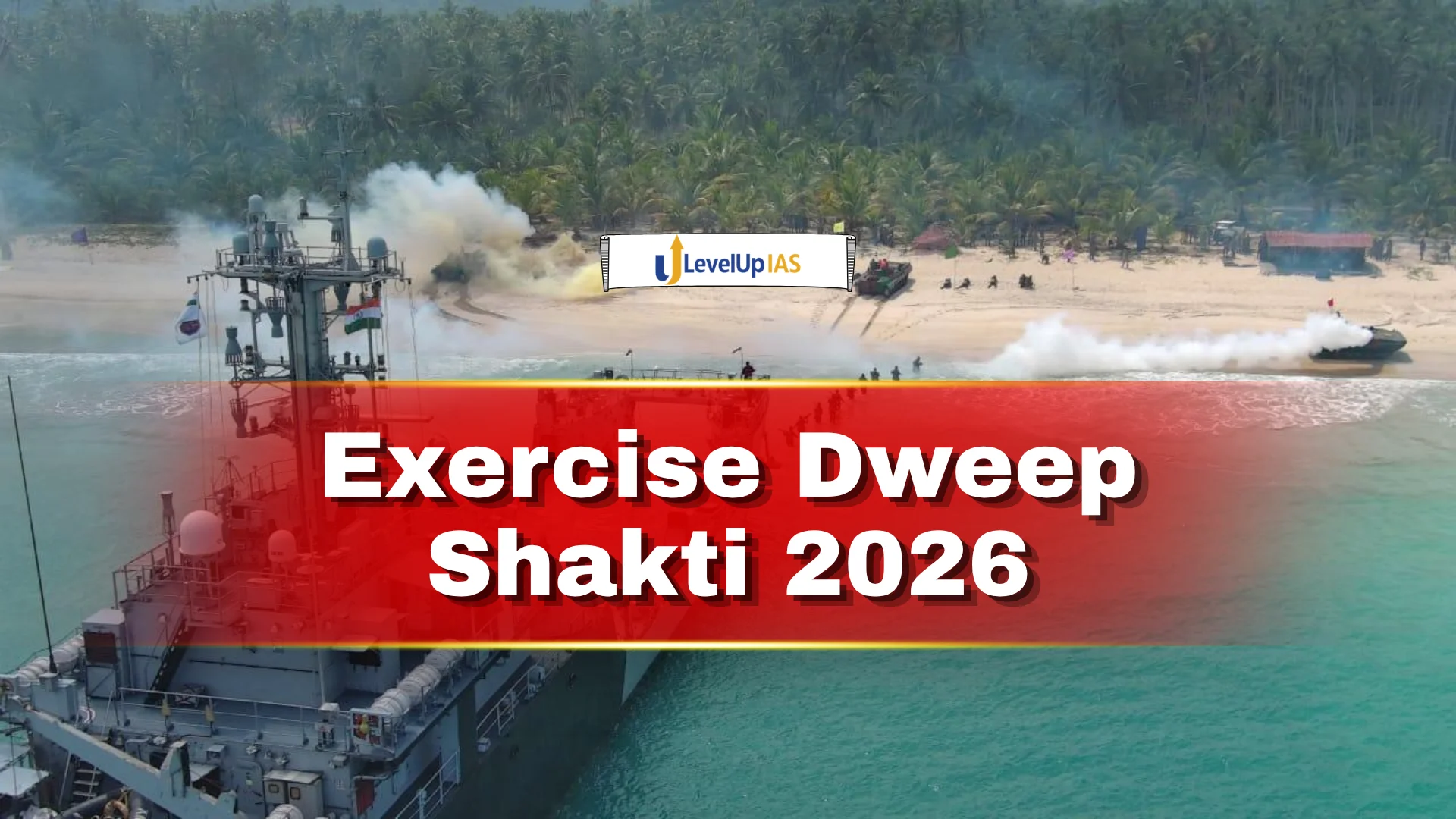
Exercise Dweep Shakti 2026
Content
- Why in News?
- Introduction
- Objectives and Operational Focus
- Key Features
- Strategic Significance
- Way Forward
- Conclusion
Why in News?
The Indian Armed Forces recently concluded Exercise Dweep Shakti, a high-intensity tri-service military drill showcasing enhanced joint operational capabilities in island and maritime environments.
Introduction
Exercise Dweep Shakti is a large-scale tri-service joint exercise involving the Indian Army, Indian Navy, and Indian Air Force. It is designed to test India’s integrated combat readiness in coastal and island territories, particularly in the context of emerging maritime security challenges.
The exercise Dweep Shakti was conducted under the Andaman and Nicobar Command (ANC), India’s only tri-service theatre command, leveraging the strategic geography of the Andaman and Nicobar Islands.
Objectives and Operational Focus
- The primary objective of the exercise Dweep Shakti is to enhance jointness and interoperability among the Indian Army, Indian Navy, and Indian Air Force, ensuring that the three services can function as a single cohesive force during complex military operations. It seeks to refine integrated command structures, communication systems, and standard operating procedures, thereby enabling a swift, coordinated, and efficient response to emerging security threats, particularly in remote island territories.
- The exercise also focuses on improving India’s capability to conduct amphibious warfare operations, including rapid troop mobilisation, sea-to-shore assault, and logistical support in hostile environments. It aims to strengthen surveillance and control over maritime zones and Exclusive Economic Zone (EEZ), ensuring the protection of critical sea lanes of communication (SLOCs) that are vital for trade and energy security.
- Additionally, the drill emphasises multi-domain operational readiness, integrating air, sea, and land capabilities along with emerging technologies such as drones and electronic warfare systems. This helps in building preparedness against both conventional and non-conventional threats, including maritime intrusions, grey-zone warfare, and strategic competition in the Indo-Pacific region.
Key Features
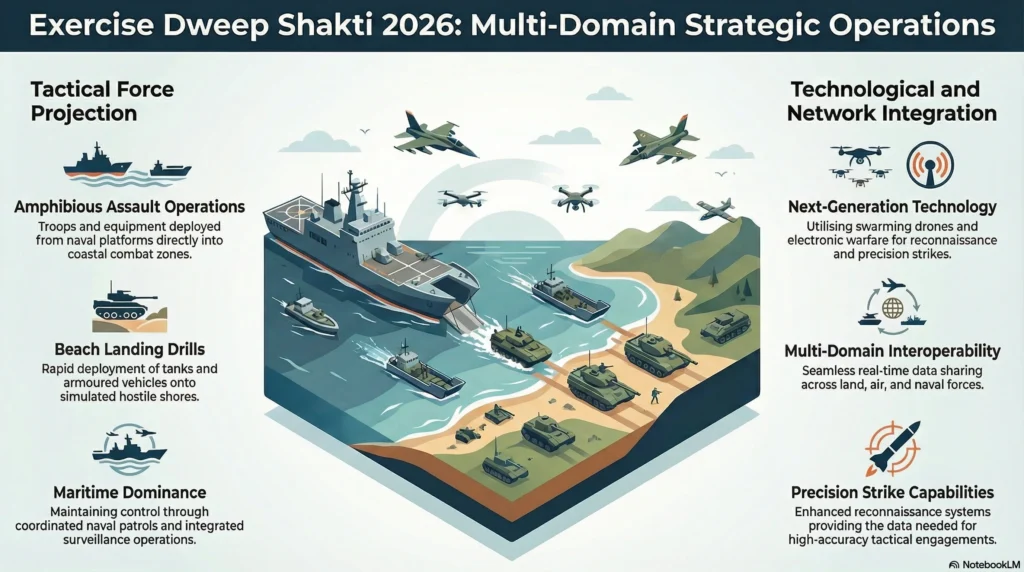
- It involved complex amphibious assault operations, where troops were deployed from naval platforms to coastal zones, simulating real combat scenarios. It also demonstrated maritime dominance capabilities through coordinated naval patrols and surveillance operations.
- Another significant aspect was the execution of beach landing drills, where heavy military equipment such as tanks and armoured vehicles were deployed onto simulated hostile shores, testing logistics and rapid deployment capacity.
- It incorporated next-generation technologies, including swarming drones and electronic warfare systems, enhancing reconnaissance, surveillance, and precision strike capabilities.
- Importantly, it tested multi-domain interoperability, ensuring seamless communication and real-time data sharing among land, air, and naval forces.
Strategic Significance
- Exercise Dweep Shakti highlights India’s growing focus on integrated theatre commands and joint warfare capabilities. It sends a strong signal regarding India’s preparedness to defend its island territories, often referred to as “unsinkable aircraft carriers”, particularly in the strategically sensitive Indo-Pacific region.
- It strengthens India’s ability to safeguard its Exclusive Economic Zone (EEZ) and vital maritime trade routes. It also enhances readiness against potential threats such as maritime intrusions, grey-zone warfare, and regional power competition.
- Furthermore, it reinforces the importance of the Andaman and Nicobar Islands as a strategic outpost near key global chokepoints, including the Malacca Strait.
Way Forward
- Going forward, there is a need to further strengthen joint command structures and integrated theatre commands to institutionalise seamless coordination among the armed forces. This will enhance operational efficiency and enable faster decision-making in multi-domain warfare scenarios.
- Continuous upgradation of advanced technologies, including surveillance systems, drones, and cyber capabilities, is essential to address evolving security threats and ensure real-time situational awareness.
- India should also enhance maritime partnerships and joint exercises with friendly countries, particularly in the Indo-Pacific region, to promote interoperability and collective security.
- Additionally, greater focus on capacity building, logistics infrastructure, and island defence preparedness will be crucial to safeguard India’s strategic maritime interests and ensure a robust response to emerging challenges.
Conclusion
Exercise Dweep Shakti reflects India’s evolving defence preparedness and emphasis on jointness, technological integration, and maritime security. It underscores the importance of safeguarding island territories and sea lanes in an increasingly complex geopolitical environment, making it highly relevant for from both security and strategic perspectives.
Visit LevelUp IAS- Click Here
Related reads.

Mastering Anthropology: The 292-Mark Roadmap By AIR 521
21 Aug 2026 6 min

Mastering UPSC Answer Writing by AIR 255
17 Aug 2026 5 min

GS & Optional Balancing Strategy By AIR 48
13 Aug 2026 5 min

AIR 49’s Brutally Honest UPSC Strategy Session
10 Aug 2026 4 min

Full 12 Months UPSC Roadmap By AIR 13
07 Aug 2026 5 min
Scientific Revision System By AIR 341 Vishal Pattanayak
05 Aug 2026 5 min
Put it into practice
Reading is step one.
Turn what you've just read into exam-ready answers with mentor-led practice and our structured test series.