Artemis II Mission 2026
Content
- Why in News?
- Introduction
- Mission Profile and Features
- Crew and Milestones
- Strategic and Scientific Significance
- Way Forward
- Conclusion
Why in News?
The Artemis II Mission was launched on 1st April 2026 as a landmark crewed deep-space mission, marking humanity’s return beyond low-Earth orbit for the first time in over five decades since the Apollo era.
Introduction
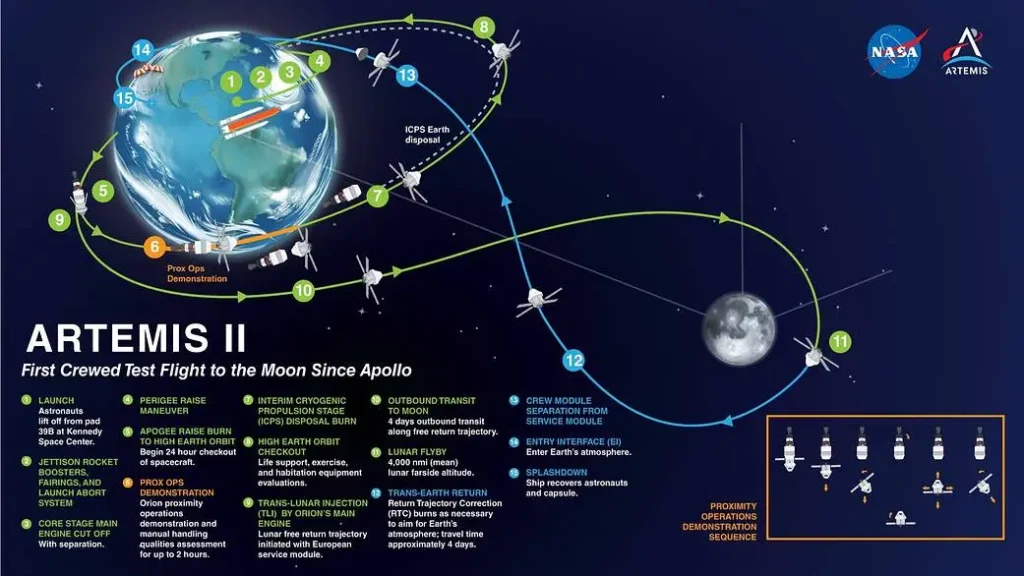
The Artemis II mission, led by the NASA, is the first crewed mission under the Artemis programme. It aims to re-establish human presence in deep space and lay the groundwork for future lunar landings.This mission will send four astronauts aboard the Orion spacecraft on a 10-day journey around the Moon. Unlike landing missions, Artemis II will conduct a lunar flyby, testing critical systems required for long-duration human spaceflight.
Mission Profile and Features
- Artemis II will follow a free-return trajectory, carrying astronauts approximately 7,400 km beyond the far side of the Moon before returning to Earth using lunar gravity. This “slingshot” or gravity assist technique minimises fuel use and ensures a safe return path.
- The mission is powered by the Space Launch System (SLS), currently the most powerful rocket ever developed, surpassing even the Saturn V in thrust capability.
- A major technological advancement is the testing of laser-based communication systems, enabling high-speed data transmission, including potential 4K video streaming from lunar distances.
- The mission also includes cutting-edge biological experiments, such as the AVATAR project, which uses “organ-on-chip” technology to study the effects of deep-space radiation and microgravity on human cells.
- Additionally, the mission reflects global collaboration, with CubeSats from multiple countries being deployed to study space weather, radiation shielding, and lunar technologies.
Crew and Milestones
The crew of the Artemis II Mission marks a significant shift in the history of human space exploration by embodying both diversity and global collaboration. The four-member team includes astronauts from NASA and the Canadian Space Agency, reflecting a broader international partnership in deep-space missions.
This mission is historically important as it includes the first woman and the first person of colour to travel beyond low-Earth orbit, breaking long-standing barriers in human spaceflight. Additionally, the inclusion of a non-American astronaut represents a major step towards the internationalisation of crewed space exploration, moving beyond the earlier era dominated by a few nations.
The Artemis II mission also signifies the revival of human deep-space missions after more than five decades, since the era of the Apollo 17 mission. It demonstrates advancements in crew selection, inclusivity, and global cooperation, aligning with modern values of representation and shared scientific progress.
Overall, the crew composition and milestones of Artemis II highlight a transition towards a more inclusive, collaborative, and globally integrated approach to space exploration, setting the stage for future missions to the Moon and beyond.
Strategic and Scientific Significance
Artemis II is a crucial step in advancing human space exploration beyond Earth orbit. It validates life-support systems, crew safety mechanisms, and deep-space navigation technologies necessary for future missions.
The mission plays a foundational role in NASA’s long-term goal of establishing a sustainable human presence on the Moon, and eventually enabling missions to Mars.
From a geopolitical perspective, it reinforces leadership in space exploration and highlights the growing importance of space as a domain of strategic competition and cooperation.
Way Forward
- Going forward, the success of the Artemis II Mission should pave the way for future missions like Artemis III, which aims to achieve a human landing on the Moon’s south pole and enable long-term lunar exploration.
- There is a need to strengthen deep-space capabilities, including life-support systems, radiation protection, and advanced propulsion technologies, which are essential for future missions to Mars. The development of infrastructure such as the Lunar Gateway will support sustained human presence beyond Earth orbit.
- Greater emphasis must also be placed on international cooperation through frameworks like the Artemis Accords, along with evolving norms for space governance, including debris management and responsible use of space resources.
- Finally, promoting innovation, private sector participation, and cost-effective technologies will be crucial for making deep-space exploration sustainable and inclusive.
Conclusion
The Artemis II mission marks a historic return to deep-space human exploration, bridging the gap between past achievements and future ambitions. By combining advanced technology, international collaboration, and scientific innovation, it represents a critical milestone in humanity’s journey toward sustained presence beyond Earth.
Visit LevelUp IAS- Click Here