The 3-Cycle Revision Strategy

Content
- Introduction
- Understanding the 3-Cycle Approach
- First Cycle: Building Retention
- Second Cycle: Strengthening and Filtering
- Third Cycle: Final Revision Before Prelims
- Conclusion
Introduction
As UPSC Prelims 2026 approaches, the nature of preparation must change. This is no longer the phase to keep adding new sources or endlessly reading new material. At this stage, success depends largely on how effectively you revise what you have already studied. The UPSC Prelims exam is designed to test clarity, retention, and presence of mind, which can only be developed through repeated revision.
In this context, the 3-cycle revision strategy becomes extremely relevant, as it provides a structured way to revise the entire syllabus multiple times with increasing efficiency.
Understanding the 3-Cycle Approach
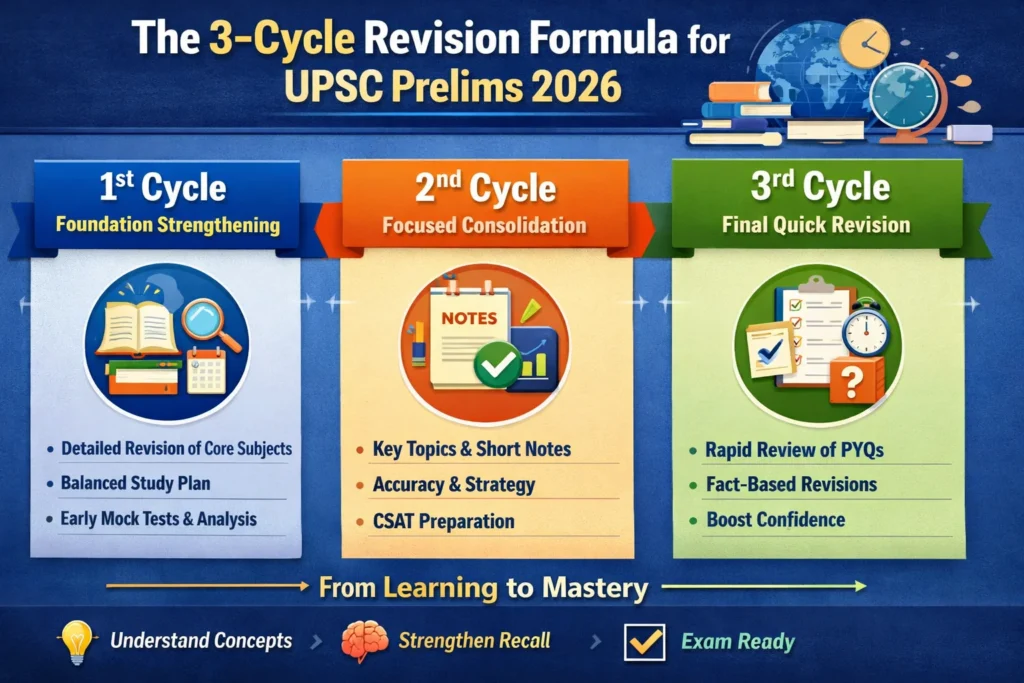
The idea behind this strategy is simple but powerful. Instead of revising randomly, the syllabus is revised in three planned cycles, where each cycle becomes shorter and sharper than the previous one. The first cycle is detailed and slow, the second becomes selective and focused, and the final cycle is quick and completely exam-oriented.
This gradual reduction in time helps the brain move from understanding to retention and finally to quick recall, which is exactly what is required in the exam hall.
First Cycle: Building Retention
In the first revision cycle, the focus should be on going back to core subjects such as Polity, Economy, Geography, and History that were studied earlier. Since Prelims 2026 is nearing, it is important not to delay this phase. If revision is postponed, much of what has been studied will begin to fade.
At this stage, the approach should remain balanced. Studying a heavy subject continuously can lead to fatigue, so it is better to combine it with a lighter subject. This helps in maintaining consistency without burnout. At the same time, current affairs should also be revised from already prepared material instead of trying to cover new magazines or sources.
Mock tests should begin alongside this cycle. Many aspirants wait for “complete preparation” before attempting mocks, but that stage never really comes. Instead, early mocks help in identifying gaps and weak areas. The key lies in analysing mistakes carefully and noting down topics that require repeated revision.
Second Cycle: Strengthening and Filtering
By the time the second revision cycle begins, the candidate already has a fair idea of the syllabus. Now the focus shifts from covering everything to focusing on what actually matters for the exam. Important themes, repeated PYQ areas, and factual portions should be prioritised.
This is also the stage where candidates should start preparing short revision notes. These notes should not be bulky; rather, they should capture only the most important facts, tricky areas, and commonly confused concepts. These will become extremely useful in the final days before Prelims 2026.
Mock tests in this phase help refine strategy. Instead of worrying about marks, the focus should be on improving accuracy, reducing silly mistakes, and developing a clear approach to solving questions. CSAT preparation should also be taken seriously at this stage to avoid last-minute surprises.
Third Cycle: Final Revision Before Prelims
The last 10-15 days before Prelims 2026 form the most critical phase of preparation. By now, the goal is not to learn anything new but to revise efficiently and build confidence.
Revision during this phase should be limited to short notes, previously marked topics, and PYQs. Reading standard books line by line again is neither practical nor useful. Instead, emphasis should be on fact-based areas and topics that require memorisation, as these can make a marginal difference in the final score.
Equally important is maintaining calmness. Many aspirants feel anxious about what they have not covered, but this is counterproductive. The focus should remain on strengthening what has already been prepared.
Conclusion
The 3-cycle revision strategy offers a practical and effective way to handle the vast UPSC syllabus, especially when Prelims 2026 is close. It ensures multiple revisions, better retention, and improved confidence.
Ultimately, clearing prelims is not about studying more, but about revising smarter and recalling better under pressure.
Visit LevelUp IAS- Click Here