Humpback Whale UPSC

Content
- Why in News?
- Introduction
- Classification and Distribution
- Physical Features and Behaviour
- Ecological Significance
- Conservation Status
- Threats
- Significance for India
- Conclusion
Why in News?
In early 2026, a humpback whale is in the news primarily due to a dramatic, high-profile stranding in the Baltic Sea near Germany. As of April 2026, rescuers halted efforts to save the 13.5-meter mammal after it remained stuck in shallow waters for over a week, with experts fearing for its survival.
Introduction
The Humpback Whale is one of the most distinctive and widely studied marine mammals, known for its long pectoral fins, complex songs, and spectacular breaching behaviour. It has recently been in the news due to conservation discussions and sightings in Indian waters, highlighting the importance of marine biodiversity protection. For UPSC, it is important from the perspective of species conservation, marine ecology, and international environmental governance.
Classification and Distribution
The humpback whale belongs to the baleen whale group under the family Balaenopteridae. It is found in all major oceans, ranging from polar to tropical waters, making it a highly migratory species.
These whales typically migrate between feeding grounds in polar regions and breeding grounds in tropical or subtropical waters. In the Indian Ocean region, sightings are reported along the western and eastern coasts of India, including areas like the Arabian Sea and the Bay of Bengal.
Physical Features and Behaviour
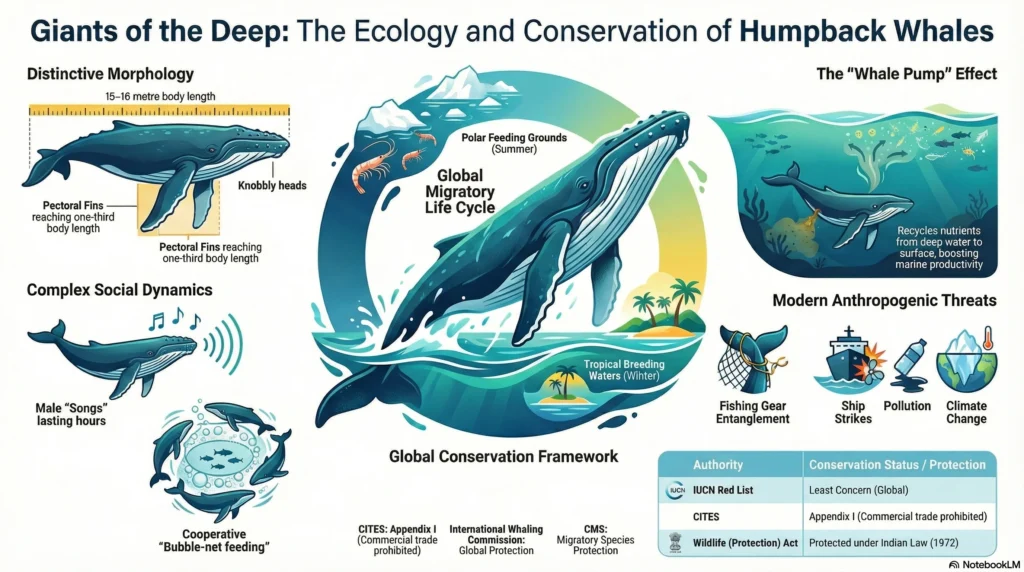
- The humpback whale is easily identifiable due to its large size (up to 15-16 metres) and unique morphological features. Its exceptionally long pectoral fins, which can be one-third of its body length, distinguish it from other whale species. The species also has a knobbly head and a distinctive hump, from which it derives its name.
- One of the most remarkable characteristics of humpback whales is their complex vocalisations or “songs”, primarily produced by males. These songs can last for hours and are believed to play a role in mating behaviour and communication.
- Another notable behaviour is breaching, where the whale leaps out of the water and crashes back, possibly for communication, parasite removal, or social interaction. They are also known for bubble-net feeding, a cooperative hunting technique where groups of whales create circular bubbles to trap fish.
Ecological Significance
Humpback whales play a crucial role in maintaining the health of marine ecosystems. As large marine mammals, they contribute to nutrient cycling through a process known as the “whale pump”, where nutrients from deep waters are brought to the surface through excretion. This enhances primary productivity and supports the marine food web.
Additionally, their feeding behaviour helps regulate fish populations, maintaining ecological balance. Their presence is often considered an indicator of healthy ocean ecosystems.
Conservation Status
According to the International Union for Conservation of Nature, the humpback whale is currently listed as Least Concern on the IUCN Red List. However, certain regional populations remain vulnerable and require continued monitoring.
The species is also protected under several international agreements, including:
- The International Whaling Commission, which regulates whaling activities.
- The Convention on International Trade in Endangered Species of Wild Fauna and Flora, where it is listed in Appendix I, prohibiting commercial trade.
- The Convention on Migratory Species, recognising its migratory nature and need for international conservation efforts.
In India, humpback whales are protected under the Wildlife (Protection) Act, 1972.
Threats
- Despite improvements in global populations after the ban on commercial whaling, humpback whales continue to face multiple threats. One of the major concerns is entanglement in fishing gear, which can cause injury or death.
- Ship strikes are another significant threat, especially in busy shipping routes. Additionally, marine pollution, including plastic waste and oil spills, affects their habitat and health.
- Climate change is emerging as a long-term threat, as it alters ocean temperatures and affects the availability of prey species. Increasing underwater noise pollution from shipping and industrial activities also disrupts their communication and navigation.
Significance for India
For India, the presence of humpback whales in its maritime zones highlights the importance of marine biodiversity conservation. It aligns with India’s commitments under global environmental frameworks and its focus on the Blue Economy.
Conservation of such species also promotes eco-tourism opportunities, such as whale watching, while ensuring sustainable use of marine resources.
Conclusion
The humpback whale represents not only a charismatic marine species but also a key component of oceanic ecosystems. While global conservation efforts have led to some recovery, continued vigilance is required to address emerging threats. For UPSC preparation, it is important to understand both the ecological role and conservation framework associated with the species.
Protecting humpback whales ultimately contributes to the broader goal of maintaining healthy and resilient marine ecosystems.
Visit LevelUp IAS- Click Here