India’s First Fast Breeder Reactor (FBR)
Content
- Why in News?
- Introduction
- Concept of Fast Breeder Reactor
- Principle of Breeding and Nuclear Reaction
- Criticality in Nuclear Reactors
- India’s Prototype Fast Breeder Reactor (PFBR)
- Role in India’s Three-Stage Nuclear Programme
- Significance
- Challenges
- Conclusion
Why in News?
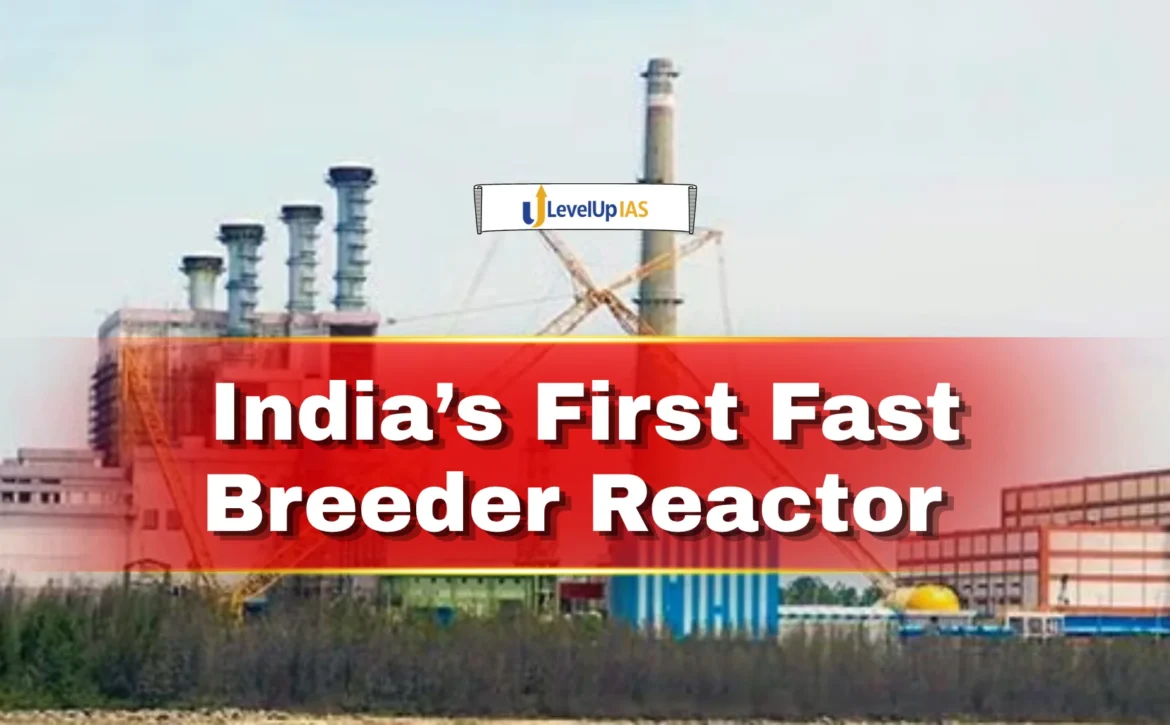
India’s Prototype Fast Breeder Reactor (PFBR) at Kalpakkam has recently achieved Criticality, marking a major milestone in the country’s nuclear energy programme.
This development signifies that the reactor has successfully initiated a self-sustaining nuclear chain reaction and is moving towards power generation. It is a crucial step in advancing India’s three-stage nuclear programme and achieving long-term energy security.
Introduction
A Fast Breeder Reactor represents one of the most advanced technologies in nuclear energy generation, designed to address the limitations of conventional reactors by producing more fuel than it consumes.
For a country like India, which has limited uranium reserves but abundant thorium resources, FBR technology plays a transformative role in ensuring sustainable and secure energy supply.
Concept of Fast Breeder Reactor
A Fast Breeder Reactor is a type of nuclear reactor that operates using fast neutrons rather than thermal (slow) neutrons. In conventional reactors, slow neutrons sustain the chain reaction, whereas in FBRs, high-energy fast neutrons are used, which allows for a more efficient fission process.
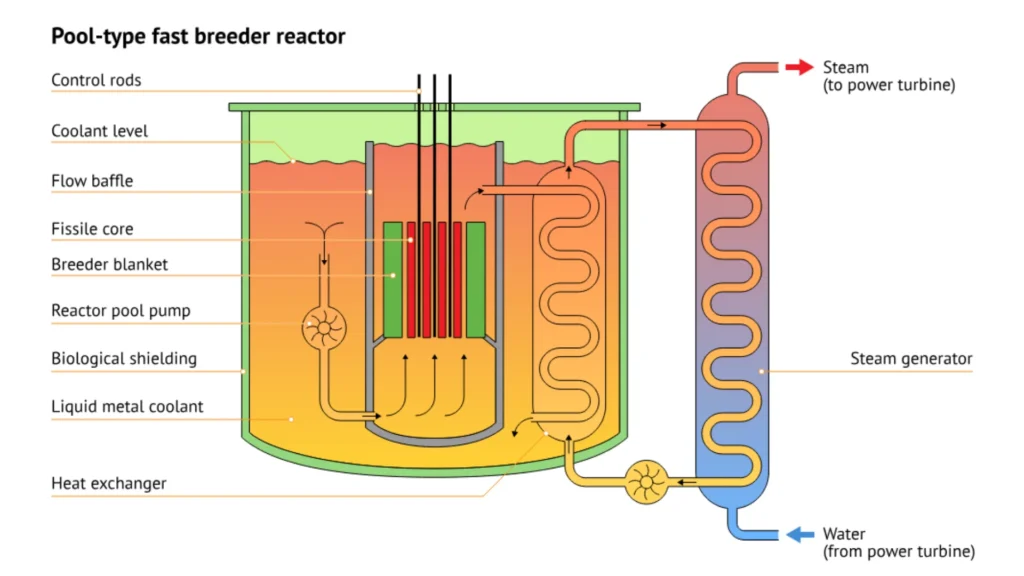
The defining feature of an FBR lies in its ability to “breed” fissile material. It uses a combination of fissile and fertile materials. Typically, plutonium-239 acts as the fissile fuel, while uranium-238 serves as the fertile material. During reactor operation, uranium-238 absorbs neutrons and is converted into plutonium-239, thereby generating additional fuel.
This process enables the reactor to produce more fissile material than it consumes, making it significantly more efficient in terms of fuel utilisation. In most designs, fuel is used in the form of Mixed Oxide (MOX), which combines plutonium with uranium.
Principle of Breeding and Nuclear Reaction
The breeding process is central to the functioning of an FBR. When a fast neutron strikes a fissile nucleus such as plutonium-239, it splits, releasing energy and additional neutrons. Some of these neutrons are absorbed by fertile material like uranium-238, converting it into new fissile material.
This cycle ensures a continuous supply of fuel within the reactor, thereby extending the life of nuclear resources. It also contributes to the concept of a closed nuclear fuel cycle, where waste materials are reprocessed and reused, reducing the need for fresh uranium inputs.
Criticality of the Reactors
- A key milestone in the operation of any nuclear reactor is achieving Criticality. Criticality refers to the condition in which a nuclear reactor sustains a stable and self-sufficient chain reaction. At this stage, each fission event produces exactly the number of neutrons required to continue the reaction without external support.
- There are three states associated with reactor behaviour. In a subcritical state, the chain reaction gradually dies out. In a critical state, the reaction is steady and self-sustaining. In a supercritical state, the reaction intensifies rapidly and must be carefully controlled.
- Achieving controlled criticality is a crucial step in reactor commissioning, as it demonstrates that the reactor core is functioning as designed and is ready for gradual power generation.
India’s Prototype Fast Breeder Reactor (PFBR)
- India’s PFBR at Kalpakkam is a 500 MWe sodium-cooled, pool-type fast breeder reactor, developed as part of the country’s strategic nuclear programme. It is located at the Indira Gandhi Centre for Atomic Research and is operated by Bharatiya Nabhikiya Vidyut Nigam Limited, a public sector enterprise under the Department of Atomic Energy.
- The reactor uses MOX fuel composed of plutonium-239 and uranium-238. Its sodium-cooling system allows efficient heat transfer while maintaining the fast neutron spectrum required for breeding. The pool-type design enhances safety by placing all major components in a single vessel.
- The recent achievement of criticality signifies that the reactor has successfully initiated a controlled nuclear chain reaction and is progressing toward electricity generation. This development places India among a select group of nations possessing advanced fast breeder reactor technology, with Russia being the only other country operating commercial-scale FBRs.
Role in India’s Three-Stage Nuclear Programme
Fast breeder reactors form the second stage of India’s three-stage nuclear programme, originally conceptualised by Homi J. Bhabha.
In the first stage, Pressurised Heavy Water Reactors (PHWRs) use natural uranium to produce plutonium as a by-product. The second stage involves FBRs, which utilise this plutonium to generate additional fissile material, thereby multiplying fuel resources.
The third stage aims to use thorium, which is abundantly available in India, to produce uranium-233 as a long-term energy source. FBRs act as a crucial bridge between the uranium-based first stage and the thorium-based third stage, making them indispensable for India’s nuclear strategy.
Significance of Fast Breeder Reactors
- Fast breeder reactors are critical for ensuring long-term energy sustainability, especially for countries with limited uranium reserves. They significantly enhance fuel efficiency by extracting more energy from the same amount of nuclear material.
- Another important advantage is their ability to reduce nuclear waste. Materials that would otherwise remain unused in conventional reactors can be converted into useful fuel, thereby minimising radioactive waste and improving resource utilisation.
- In India’s context, FBRs are essential for unlocking the potential of thorium reserves. By generating fissile material required for the third stage of the nuclear programme, they contribute directly to energy independence and strategic autonomy.
Challenges and Concerns
Despite their advantages, fast breeder reactors face several challenges. The technology is complex and capital-intensive, requiring high initial investment and advanced engineering capabilities. The use of sodium as a coolant poses operational risks, as it reacts violently with water and air.
There are also concerns related to nuclear proliferation, as plutonium used in FBRs can potentially be diverted for non-civilian purposes. Additionally, issues related to long-term waste management and public acceptance remain important considerations.
Conclusion
Fast breeder reactors represent a critical advancement in nuclear energy technology, offering a pathway toward efficient fuel utilisation and long-term sustainability. India’s success in achieving criticality at the PFBR in Kalpakkam marks a significant step in its journey toward energy security and a closed nuclear fuel cycle.
Visit LevelUp IAS- Click Here