Anglo-Maratha Wars, Modern History
Content
- Introduction
- Background
- First Anglo-Maratha War
- Second Anglo-Maratha War
- Third Anglo-Maratha War
- Impact and Significance
- Conclusion
- FAQs
Introduction
The Anglo-Maratha Wars represent a decisive phase in the establishment of British supremacy in India. Fought between the late eighteenth and early nineteenth centuries, these three wars were the outcome of the gradual decline of the Maratha Confederacy and the expansionist ambitions of the British East India Company.
The conflicts must be understood not merely as military engagements but as a culmination of internal political fragmentation within the Maratha polity and calculated British diplomatic intervention. Ultimately, these wars led to the dissolution of Maratha power and the consolidation of British paramountcy over the Indian subcontinent.
Background: Decline of Maratha Power and British Expansion
The Marathas had emerged as a dominant political force in India after the decline of the Mughal Empire. Under the leadership of capable Peshwas like Bajirao I, they expanded their influence across large parts of India. However, the Third Battle of Panipat (1761) marked a major setback, severely weakening their military strength and political cohesion. Although the Marathas managed to recover partially in the following decades, their unity remained fragile.
A significant transformation occurred with the rise of the Peshwa system, where the Peshwa evolved from a prime ministerial role into the de facto ruler of the Maratha state. The establishment of the Maratha Confederacy, consisting of powerful families such as the Gaekwads of Baroda, the Bhonsles of Nagpur, the Holkars of Indore, the Sindhias of Gwalior, and the Peshwa at Poona, created a decentralized political structure. While this system facilitated expansion, it also fostered internal rivalry and weakened centralized authority.
The death of strong leaders like Madhavrao I in 1772 further destabilized the confederacy. The absence of effective leadership, coupled with factionalism among Maratha chiefs, created opportunities for external intervention. The British East India Company, having consolidated its position in Bengal, Bihar, and Orissa, sought to replicate similar arrangements in western India. The internal dissensions within the Maratha polity provided the perfect context for British interference.
Entry of the British into Maratha Politics
The British entry into Maratha politics was neither accidental nor purely defensive; it was a strategic move aimed at exploiting internal conflicts. Succession disputes, particularly within the Peshwa lineage, offered the British an opportunity to intervene as arbiters and allies. Their objective was to establish political control through treaties, military alliances, and eventually direct domination.
First Anglo-Maratha War (1775-1782)
The First Anglo-Maratha War originated in the succession dispute following the death of Peshwa Madhavrao I. His brother Narayanrao became Peshwa but was assassinated by his uncle Raghunathrao, who then attempted to claim the position.
However, the birth of Narayanrao’s posthumous son, Sawai Madhavrao, complicated the situation. A council of twelve Maratha chiefs, known as the Barabhai Council under Nana Phadnavis, declared the infant as the rightful Peshwa and assumed regency.
Raghunathrao, unwilling to relinquish power, sought British support and signed the Treaty of Surat (1775), ceding territories like Salsette and Bassein in exchange for military assistance. This marked the beginning of British involvement in Maratha affairs.
However, the Calcutta Council opposed this treaty and replaced it with the Treaty of Purandar (1776), recognizing Sawai Madhavrao as Peshwa and granting a pension to Raghunathrao.
The conflict escalated when Nana Phadnavis allowed the French to establish a base on the western coast, prompting British retaliation. The Marathas, under the leadership of Mahadji Sindhia, demonstrated superior strategic acumen. They trapped British forces in the ghats near Talegaon and forced their surrender through the Treaty of Wadgaon (1779), which humiliated the British.
However, Governor-General Warren Hastings refused to accept this defeat and continued military operations. Eventually, both sides opted for peace, leading to the Treaty of Salbai (1782). This treaty restored territories to the Marathas while allowing the British to retain Salsette. It also ensured peace for nearly two decades and recognized Madhavrao II as Peshwa.
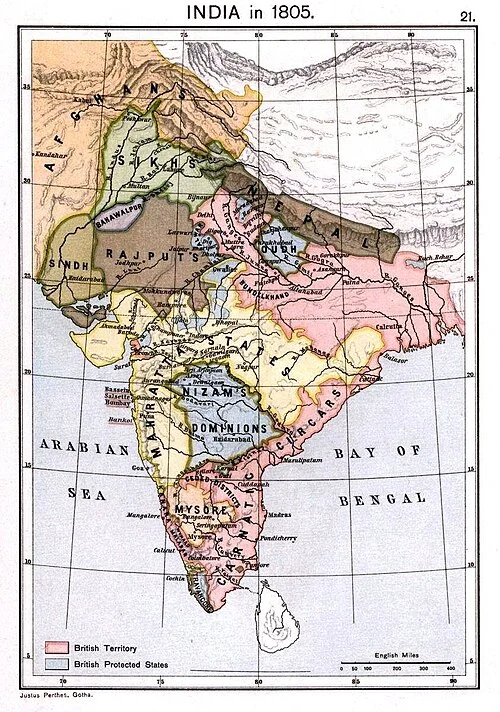
Second Anglo-Maratha War (1803-1805)
The Second Anglo-Maratha War was primarily a consequence of internal conflicts within the Maratha Confederacy. After the death of Peshwa Madhavrao Narayan, Bajirao II ascended the throne but proved to be an ineffective ruler. His rivalry with powerful chiefs like Jaswant Rao Holkar and Daulat Rao Sindhia destabilized the political structure.
The turning point came when Holkar defeated Bajirao II in 1802 at the Battle of Hadapsar, forcing him to flee to Bassein. There, he entered into the Treaty of Bassein (1802) with the British.
This treaty was a landmark event, as it placed the Peshwa under British protection through the Subsidiary Alliance system. Bajirao II agreed to maintain British troops, cede territories, and surrender control over foreign relations.
This treaty was strongly opposed by other Maratha chiefs, particularly Sindhia and the Bhonsle, who viewed it as a surrender of Maratha sovereignty. War became inevitable. The British, with their superior organization and military discipline, defeated the combined forces of Sindhia and Bhonsle in several decisive battles.
Jaswant Rao Holkar attempted to resist British expansion and sought to unite Indian powers against them, but his efforts failed. By the end of the war, the Marathas were reduced to subordinate allies or vassals of the British. The Treaty of Bassein thus marked a major step in establishing British dominance in India.
Third Anglo-Maratha War (1817-1818)
The Third Anglo-Maratha War was the final and decisive conflict that ended Maratha power. It was shaped by British imperial ambitions under Governor-General Lord Hastings and the growing unrest among Maratha chiefs due to earlier humiliations, particularly the Treaty of Bassein.
Another factor was the rise of the Pindaris, irregular plunderers who had once served the Marathas but had become a lawless force. The British used the presence of the Pindaris as a pretext to intervene militarily, accusing the Marathas of supporting them.
In 1817, Peshwa Bajirao II made a last attempt to assert independence by attacking the British Residency at Poona. Simultaneously, other Maratha chiefs also engaged in hostilities. However, the Maratha forces were disorganized and lacked unity. The British decisively defeated them in key battles such as Khirki, Sitabuldi, and Mahidpur.
A series of treaties followed, including the Treaty of Poona (1817), Treaty of Gwalior (1817), and Treaty of Mandasor (1818). By June 1818, Bajirao II surrendered. The office of Peshwa was abolished, and he was pensioned off to Bithur. A small principality of Satara was created under Pratap Singh, a descendant of Shivaji, but it remained under British control.
Impact and Significance of Anglo-Maratha Wars
The Anglo-Maratha Wars had far-reaching consequences for Indian history. They resulted in the complete dissolution of the Maratha Confederacy, ending one of the most powerful indigenous political formations of the time. The British East India Company emerged as the paramount power in India, controlling vast territories and establishing political supremacy.
The wars also marked the end of major Indian resistance at a pan-regional level. While earlier powers like Mysore had challenged the British, the defeat of the Marathas removed the last significant obstacle to British expansion.
Administratively, the British extended their governance over former Maratha territories, introducing new systems of revenue, law, and administration. Socially and politically, the decline of traditional Maratha nobility led to a restructuring of power relations in Indian society.
Conclusion
The Anglo-Maratha Wars were not merely a series of military conflicts but a turning point in Indian history. They highlight how internal divisions and lack of unity among Indian powers facilitated British expansion. The wars ultimately paved the way for the establishment of British colonial rule across India, marking the transition from regional polities to centralized colonial governance.
FAQs
Q1. What were the Anglo-Maratha Wars?
The Anglo-Maratha Wars were a series of three conflicts between the East India Company and the Maratha Confederacy.
Q2. How many Anglo-Maratha Wars were fought?
There were three wars:
Third Anglo-Maratha War (1817-1818)
First Anglo-Maratha War (1775-1782)
Second Anglo-Maratha War (1803-1805)
Q3. Why were the Anglo-Maratha Wars significant?
They marked the end of Maratha power and consolidated British authority in India.
Q4. What was the Treaty of Bassein?
The Treaty of Bassein was an agreement in which the Peshwa accepted British protection, weakening the Maratha Confederacy.
Q5. What was the outcome of the Anglo-Maratha Wars?
The wars resulted in the defeat of the Marathas and the establishment of British dominance over most parts of India.
Click on the question to see the Answers
Visit LevelUp IAS- Click Here