
GS-I (History, Geography, Society)
Pressure Belts of the Earth, Climatology
Content
- Introduction
- Formation of Pressure Belts
- Major Pressure Belts
- Detailed Understanding of Each Belt
- Seasonal Shifting of Pressure Belts
- Factors Affecting Pressure Belts
- Significance in Climatology
- Conclusion
- FAQs
Introduction
Pressure belts are one of the most fundamental concepts in climatology, forming the basis of global atmospheric circulation, wind systems, and climate patterns. They refer to latitudinal zones of relatively high and low atmospheric pressure that encircle the Earth and remain semi-permanent in nature. These belts are not random rather, they are a direct outcome of differential heating of the Earth’s surface and the dynamic movement of air masses.
Concept and Formation of Pressure Belts
The origin of pressure belts lies in the unequal distribution of solar energy across latitudes. The equatorial region receives maximum insolation, leading to intense heating of the surface. This causes the air to expand, become lighter, and rise upward, creating a zone of low pressure. In contrast, the polar regions receive minimal solar radiation, resulting in cold, dense air that sinks, forming high-pressure areas.
However, the system is not limited to a simple equator-to-pole circulation. Due to the rotation of the Earth and the influence of the Coriolis force, the rising and sinking air currents are organised into distinct cells, giving rise to alternating belts of high and low pressure across latitudes. These belts are generally arranged symmetrically in both hemispheres.
Major Pressure Belts of the Earth
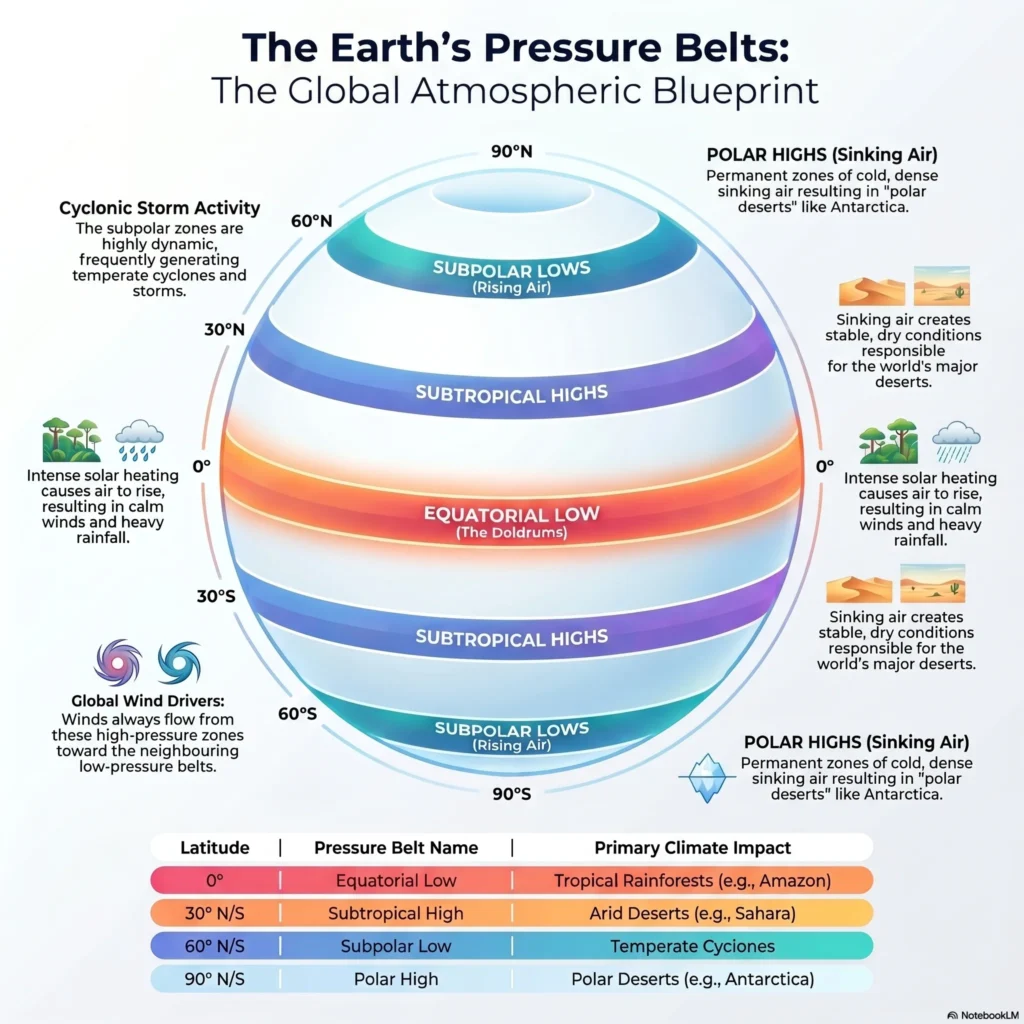
The Earth has four primary pressure belts in each hemisphere, forming a global pattern. These belts are continuous but vary slightly due to land–water distribution and seasonal changes.
| Pressure Belt / Wind System | Location | Characteristics | Examples / Impact |
| Equatorial Low-Pressure Belt (Doldrums) | Around 0° latitude | High temperature leads to rising air, calm surface winds, heavy convectional rainfall | Dense tropical forests like Amazon and Congo |
| Subtropical High-Pressure Belts | Around 30°N and 30°S | Descending air creates stable high pressure, dry and clear conditions | Major deserts such as Sahara, Arabian, Kalahari |
| Subpolar Low-Pressure Belts | Around 60°N and 60°S | Convergence of warm and cold air; rising motion, cyclonic activity | Temperate cyclones in North Atlantic |
| Polar High-Pressure Belts | Around 90°N and 90°S | Cold dense air sinks, stable and dry conditions | Polar deserts like Antarctica |
| Polar Easterlies (Winds) | From poles toward 60° latitude | Cold, dry winds flowing east to west under Coriolis influence | Arctic and Antarctic wind systems |
Detailed Understanding of Each Belt
- The equatorial low-pressure belt, often referred to as the doldrums, is characterised by intense heating and rising air currents. The absence of strong horizontal winds leads to calm conditions at the surface, while the upward movement of moist air results in heavy convectional rainfall. This region is associated with the Inter-Tropical Convergence Zone (ITCZ), where trade winds from both hemispheres converge.
- The subtropical high-pressure belts, located around 30° latitudes, are formed by the descending branch of the Hadley cell. As air descends, it becomes compressed and warms, leading to dry and stable atmospheric conditions. These regions are marked by clear skies and minimal precipitation, which explains the concentration of the world’s major deserts in these latitudes.
- The subpolar low-pressure belts develop around 60° latitudes, where warm westerlies from the subtropics meet cold polar easterlies. This convergence leads to the uplift of air and the formation of low-pressure conditions. These belts are highly dynamic and are associated with frequent cyclonic disturbances and storm systems, especially in the Northern Hemisphere.
- The polar high-pressure belts exist at the poles, where extremely low temperatures cause air to contract and sink. These regions experience stable atmospheric conditions with very little precipitation, often referred to as polar deserts.
Seasonal Shifting of Pressure Belts
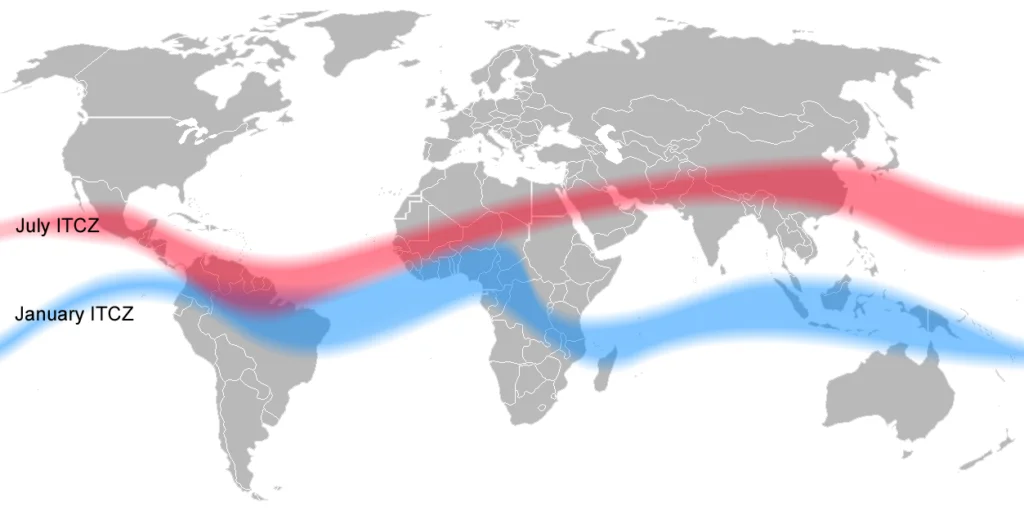
- One of the most important aspects of pressure belts is their seasonal migration. These belts do not remain fixed but shift northward and southward with the apparent movement of the Sun. This shift is primarily caused by the Earth’s axial tilt and revolution.
- During the Northern Hemisphere summer, all pressure belts move northward, while during winter, they shift southward. The equatorial low-pressure belt (ITCZ) shows the most noticeable movement, often shifting several degrees from the equator.
- This seasonal migration has profound implications for global climate systems. In the Indian context, the northward shift of the ITCZ during summer creates a low-pressure area over the Indian subcontinent, drawing in moisture-laden winds from the Indian Ocean. This leads to the onset of the southwest monsoon. Similarly, the shifting of subpolar lows influences the movement of temperate cyclones.
Factors Affecting Pressure Belts
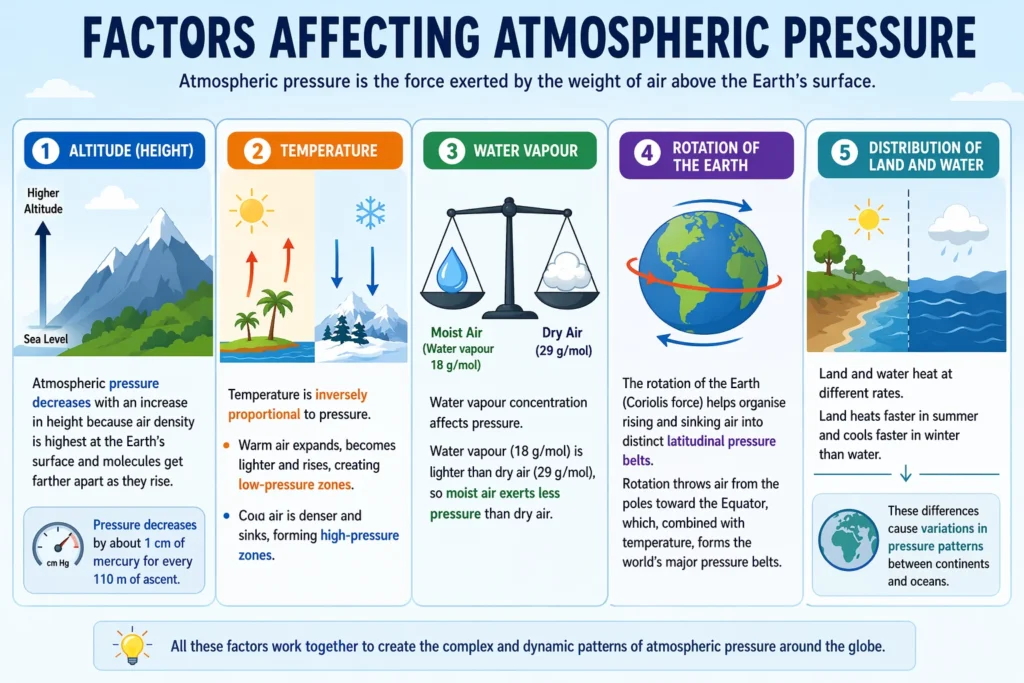
- While the general pattern of pressure belts is latitudinal, several factors cause deviations and complexities.
- The unequal distribution of land and water leads to variations in pressure patterns, especially between continents and oceans. For example, during summer, land heats up faster than water, creating low-pressure areas over continents.
- The rotation of the Earth introduces the Coriolis force, which deflects moving air and helps organise pressure systems into distinct circulation cells.
- Altitude and topography also influence local pressure variations. Mountain ranges can obstruct air movement and create regional pressure differences.
Significance in Climatology
- Pressure belts are central to understanding global wind systems. Winds always blow from high-pressure areas to low-pressure areas, and the arrangement of pressure belts determines the direction and nature of these winds. Trade winds, westerlies, and polar easterlies all originate due to these pressure differences.
- They also control precipitation patterns across the globe. Regions under low-pressure belts experience rising air and heavy rainfall, while high-pressure belts are associated with descending air and arid conditions.
- Pressure belts play a crucial role in ocean circulation as well. Surface winds generated by pressure differences drive ocean currents, which help redistribute heat and regulate global temperatures.
- In addition, they are critical for predicting weather phenomena such as cyclones, anticyclones, monsoons, and droughts. Their seasonal movement directly influences agricultural cycles and water availability in many parts of the world.
Conclusion
Pressure belts form the backbone of Earth’s atmospheric circulation system. They not only determine wind patterns but also shape global climate zones, rainfall distribution, and ocean currents. For UPSC preparation, a clear conceptual understanding of pressure belts, along with their seasonal shifting and climatic implications, is essential for both Prelims and Mains, especially in Geography, Environment, and Disaster Management contexts.
FAQs
Q1. What are pressure belts of the Earth?
Pressure belts of the Earth are latitudinal zones of high and low atmospheric pressure formed due to unequal heating of the Earth’s surface and rotation.
Q2. What are the major pressure belts?
There are four main types:
Polar High Pressure Belts
Equatorial Low Pressure Belt (ITCZ)
Subtropical High Pressure Belts
Subpolar Low Pressure Belts
Q3. What is the ITCZ?
The Intertropical Convergence Zone is a low-pressure belt near the equator where trade winds converge, leading to rising air and heavy rainfall.
Q4. How do pressure belts influence winds?
Air moves from high-pressure to low-pressure areas, creating planetary wind systems like trade winds, westerlies, and polar easterlies.
Q5. Why do pressure belts shift?
They shift due to the apparent movement of the Sun (seasonal changes), causing variations in climate and monsoon patterns.
Click on the question to see the Answers
Visit LevelUp IAS- Click Here
Related reads.
Coastal Landforms
28 Sep 2026 8 min

Medieval Indian Literature
28 Sep 2026 8 min
Ocean Currents
26 Sep 2026 7 min

Ancient Indian Literature
26 Sep 2026 6 min
Salinity Distribution in Oceans
25 Sep 2026 6 min

Folk Theatre of India
25 Sep 2026 5 min
Put it into practice
Reading is step one.
Turn what you've just read into exam-ready answers with mentor-led practice and our structured test series.