Indian Monsoon UPSC
Content
- Introduction
- Concept
- Types
- Mechanism and Driving Forces
- Regional Variations
- Impact of Monsoon
- Monsoon Prediction and Management
- Conclusion
- FAQs
Introduction
The Indian monsoon is one of the most significant climatic phenomena influencing the Indian subcontinent. It is not merely a seasonal rainfall event but a complex atmospheric system driven by the interaction of land, ocean, and atmospheric dynamics. The monsoon governs India’s climate, agriculture, water resources, and overall socio-economic structure. Given that a large proportion of India’s population depends on rain-fed agriculture, the monsoon acts as the lifeline of the economy and sustains ecological balance.
Concept of Monsoon
The term “monsoon” is derived from the Arabic word mausim, meaning “season.” In meteorological terms, a monsoon refers to a seasonal reversal of winds accompanied by corresponding changes in precipitation. It involves large-scale atmospheric circulation patterns influenced by differential heating of land and sea.
The Indian monsoon is distinct due to its intensity, variability, and widespread socio-economic impact. It determines cropping patterns, water availability, and even industrial and economic performance.
Types
1. Southwest Monsoon (June to September)
The southwest monsoon is the principal rainy season in India, contributing nearly 75–80% of the annual rainfall. During summer, intense heating over the northwestern parts of India, especially the Thar Desert region, creates a low-pressure zone. Simultaneously, the surrounding Indian Ocean maintains relatively higher pressure. This pressure gradient drives moisture-laden winds from the ocean towards the Indian landmass.
The onset of the monsoon is marked by a sudden increase in humidity, cloud cover, and rainfall, along with a drop in temperature. These winds bifurcate into two branches: the Arabian Sea branch and the Bay of Bengal branch. The Western Ghats and northeastern hills receive very heavy rainfall due to orographic uplift, while interior regions receive moderate rainfall.
This phase supports the Kharif cropping season, making it crucial for crops like rice, maize, sugarcane, pulses, and millets. Variability in onset and distribution can significantly impact agricultural productivity and rural livelihoods.
2. Northeast Monsoon (October to December)
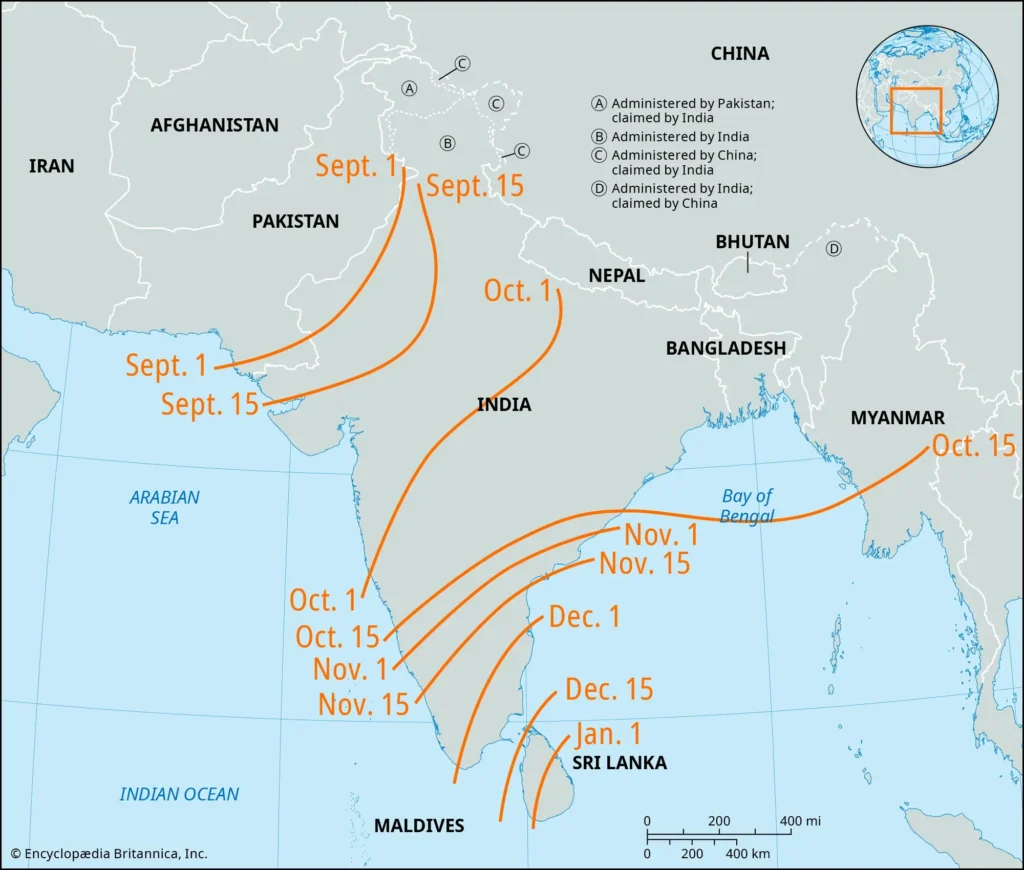
Also known as the retreating monsoon, this phase begins with the withdrawal of the southwest monsoon. As the sun shifts southward, a high-pressure system develops over northern India, and winds reverse direction, blowing from land to sea.
These winds pick up moisture from the Bay of Bengal and bring rainfall primarily to the southeastern coast, especially Tamil Nadu, Andhra Pradesh, and parts of Kerala. Although it contributes only about 10-15% of India’s total rainfall, it is critically important for southern India, particularly for Rabi crops and groundwater recharge.
Mechanism and Driving Forces of Indian Monsoon
1. Differential Heating of Land and Sea
Land heats and cools faster than water, creating seasonal pressure differences that drive monsoon winds from sea to land in summer and reverse in winter.
2. Inter-Tropical Convergence Zone (ITCZ)
The Inter-Tropical Convergence Zone is a low-pressure zone near the equator where trade winds converge. During summer, it shifts northward over India, drawing in moist winds and initiating monsoon rainfall. In winter, it shifts southward, leading to dry conditions over India.
3. Tibetan Plateau
The Tibetan Plateau acts as a heat source during summer, heating the overlying air and strengthening monsoon circulation. It also acts as a physical barrier, influencing atmospheric circulation and jet stream behaviour.
4. Role of Jet Streams
Upper atmospheric winds, especially the subtropical westerly jet and tropical easterly jet, influence the onset and withdrawal of the monsoon. The shift of the westerly jet northward allows the monsoon to advance, while the tropical easterly jet strengthens rainfall.
5. Somali Jet (Low-Level Jet)
This is a strong low-level wind current over the Arabian Sea that transports large amounts of moisture towards the Indian subcontinent, intensifying the southwest monsoon.
6. Oceanic Factors (ENSO & IOD)
Phenomena such as El Niño and La Niña significantly influence monsoon variability. El Niño is generally associated with weaker monsoons, while La Niña often enhances rainfall. Similarly, the Indian Ocean Dipole (IOD) affects sea surface temperatures and rainfall distribution.
Regional Variations in Monsoon Rainfall
The Indian monsoon exhibits significant spatial variability due to topography and geographical location. The Western Ghats and northeastern states receive extremely heavy rainfall due to orographic effects. Places like Mawsynram and Cherrapunji are among the wettest regions in the world.
The northern plains receive moderate to heavy rainfall influenced by monsoon progression. In contrast, the Deccan Plateau experiences relatively less rainfall as the winds lose moisture while crossing the Western Ghats. Arid regions such as Rajasthan and parts of Gujarat receive scanty and erratic rainfall, making them prone to droughts.
Impact of Monsoon
1. Agriculture
The monsoon determines cropping patterns, sowing cycles, and agricultural productivity. A good monsoon ensures food security, while a deficient monsoon leads to crop failure and distress.
2. Water Resources
Monsoon rains replenish rivers, lakes, reservoirs, and groundwater, which are essential for irrigation, drinking water, and hydropower generation.
3. Economy
A strong monsoon boosts rural incomes, agricultural output, and GDP growth, while poor rainfall can lead to inflation, reduced consumption, and economic slowdown.
4. Health and Society
While monsoon improves water availability, it also increases the risk of waterborne diseases such as dengue, malaria, and cholera.
5. Infrastructure and Environment
Heavy rainfall can lead to floods, landslides, and infrastructure damage. At the same time, it supports ecosystems, soil moisture, and biodiversity.
Monsoon Prediction and Management
Advances in meteorology, including satellite observations, Doppler radar, and climate modelling, have improved monsoon forecasting.
Government initiatives focus on flood control, irrigation development, and disaster preparedness.
Adaptive strategies such as rainwater harvesting, watershed management, crop diversification, and climate-resilient agriculture are essential for mitigating risks associated with monsoon variability.
Conclusion
The Indian monsoon is a complex and dynamic climatic system that profoundly influences India’s environment, economy, and society. Its dependence on multiple atmospheric and oceanic factors makes it both vital and unpredictable. In the context of climate change, improving monsoon prediction, strengthening adaptive capacity, and ensuring sustainable resource management are crucial for maintaining India’s socio-economic stability. The monsoon, therefore, remains not just a climatic phenomenon but the backbone of India’s development and survival.
FAQs
Q1. What is the Indian Monsoon?
The Indian Monsoon refers to a seasonal reversal of winds accompanied by significant rainfall, crucial for agriculture and water resources in India.
Q2. What are the main types of monsoon in India?
Southwest Monsoon (June-September) – brings major rainfall
Northeast Monsoon (October-December) – affects mainly Tamil Nadu coast
Q3. What is the mechanism of the Indian Monsoon?
It is driven by:
Influence of jet streams and ocean currents
Differential heating of land and sea
Shift of the Intertropical Convergence Zone
Formation of low pressure over the Indian subcontinent
Q4. What are the branches of the Southwest Monsoon?
Arabian Sea Branch
Bay of Bengal Branch
Q5. What factors influence the Indian Monsoon?
Key factors include:
Himalayan and Western Ghats topography
El Niño and La Niña
Indian Ocean Dipole (IOD)
Jet streams
Click on the question to see the Answers
Visit LevelUp IAS- Click Here