
Mains Articles
Volcanism, Geomorphology UPSC
Content
- Introduction
- Concept
- Important Terminology
- Causes of Volcanism
- Process of Volcanism
- Effects of Volcanism
- Distribution of Volcanoes
- Conclusion
- FAQs
Introduction
Volcanism is a fundamental geological process through which magma, gases, and pyroclastic materials are expelled from the Earth’s interior onto the surface. It plays a crucial role in shaping the Earth’s crust, influencing climate systems, and contributing to both constructive and destructive geomorphic processes.
For UPSC, volcanism is important from the perspectives of physical geography, disaster management, and environmental impacts.
Concept of Volcanism
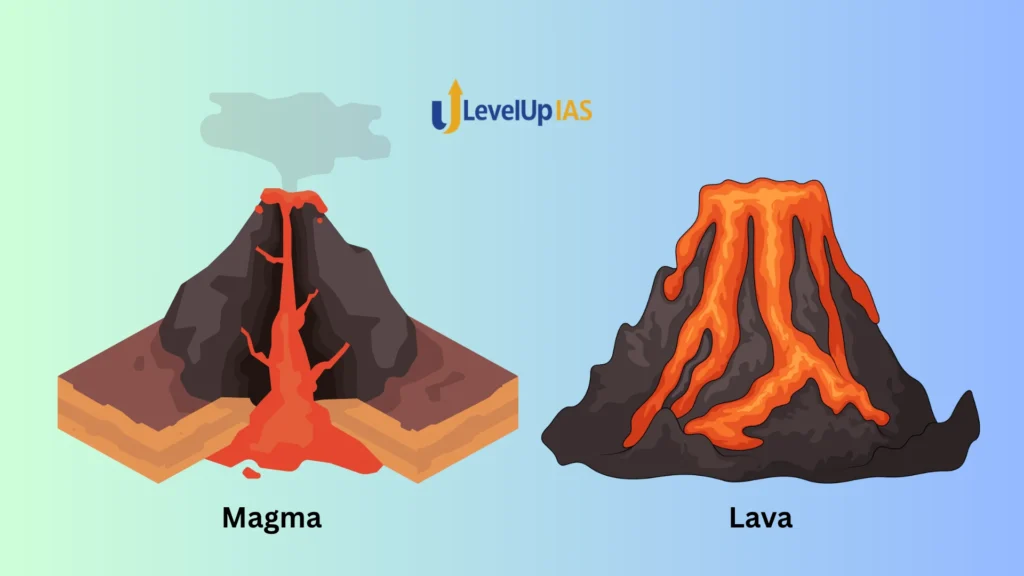
Volcanism refers to all processes by which molten material from within the Earth reaches the surface. This molten material, known as magma inside the Earth, becomes lava when it erupts. The process is primarily driven by internal heat energy and tectonic activity.
Volcanoes are the surface expressions of volcanism. Depending on magma composition and eruption style, different volcanic landforms such as shield volcanoes, composite (stratovolcanoes), and cinder cones are formed. Eruptions may be effusive, involving quiet lava flows, or explosive, characterized by violent ejection of ash, gases, and pyroclastic materials.
Important Terminology in Volcanism
Magma refers to molten rock beneath the Earth’s crust, while lava is magma that has reached the surface. A volcano is the landform created by repeated accumulation of erupted materials such as lava and ash. The opening through which magma escapes is known as a vent, and the depression at the summit is called a crater.
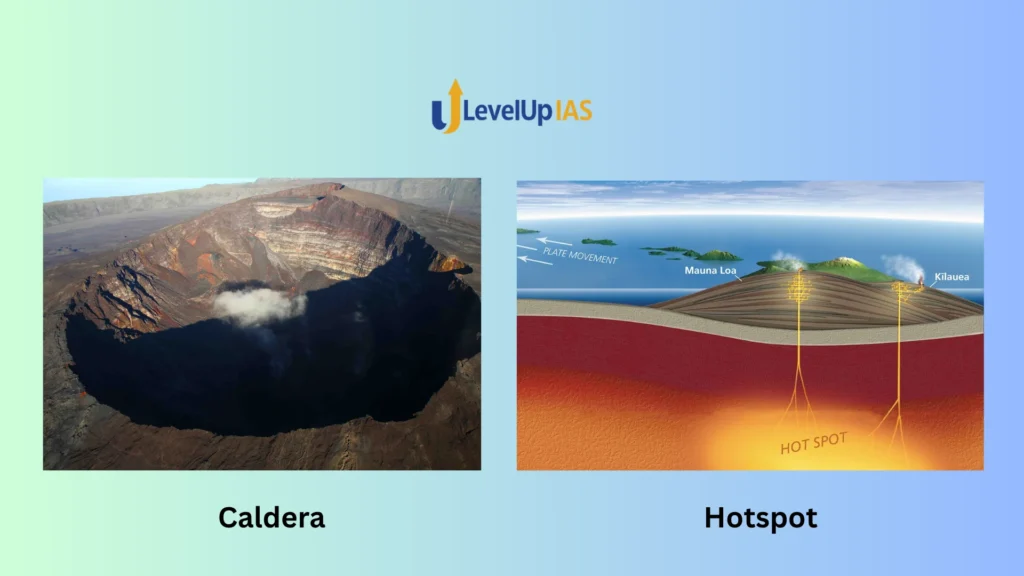
A caldera is a large basin formed when a magma chamber collapses after a major eruption. Pyroclastic flows are extremely hot and fast-moving currents of gases, ash, and debris, which are among the most destructive volcanic hazards. Tephra includes all solid materials ejected during eruptions, while volcanic ash consists of very fine particles that can travel long distances.
Hotspots are areas of volcanic activity away from plate boundaries, caused by mantle plumes, as seen in Hawaii. Fissures are elongated cracks through which lava flows out. Rocks such as basalt (low silica, fluid lava) and andesite/rhyolite (high silica, viscous lava) determine eruption style.
Features like volcanic domes, lahars (volcanic mudflows), plumes, geysers, and tuff deposits further define volcanic landscapes.
Causes of Volcanism
Volcanism is primarily linked to tectonic and internal processes of the Earth.
- The movement of tectonic plates is the most important cause. At divergent boundaries, plates move apart, allowing magma to rise and form new crust, as seen along mid-ocean ridges. At convergent boundaries, one plate subducts beneath another, leading to melting and explosive volcanism, particularly around the Pacific Ring of Fire.
- Hotspot volcanism occurs due to mantle plumes, where upwelling magma creates volcanic islands independent of plate boundaries. Additionally, mantle convection currents driven by internal heat facilitate magma generation.
- Pressure build-up within magma chambers, aided by expanding gases, leads to eruptions. Structural weaknesses in the crust, such as faults and fractures, act as pathways for magma ascent. Thermal anomalies, including radioactive decay within the Earth, further contribute to magma formation.
Process of Volcanism
Volcanism follows a systematic sequence of geological processes.
- The first stage involves magma generation, which occurs due to partial melting in the mantle or lower crust caused by increased temperature, reduced pressure, or the presence of volatiles like water vapor.
- The generated magma rises and accumulates in underground reservoirs called magma chambers. Over time, dissolved gases expand, leading to a build-up of pressure within these chambers.
- When the pressure exceeds the strength of the overlying rocks, it results in fracturing of the crust, creating pathways for magma to ascend. This culminates in an eruption, which may be effusive or explosive depending on magma composition and gas content.
- Following eruption, volcanic materials solidify to form landforms such as volcanoes, lava plateaus, domes, and calderas. In the post-eruption stage, secondary activities like geysers, fumaroles, and hot springs may continue, indicating residual geothermal energy.
Effects of Volcanism
Volcanism has both destructive and constructive impacts, making it a double-edged phenomenon.
- On the negative side, volcanic eruptions can cause loss of life, destruction of property, and large-scale displacement of populations. Pyroclastic flows, ash fall, and toxic gases pose serious health hazards. Volcanic eruptions can also disrupt air travel and damage infrastructure.
- From a climatic perspective, large eruptions inject ash and aerosols into the atmosphere, which can lead to short-term global cooling by blocking solar radiation. Super-eruptions have the potential to affect global agriculture and ecosystems.
- However, volcanism also has significant positive impacts. Volcanic soils are highly fertile due to the presence of minerals, supporting agriculture in regions like Java and the Deccan Plateau. It also provides geothermal energy resources and contributes to the formation of valuable minerals.
- Geomorphologically, volcanism plays a constructive role by creating new landforms and reshaping landscapes. It also contributes to hydrological changes, sometimes triggering landslides, tsunamis, or altering river courses.
Distribution of Volcanoes
Volcanic activity is not randomly distributed but follows specific global patterns linked to plate tectonics.
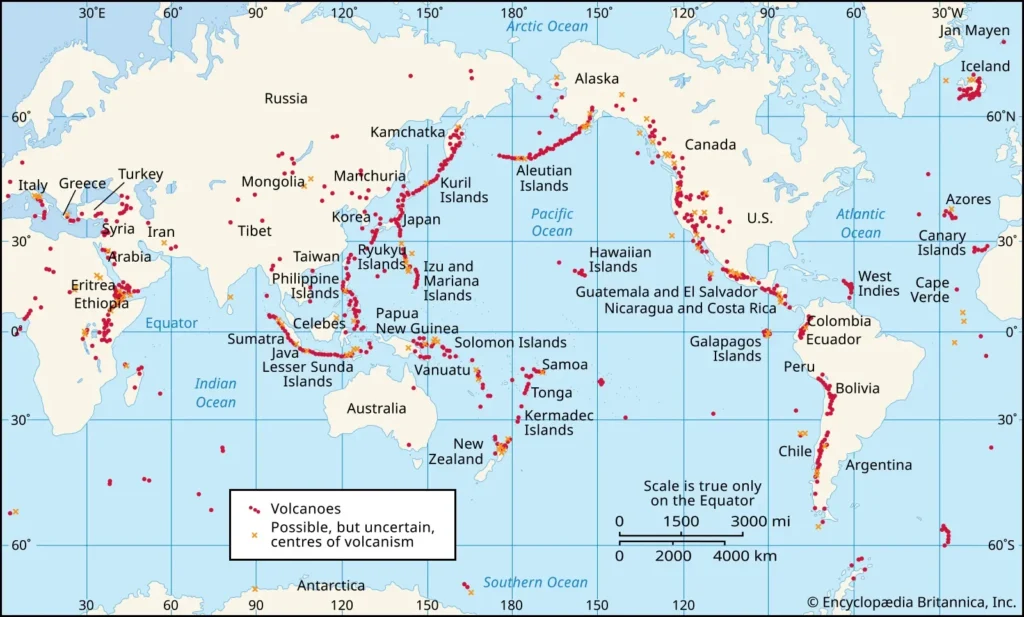
- The most prominent zone is the Pacific Ring of Fire, which contains about 75% of the world’s active volcanoes. This region includes countries like Japan, Indonesia, and the western coasts of the Americas.
- Another important zone is the mid-ocean ridges, such as the Mid-Atlantic Ridge, where continuous volcanic activity forms new oceanic crust.
- Hotspots represent intraplate volcanism, with classic examples including Hawaii, Iceland, and Yellowstone. Rift zones, such as the East African Rift, also exhibit volcanic activity due to crustal stretching.
- Subduction zones, where one plate descends beneath another, give rise to explosive volcanoes forming volcanic arcs, such as those seen in Japan and the Andes.
Conclusion
Volcanism is a dynamic and continuous process that reflects the internal energy of the Earth. While it poses serious hazards, it also contributes significantly to land formation, resource generation, and ecological development.
FAQs
Q1. What is volcanism?
Volcanism refers to the movement of magma, gases, and pyroclastic materials from the Earth’s interior to its surface, resulting in the formation of volcanic landforms.
Q2. What is the process of volcanism?
Volcanism begins with the formation of magma in the mantle due to melting. This magma rises through cracks and fissures due to pressure and buoyancy. It accumulates in magma chambers and eventually erupts through vents, releasing lava, ash, and gases onto the surface.
Q3. What are the main causes of volcanism?
Volcanism is caused by:
Crustal weaknesses and fractures
Plate tectonic activity (divergent and convergent boundaries)
Subduction of oceanic plates leading to melting
Hotspots (mantle plumes rising from deep within the Earth)
Q4. What is the global distribution of volcanoes?
Volcanoes are unevenly distributed and mainly occur along plate boundaries. The most prominent zone is the Pacific Ring of Fire, which accounts for the majority of active volcanoes. Other regions include mid-ocean ridges and hotspot areas like Hawaii.
Q5. What are the types of volcanic eruptions?
Volcanic eruptions can be:
Explosive (violent eruptions with ash and gases)
The type depends on magma composition, viscosity, and gas content.
Effusive (quiet lava flows)
Click on the question to see the Answers
Visit LevelUp IAS- Click Here
Related reads.
How to Read NCERTs for UPSC: Subject-Wise Strategy & Notes Making
22 Jun 2026 10 min
PSIR Topper's Answer Copies
22 Jun 2026 1 min
Sociology Optional PYQs (2009-2024)
22 Jun 2026 1 min
Philosophy Optional PYQs
22 Jun 2026 1 min
PSIR Optional PYQs
22 Jun 2026 1 min
History Optional PYQs (2009-2025) – Free PDF & Video
22 Jun 2026 1 min
Put it into practice
Reading is step one.
Turn what you've just read into exam-ready answers with mentor-led practice and our structured test series.