Non-Cooperation Movement (1920-1922)
Content
- Introduction
- Background
- Causes
- Launch of the Movement
- Objectives of the Indian National Congress
- Programmes and Methods
- Spread of the Non-Cooperation Movement
- Role of Gandhi in the Movement
- Chauri Chaura Incident
- Significance of the Formation of INC
- Limitations
- Conclusion
- FAQs
Introduction
The Non-Cooperation Movement (NCM) was the first truly nationwide mass movement launched under the leadership of Mahatma Gandhi against British colonial rule in India. It marked a turning point in the history of the Indian national movement because it transformed the freedom struggle from an elite constitutional agitation into a broad-based mass movement involving peasants, workers, students, women, traders, and the middle classes.
Launched officially in 1920 by the Indian National Congress, the movement aimed at achieving Swaraj through peaceful and non-violent means by withdrawing Indian cooperation from British institutions and administration. The movement was deeply influenced by the Rowlatt Act, the Jallianwala Bagh Massacre, and the Khilafat issue.
The movement continued till February 1922 and was withdrawn after the Chauri Chaura incident in Gorakhpur district of Uttar Pradesh. Despite its abrupt end, the movement fundamentally altered the character of Indian nationalism and established Gandhi as the undisputed leader of the national movement.
Background
The years following the First World War witnessed growing dissatisfaction against British rule in India. Indians had supported Britain during the war with the expectation that constitutional reforms and greater political rights would follow. However, instead of granting meaningful self-government, the British adopted repressive measures.
The economic condition of the people deteriorated sharply during and after the war. Heavy taxation, rising prices, inflation, forced recruitment, and shortages created immense hardship among the masses. Simultaneously, political repression increased, leading to widespread resentment.
The passage of the Rowlatt Act in 1919 became a major turning point. The Act empowered the government to arrest and detain individuals without trial. Gandhi described it as a “Black Act” and launched a nationwide Satyagraha against it.
Public anger intensified further after the Jallianwala Bagh Massacre of April 1919, where General Dyer ordered troops to fire on a peaceful gathering in Amritsar, killing hundreds of innocent civilians. The massacre shocked the entire nation and destroyed Indian faith in British justice.
At the same time, Indian Muslims were agitated over the fate of the Ottoman Caliph after the First World War. The Khilafat Movement emerged to protest British actions against Turkey. Gandhi saw in the Khilafat issue an opportunity to unite Hindus and Muslims against colonial rule.
Thus, political repression, economic hardship, nationalist awakening, and the Khilafat issue together created the conditions for launching the Non-Cooperation Movement.
Causes of the Non-Cooperation Movement
First World War and Economic Hardships
The First World War imposed enormous economic burdens on India. Taxes increased, prices of essential commodities rose rapidly, and inflation affected ordinary people severely. Rural indebtedness increased, while peasants suffered due to forced cultivation and revenue demands.
The post-war economic crisis created widespread dissatisfaction among both urban and rural populations.
Failure of Constitutional Reforms
The British introduced the Government of India Act, 1919 based on the Montagu-Chelmsford Reforms. However, these reforms failed to satisfy Indian aspirations. The system of dyarchy gave only limited powers to Indians while real authority remained with the British.
Nationalist leaders considered the reforms disappointing and inadequate.
Rowlatt Act (1919)
The Rowlatt Act authorised the government to detain individuals without trial and suppress political activities. It violated civil liberties and generated nationwide protests.
Gandhi launched the Rowlatt Satyagraha, which became his first all-India movement.
Jallianwala Bagh Massacre
The massacre at Jallianwala Bagh in Amritsar on 13 April 1919 deeply disturbed the Indian psyche. General Dyer’s brutal firing on an unarmed gathering symbolised colonial oppression and convinced many Indians that cooperation with the British was impossible.
Khilafat Movement
The Khilafat Movement was launched by Indian Muslims to defend the Ottoman Caliphate after the war. Gandhi supported the movement to promote Hindu-Muslim unity and integrate Muslim masses into the national movement.
The convergence of the Khilafat Movement and Non-Cooperation Movement gave the struggle a broader mass base.
Launch of the Non-Cooperation Movement
At the special session of the Congress held at Calcutta in September 1920, Gandhi persuaded the Congress to adopt the programme of Non-Cooperation. The movement was formally approved at the Nagpur Session of Congress in December 1920.
The Nagpur Session also reorganised the Congress on linguistic lines and broadened its organisational structure, enabling mass participation.
The movement sought to attain Swaraj through peaceful and legitimate means by refusing cooperation with British institutions.
Objectives of the Movement
The movement had both immediate and long-term objectives.
The immediate objectives included:
- Redressal of Punjab wrongs, especially justice for the Jallianwala Bagh Massacre.
- Protection of the Khilafat cause.
- Protest against colonial repression.
The larger objective was the attainment of Swaraj or self-government.
Programmes and Methods of the Movement
The movement involved the systematic boycott of British institutions and practices.
Boycott of Government Institutions
Students were encouraged to leave government schools and colleges. Lawyers were asked to boycott courts, and people were urged not to participate in legislative councils.
Many prominent lawyers such as C. R. Das, Motilal Nehru, and Rajendra Prasad gave up their legal practices.
Boycott of Foreign Goods
The movement promoted the boycott of imported British goods and encouraged the use of Swadeshi products. Foreign cloth was publicly burned in several places.
Khadi and spinning through the Charkha became symbols of self-reliance and nationalism.
Surrender of Titles
People were urged to surrender titles and honours given by the British government. Gandhi himself returned the Kaiser-i-Hind medal awarded to him.
Promotion of National Education
National educational institutions were established as alternatives to British-controlled institutions. Important institutions founded during this period included:
- Jamia Millia Islamia
- Kashi Vidyapeeth
- Bihar Vidyapeeth
Constructive Programme
- The movement also focused on:
- Establishment of panchayats
- Promotion of Hindu-Muslim unity
- Removal of untouchability
- Spread of khadi and village industries
Spread of the Non-Cooperation Movement
The movement spread rapidly across India and acquired diverse regional forms depending on local grievances and conditions.
In Bengal, nationalist mobilisation was organised by leaders like Chittaranjan Das and Birendranath Sasmal.
In Punjab, the Akali Movement for Gurudwara reform became closely linked with Non-Cooperation.
In Awadh and parts of Uttar Pradesh, peasant movements under leaders like Baba Ram Chandra merged with the movement.
In Andhra, tribal resistance under Alluri Sitarama Raju connected anti-colonial struggles with local grievances.
In Kerala, the Moplah uprising reflected agrarian and religious tensions during the period.
In Gujarat, Sardar Vallabhbhai Patel played a major role in mobilising people.
Women, students, traders, workers, and peasants participated enthusiastically, making it the first genuinely mass-based national movement.
Role of Gandhi in the Movement
Mahatma Gandhi transformed Indian nationalism through the Non-Cooperation Movement. He introduced the methods of Satyagraha, non-violence, and mass mobilisation into national politics.
Gandhi emphasised discipline, self-sacrifice, and peaceful resistance. He believed that British rule survived because Indians cooperated with it, and therefore withdrawal of cooperation would weaken colonial authority.
His leadership brought ordinary people into politics on an unprecedented scale.
Chauri Chaura Incident
The movement came to an abrupt end after the Chauri Chaura incident on 5 February 1922 in Gorakhpur district of Uttar Pradesh.
During a protest, a violent clash occurred between demonstrators and police. Protesters set fire to a police station, resulting in the death of several policemen.
Gandhi believed that the incident violated the principle of non-violence, which was the foundation of the movement. Consequently, he decided to withdraw the Non-Cooperation Movement on 11 February 1922.
This decision disappointed many nationalist leaders such as Subhas Chandra Bose and Jawaharlal Nehru, who felt the movement had reached a critical stage.
Reasons for Withdrawal:
Apart from the Chauri Chaura incident, several factors contributed to the withdrawal:
The movement had witnessed sporadic violence in several regions, indicating lack of discipline among participants.
The government had intensified repression through arrests, censorship, and bans on public meetings.
The Khilafat issue lost relevance after the abolition of the Ottoman Caliphate by Mustafa Kemal Ataturk.
There were fears within Congress leadership that the movement might turn into a broader social revolution against landlords and elites.
Significance
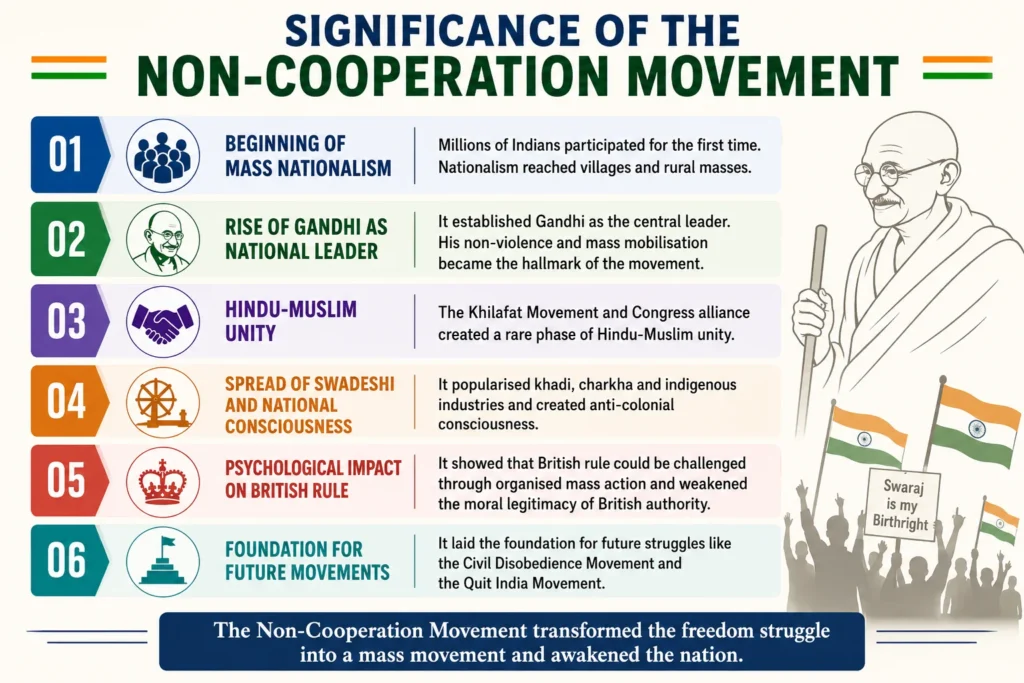
The Non-Cooperation Movement occupies a crucial place in the history of the Indian freedom struggle.
Beginning of Mass Nationalism
For the first time, millions of ordinary Indians participated directly in the national movement. Nationalism moved beyond urban educated elites and reached villages and rural masses.
Rise of Gandhi as National Leader
The movement established Gandhi as the central leader of Indian nationalism. His methods of non-violence and mass mobilisation became dominant features of the freedom struggle.
Hindu-Muslim Unity
The alliance between the Khilafat Movement and Congress created a rare phase of Hindu-Muslim unity in Indian politics.
Spread of Swadeshi and National Consciousness
The movement popularised khadi, charkha, and indigenous industries. It also generated anti-colonial consciousness among diverse sections of society.
Psychological Impact on British Rule
The movement demonstrated that British rule could be challenged through organised mass action. It weakened the moral legitimacy of colonial authority.
Foundation for Future Movements
The experiences gained during the movement laid the groundwork for later struggles such as:
- Civil Disobedience Movement
- Quit India Movement
Limitations and Decline of the Movement
Despite its achievements, the movement had several limitations.
The movement lacked a clear roadmap for achieving Swaraj beyond boycott and non-cooperation.
Rural participation often reflected local agrarian grievances rather than nationalist objectives.
The merger with the Khilafat issue introduced religious elements into politics, which later weakened secular nationalist unity.
The sudden withdrawal created frustration among many young nationalists and revolutionaries.
The movement also failed to sustain long-term organisational discipline.
Conclusion
The Non-Cooperation Movement marked the transition of the Indian national movement into a broad-based mass struggle. It transformed the political consciousness of Indians and challenged the legitimacy of British rule on an unprecedented scale.
Although the movement was withdrawn before achieving Swaraj, it succeeded in politicising millions of Indians and creating a spirit of resistance against colonialism. The movement demonstrated the strength of non-violent mass mobilisation and established Gandhi’s leadership over the national movement.
In many ways, the Non-Cooperation Movement laid the foundation for the later phases of India’s struggle for independence and remains one of the most significant chapters in modern Indian history.
FAQs
Q1. What was the Non-Cooperation Movement?
The Non-Cooperation Movement was the first large-scale mass movement launched by Mahatma Gandhi against British rule based on non-violence and non-cooperation.
Q2. Why was the Non-Cooperation Movement launched?
The movement was launched due to:
Demand for Swaraj (self-rule)
Jallianwala Bagh Massacre
Repressive British policies
Support for the Khilafat Movement
Q3. What were the main methods used in the movement?
Methods included:
Promotion of khadi and swadeshi
Boycott of foreign goods
Resignation from government jobs
Boycott of courts and educational institutions
Q4. What was the significance of the movement?
It transformed the freedom struggle into a mass movement involving peasants, workers, students, and women across India.
Q5. Why was the Non-Cooperation Movement withdrawn?
The movement was withdrawn after the Chauri Chaura Incident, where protesters set a police station on fire, leading Gandhi to suspend the movement due to violence.
Click on the question to see the Answers
Visit LevelUp IAS- Click Here