
Mains Articles
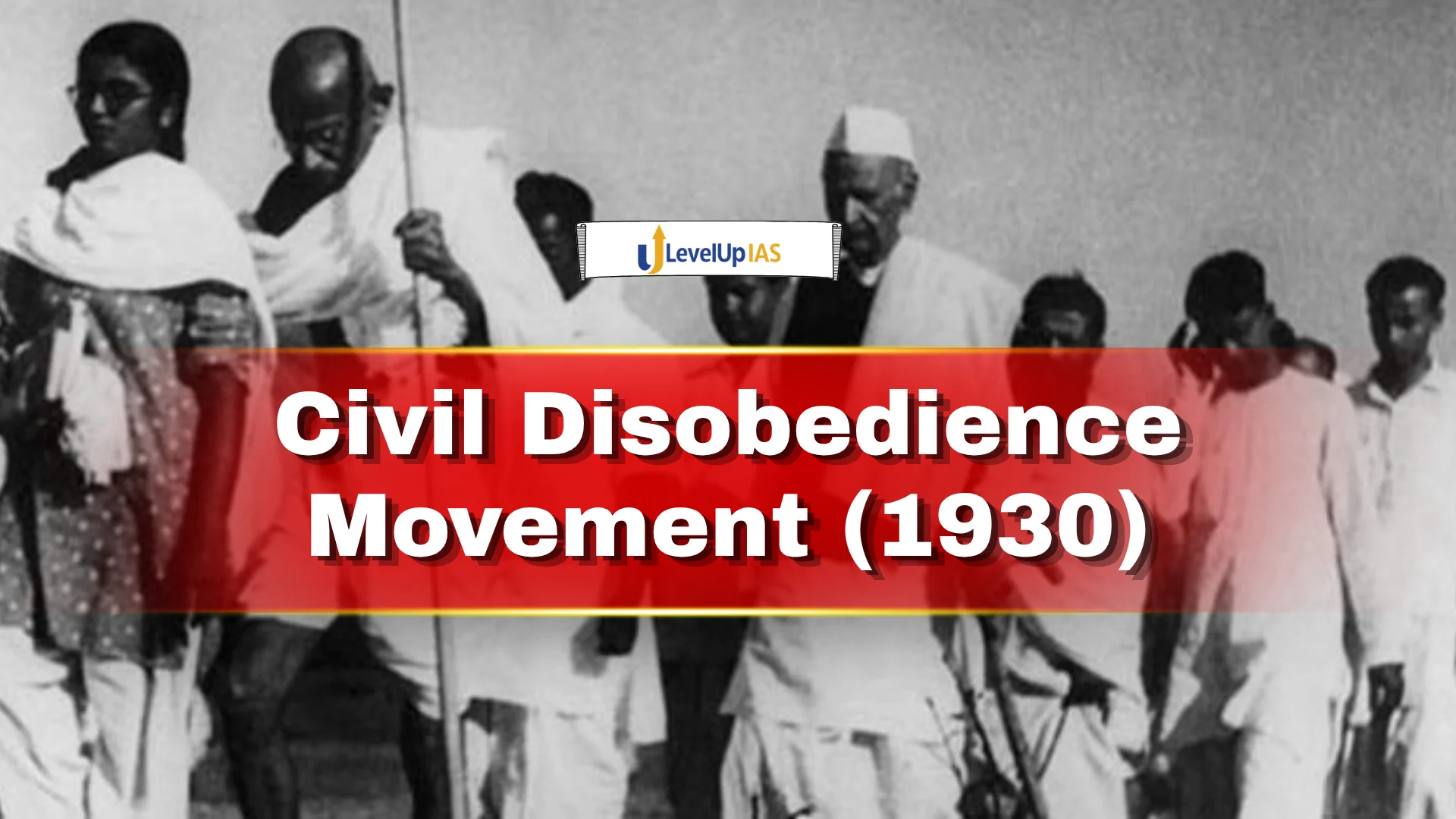
Civil Disobedience Movement (1930)
Content
- Introduction
- Background
- Gandhi’s Eleven Demands
- Dandi March
- Nature and Methods
- Spread of the Movement
- Participation of Different Social Groups
- Government Response
- Gandhi-Irwin Pact (1931)
- Karachi Session
- Revival and Withdrawal
- Significance of the Formation of INC
- Limitations
- Conclusion
- FAQs
Introduction
The Civil Disobedience Movement (1930-1934) was one of the most important phases of the Indian national movement and marked the second great mass struggle against British colonial rule after the Non-Cooperation Movement. It represented a new stage in India’s freedom struggle because, for the first time, the Indian National Congress openly declared the objective of Purna Swaraj (Complete Independence). The movement transformed nationalism from a limited political agitation into a widespread mass movement involving peasants, students, women, workers, traders, and tribal communities.
The movement was formally launched by Mahatma Gandhi on 6 April 1930 after breaking the salt laws at Dandi. Through peaceful defiance of unjust colonial laws, Gandhi aimed to challenge the moral legitimacy of British rule in India. The movement became famous worldwide for its non-violent methods, especially the historic Dandi March, which emerged as a symbol of resistance against imperial exploitation.
Background
The origins of the movement can be traced to the political developments of the late 1920s. During this period, dissatisfaction against British rule intensified because constitutional reforms introduced by the colonial government failed to satisfy Indian aspirations. Simultaneously, revolutionary activities, economic hardships, and rising nationalist sentiments created conditions for a mass struggle.
The Calcutta Session of the Indian National Congress accepted the Nehru Report and demanded Dominion Status for India. Congress warned the British government that if Dominion Status was not granted by 31 December 1929, a nationwide movement would be launched. However, the British government ignored these demands.
In October 1929, Lord Irwin issued the Irwin Declaration, vaguely promising Dominion Status in the future and announcing a Round Table Conference. The declaration lacked any clear timeline, which disappointed Indian leaders.
Nationalist leaders then issued the Delhi Manifesto demanding:
- Immediate recognition of Dominion Status,
- Release of political prisoners,
- Majority representation for Congress in the proposed Round Table Conference.
When these demands were rejected, the Congress adopted a more radical stance.The turning point came at the historic Lahore Session of the Indian National Congress under the presidency of Jawaharlal Nehru. The session declared Purna Swaraj as the ultimate goal of the freedom struggle. It was decided that 26 January 1930 would be observed as Independence Day across India. Congress also authorised Gandhi to launch a mass civil disobedience movement at an appropriate time.
Gandhi’s Eleven Demands
Before launching the movement, Gandhi attempted reconciliation with the British government. On 31 January 1930, he submitted eleven demands to Lord Irwin. These demands were moderate in nature and aimed at appealing to different social groups including peasants, industrialists, and middle classes.
The demands included reduction of land revenue, abolition of salt tax, reduction in military expenditure, release of political prisoners, protection of Indian textiles, prohibition of intoxicants, and reforms in the Criminal Investigation Department.
Among all these demands, Gandhi strategically chose the salt tax issue for launching the movement because salt was a basic necessity used by every Indian, rich or poor. By targeting salt laws, Gandhi transformed a simple commodity into a powerful symbol of colonial exploitation.
Dandi March and Launch of the Movement
The movement officially began with the historic Dandi March, also known as the Salt March.
On 12 March 1930, Gandhi started his march from Sabarmati Ashram near Ahmedabad along with 78 carefully selected volunteers. Covering nearly 390 kilometres over 24 days, the march attracted nationwide attention. Gandhi addressed villagers, mobilised masses, and spread the message of non-violent resistance throughout the journey.
On 6 April 1930, Gandhi reached the coastal village of Dandi in Gujarat and symbolically broke the salt law by picking up a lump of natural salt from the seashore. This act marked the formal beginning of the Civil Disobedience Movement.
The symbolic defiance of the salt law inspired millions across the country. Gandhi declared that obedience to unjust colonial laws was morally wrong, and therefore civil disobedience had become a patriotic duty.
Nature and Methods of the Movement
Unlike the Non-Cooperation Movement, which focused mainly on boycott, the Civil Disobedience Movement involved direct violation of colonial laws. It combined non-cooperation with active resistance.
The major forms of protest included:
- Breaking the salt laws,
- Boycott of foreign cloth and liquor,
- Refusal to pay taxes,
- Boycott of courts and legislative institutions,
- Resignation from government jobs,
- Picketing liquor shops,
- Promotion of Khadi and Swadeshi,
- Organising peaceful demonstrations and marches.
The movement strictly emphasised truth and non-violence. Gandhi insisted that participants maintain discipline even under severe repression.
Spread of the Movement Across India
One of the most remarkable features of the Civil Disobedience Movement was its nationwide spread. Different regions adopted diverse forms of struggle according to local conditions.
In Tamil Nadu, C. Rajagopalachari organised the famous Vedaranyam Salt March from Tiruchirapalli to the Tanjore coast.
In Malabar, leaders like K. Kelappan conducted salt satyagrahas and mobilised peasants.
In Bengal, Subhas Chandra Bose and J. M. Sengupta organised anti-chaukidari tax campaigns and mass protests.
In the North-West Frontier Province, Khan Abdul Ghaffar Khan mobilised the Khudai Khidmatgars or Red Shirts. The movement here demonstrated extraordinary courage when soldiers of the Garhwal Rifles refused orders to fire on peaceful protestors.
In Gujarat, Sardar Vallabhbhai Patel led no-tax campaigns in Bardoli and Kheda.
In Bihar, Orissa, United Provinces, and Andhra, peasants and students participated actively. In many tribal areas, forest laws were defied through peaceful satyagraha.
Participation of Different Social Groups
The Civil Disobedience Movement witnessed broader social participation than previous movements.
Women:
Women emerged as active participants in the national movement for the first time on such a large scale. Leaders like Sarojini Naidu played a major role in leading demonstrations and salt satyagrahas. Thousands of women picketed liquor shops and foreign cloth stores. Participation in the movement gave Indian women greater political confidence and public visibility.
Peasants:
Peasants joined the movement in large numbers, especially in Gujarat, Uttar Pradesh, Andhra Pradesh, and Bihar. Their grievances included high land revenue demands, rural indebtedness, and exploitation by landlords and colonial officials.
Students and Youth:
Students boycotted educational institutions and participated in demonstrations, strikes, and volunteer corps. The youth were deeply inspired by nationalist ideals and revolutionary activities.
Business Groups:
Industrialists and merchants initially supported the movement because they wanted protection from foreign competition. Business communities, especially the Marwaris and Gujarati traders, contributed financially to the nationalist cause.
Muslims:
Muslim participation was relatively lower than during the Non-Cooperation Movement because communal tensions had increased after the decline of the Khilafat Movement.
Government Response
The British government responded with severe repression. Gandhi and thousands of Congress leaders were arrested. Public meetings were banned, newspapers censored, and volunteer organisations declared illegal.
One of the most dramatic events occurred at the Dharasana Salt Satyagraha, where peaceful satyagrahis were brutally beaten by police. International journalists reported the incident, generating worldwide sympathy for the Indian struggle.
Despite harsh repression, the movement continued in many regions through underground networks and local leadership.
Gandhi-Irwin Pact (1931)
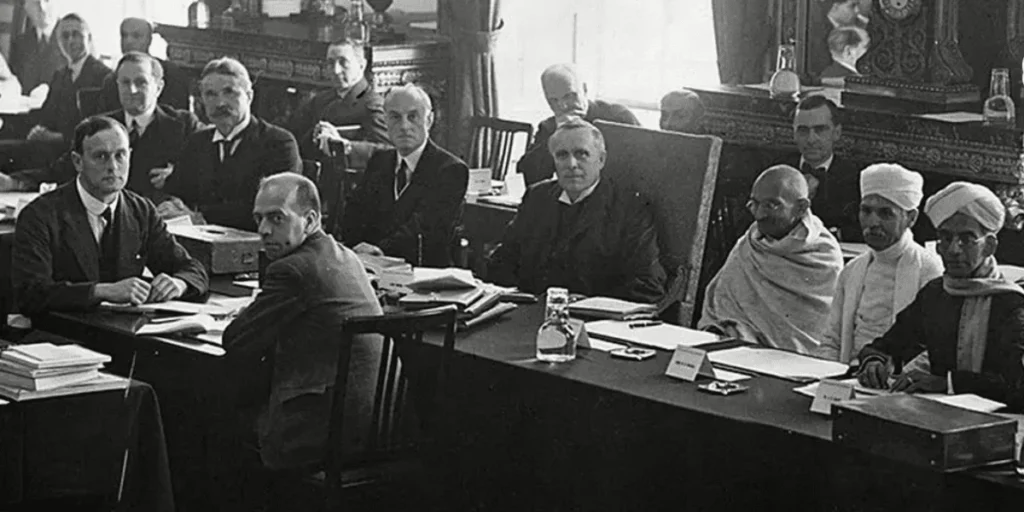
The Gandhi-Irwin Pact was a political agreement signed on 5 March 1931 between Mahatma Gandhi and Lord Irwin. The pact marked the temporary suspension of the Civil Disobedience Movement and represented the first major negotiation between the British Government and the Indian National Congress on relatively equal terms.
The agreement came after months of intense mass protests, widespread arrests, economic disruption, and growing international criticism of British repression in India. The British government realised that it was becoming difficult to control the movement solely through force, while Congress also needed political space to continue the struggle through negotiations.
Under the terms of the pact, the British government agreed to:
- Release political prisoners who had not been convicted of violence,
- Withdraw ordinances and relax emergency measures,
- Restore confiscated property of satyagrahis wherever possible,
- Permit peaceful picketing of liquor and foreign cloth shops,
- Allow Indians living near coastal areas to manufacture salt for personal use.
In return, Gandhi agreed to:
- Suspend the Civil Disobedience Movement,
- Participate in the Second Round Table Conference in London as the sole representative of the Congress,
- Withdraw the boycott of British goods and institutions temporarily.
However, the pact did not fulfil several important nationalist demands. The British government did not agree to abolish the salt tax completely, nor did it accept the demand for immediate Purna Swaraj. Revolutionary prisoners such as Bhagat Singh, Sukhdev Thapar, and Shivaram Rajguru were not granted clemency, which disappointed many young nationalists.
Despite criticism, the pact had immense political significance. It marked the recognition of Congress as a major political force and demonstrated that the British government could no longer ignore Indian nationalist demands. It also symbolised the moral strength of non-violent mass struggle, as the British were compelled to negotiate directly with Gandhi.
Karachi Session of Congress (1931)
The Karachi Session of the Indian National Congress endorsed the Gandhi-Irwin Pact. More importantly, it adopted resolutions on Fundamental Rights and National Economic Programme.
These resolutions reflected the growing socio-economic vision of Congress and included:
- Civil liberties,
- Equality before law,
- Universal adult franchise,
- Protection of labour rights,
- Reduction of land revenue,
- State control over key industries.
The Karachi Resolution later influenced the making of the Indian Constitution.
Revival and Withdrawal of the Movement
The failure of the Second Round Table Conference led Gandhi to restart the movement in 1932. However, the second phase faced severe repression.
The British government:
- Arrested Congress leaders,
- Confiscated properties,
- Imposed censorship,
- Suppressed volunteer organisations.
Gradually, the movement lost momentum. By 1934, Gandhi formally withdrew the Civil Disobedience Movement.
Significance
The Civil Disobedience Movement occupies a central place in the history of the Indian freedom struggle.
First, it transformed the demand for complete independence into a mass objective. The idea of Purna Swaraj now became deeply embedded in Indian political consciousness.
Second, the movement expanded the social base of nationalism. Women, peasants, students, tribal groups, and business communities participated actively, making the freedom struggle truly national in character.
Third, it enhanced the moral legitimacy of the Congress leadership. Through disciplined non-violent struggle, Gandhi successfully projected the Indian cause internationally.
Fourth, the movement compelled the British government to negotiate with Indian leaders on an equal footing. The Gandhi-Irwin Pact symbolised this change.
Finally, the Karachi Resolution introduced socio-economic rights into nationalist politics and laid the foundation for future constitutional development in independent India.
Limitations and Decline of the Movement
Despite its achievements, the movement had several limitations.
Muslim participation remained limited due to communal tensions and political differences. Industrial workers did not participate as extensively as expected. The movement also failed to achieve its immediate objective of independence.
Government repression weakened organisational networks, and divisions within Congress affected the continuity of the struggle. Many peasants were disappointed because their economic grievances remained unresolved.
Moreover, the Gandhi-Irwin Pact disappointed radical nationalists and revolutionaries who felt that the movement ended without substantial political gains.
Conclusion
The Civil Disobedience Movement marked a decisive stage in India’s struggle for independence. It demonstrated the strength of mass mobilisation and non-violent resistance against colonial rule. Through the Salt Satyagraha and nationwide protests, Gandhi succeeded in transforming nationalism into a powerful people’s movement.
Although independence was not achieved immediately, the movement fundamentally weakened the moral foundations of British imperialism and prepared the ground for later struggles such as the Quit India Movement. It also broadened the vision of the national movement by connecting political freedom with social and economic justice.
FAQs
Q1. What was the Civil Disobedience Movement?
The Civil Disobedience Movement was a major movement led by Mahatma Gandhi in which Indians openly violated British laws through non-violent resistance.
Q2. Why was the Civil Disobedience Movement launched?
The movement was launched due to:
Failure of constitutional reforms to satisfy Indian aspirations
Demand for Poorna Swaraj (Complete Independence)
Opposition to oppressive British laws and taxes
Q3. How did the movement begin?
It began with the Dandi March, where Gandhi marched from Sabarmati Ashram to Dandi to break the British salt law.
Q4. What were the main features of the movement?
Violation of salt laws
Boycott of foreign goods and institutions
Refusal to pay taxes
Mass participation by peasants, women, students, and workers
Q5. What was the Gandhi-Irwin Pact?
The Gandhi-Irwin Pact was an agreement under which the movement was suspended and Gandhi agreed to attend the Round Table Conference.
Click on the question to see the Answers
Visit LevelUp IAS- Click Here
Related reads.

How to Read NCERTs for UPSC: Subject-Wise Strategy & Notes Making
22 Jun 2026 10 min
PSIR Topper's Answer Copies
22 Jun 2026 1 min
Sociology Optional PYQs (2009-2024)
22 Jun 2026 1 min
Philosophy Optional PYQs
22 Jun 2026 1 min
PSIR Optional PYQs
22 Jun 2026 1 min
History Optional PYQs (2009-2025) – Free PDF & Video
22 Jun 2026 1 min
Put it into practice
Reading is step one.
Turn what you've just read into exam-ready answers with mentor-led practice and our structured test series.