Enlightenment and Intellectual Revolution
Content
The Enlightenment, also known as the “Age of Reason,” was a major intellectual and philosophical movement that developed in Europe during the 17th and 18th centuries. It marked a decisive shift from the medieval worldview dominated by religious dogma, superstition, and unquestioned authority toward rational thinking, scientific inquiry, individual liberty, and secularism. Enlightenment thinkers believed that human reason could transform society, remove ignorance, and lead humanity toward progress and prosperity.
The movement profoundly influenced modern political thought, democratic institutions, scientific development, constitutionalism, human rights, secular governance, and modern education systems. It also laid the intellectual foundation for transformative events such as the American Revolution, the French Revolution, and the rise of liberalism and nationalism.
Background of the Enlightenment
Medieval Europe and the Need for Change
The roots of the Enlightenment can be traced to the conditions prevailing in medieval Europe. During the Middle Ages, society was deeply dominated by the Catholic Church and feudal institutions. Religion controlled intellectual life, and scientific inquiry was often discouraged or treated as heresy. European society was highly hierarchical, and ordinary people had limited freedoms and rights.
The Church possessed enormous authority over political, social, and cultural life. The Crusades, religious persecution, and harsh punishment for dissent created fear and intellectual stagnation. Scientific explanations were subordinated to religious beliefs, while monarchy justified its authority through the doctrine of Divine Right Theory.
Over time, dissatisfaction with religious intolerance, feudal oppression, and rigid social structures generated a desire for intellectual freedom and reform.
Influence of the Scientific Revolution
The Scientific Revolution of the 16th and 17th centuries became the most important intellectual foundation of the Enlightenment. Scientists and philosophers challenged traditional beliefs and emphasized observation, experimentation, and rational inquiry.
Francis Bacon promoted the inductive method and argued that knowledge should be based on observation and experimentation. René Descartes emphasized rationalism and logical thinking through his famous statement, “I think, therefore I am.” Galileo Galilei and Johannes Kepler challenged Church-supported astronomical theories and supported the heliocentric model proposed by Copernicus. Isaac Newton further transformed intellectual thought through his laws of motion and universal gravitation, demonstrating that the universe functioned according to discoverable natural laws.
These developments convinced European thinkers that reason and science could explain both nature and society without relying entirely on religious doctrine.
Protestant Reformation and Decline of Church Authority
The Protestant Reformation weakened the monopoly of the Catholic Church over religious and intellectual life. Reformers such as Martin Luther questioned Church corruption, rituals, and absolute authority. The resulting religious divisions encouraged debate, criticism, and individual interpretation of religious texts.
As religious authority weakened, people increasingly began to question political authority and social traditions as well. This created a favourable atmosphere for the rise of secular and rational ideas associated with the Enlightenment.
Impact of Exploration and Expansion
European exploration and overseas expansion exposed Europeans to new cultures, societies, and belief systems in Asia, Africa, and the Americas. Contact with different civilizations broadened intellectual horizons and challenged traditional assumptions regarding religion, politics, and society.
Travel literature and global interactions encouraged comparative thinking and cultural relativism, contributing to the growth of Enlightenment thought.
Core Ideas of the Enlightenment
Reason and Rationalism
Reason became the central principle of the Enlightenment. Thinkers believed that human beings possessed the capacity to understand the world through logic and rational thought. Blind faith, superstition, and unquestioned traditions were increasingly criticized.
Enlightenment philosophers argued that reason could solve social problems, improve governance, and promote human welfare. Rational inquiry replaced reliance on inherited authority.
Natural Law and Natural Rights
Enlightenment thinkers believed that universal natural laws governed both nature and human society. Inspired by Newtonian science, philosophers argued that political and social institutions should also operate according to rational principles.
John Locke developed the theory of natural rights, arguing that all individuals possessed inherent rights such as life, liberty, and property. Governments existed to protect these rights, and people had the right to resist oppressive rule.
Individualism
The Enlightenment emphasized the importance of the individual rather than the collective authority of Church or monarchy. It stressed individual liberty, freedom of thought, freedom of expression, and personal dignity.
This idea became the basis of liberal political thought and democratic governance.
Humanism
Human welfare and human progress became central concerns of Enlightenment thinkers. They believed society should be organized to improve the lives of people rather than merely preserve traditional hierarchies and privileges.
The movement challenged social inequalities and aristocratic dominance.
Secularism
The Enlightenment encouraged separation between religion and politics. Philosophers criticized Church interference in governance and promoted secular institutions.
Voltaire strongly advocated religious tolerance and criticized religious intolerance and dogmatism. Enlightenment secularism did not necessarily reject religion entirely but opposed excessive religious control over society and politics.
Belief in Progress
Enlightenment thinkers possessed strong optimism regarding human progress. They believed that scientific advancement, education, and rational governance could gradually improve society and eliminate ignorance and injustice.
This faith in progress later influenced industrialization, modern education, and democratic reforms.
Major Enlightenment Thinkers
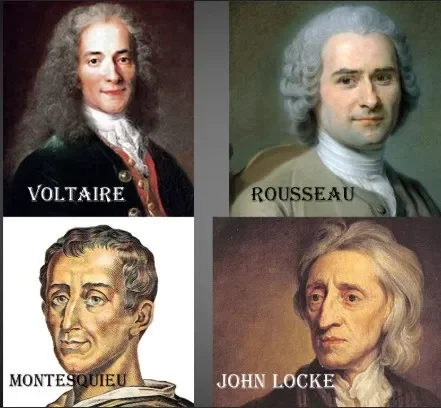
John Locke
John Locke is regarded as one of the most influential Enlightenment philosophers. He developed the theory of natural rights and argued that government derived its authority from the consent of the governed. His ideas on liberty, constitutional government, and the social contract deeply influenced democratic revolutions.
Voltaire
Voltaire criticized religious intolerance, superstition, and authoritarianism. He advocated freedom of speech, civil liberties, and secular governance. His writings exposed corruption within the Church and promoted rational thinking.
Jean-Jacques Rousseau
Rousseau emphasized popular sovereignty and the concept of the “general will.” In his Social Contract, he argued that legitimate political authority rests with the people. His ideas strongly influenced the French Revolution and democratic theory.
Montesquieu
Montesquieu proposed the doctrine of separation of powers among the executive, legislature, and judiciary. He believed division of power was necessary to prevent tyranny and safeguard liberty.
His theory became the foundation of modern constitutional democracies.
Adam Smith
Adam Smith applied Enlightenment principles to economics. In his work The Wealth of Nations (1776), he advocated laissez-faire economics, free markets, and limited state intervention.
He is regarded as the father of modern economics.
Immanuel Kant
Kant emphasized moral reasoning and individual autonomy. He argued that human beings should act according to universal moral principles derived from reason.
His philosophy greatly influenced modern ethics and political philosophy.
Reformative Impact of the Enlightenment
The Enlightenment transformed various aspects of European society. In politics, it challenged absolute monarchy and promoted constitutionalism, democracy, and individual rights. In economics, it encouraged free trade and capitalism. In law, thinkers like Cesare Beccaria opposed torture and cruel punishments and advocated humane legal reforms.
In religion, the movement promoted tolerance and secular governance. In society, Enlightenment ideas weakened feudalism and aristocratic privilege while strengthening modern ideas of equality and citizenship.
Impacts
The Enlightenment fundamentally transformed the modern world. It laid the intellectual foundations of democracy, constitutional government, secularism, liberalism, and human rights. The movement inspired major revolutions, including the American and French Revolutions, and influenced modern nationalism.
Its emphasis on scientific inquiry accelerated technological and industrial progress. Enlightenment ideas also contributed to modern educational systems, legal reforms, and international political thought.
Many principles embedded in modern constitutions, including the Indian Constitution, such as liberty, equality, secularism, and fundamental rights, reflect Enlightenment ideals.
Conclusion
The Enlightenment was a revolutionary intellectual movement that transformed Europe and laid the foundation of the modern world. By promoting reason, liberty, secularism, and scientific thinking, it challenged medieval structures and reshaped political, social, and economic life. Its influence extended far beyond Europe and continues to shape contemporary democratic institutions, human rights discourse, and modern scientific thought.
FAQs
Q1. What was the Enlightenment?
The Enlightenment was an intellectual movement in Europe that promoted reason, scientific inquiry, liberty, and rational thinking over tradition and absolute authority.
Q2. Why is the Enlightenment called an Intellectual Revolution?
It challenged traditional beliefs, monarchy, and religious dominance while encouraging critical thinking, individual rights, democracy, and scientific progress.
Q3. Who were the major thinkers of the Enlightenment?
Important thinkers included John Locke, Voltaire, Montesquieu, and Jean-Jacques Rousseau.
Q4. What were the main ideas of the Enlightenment?
Key ideas included:
Rationalism and scientific temper
Liberty and equality
Separation of powers
Natural rights
Freedom of expression
Q5. How did the Enlightenment influence political systems?
It inspired democratic ideas and constitutional governance, influencing events like the American Revolution and the French Revolution.
Click on the question to see the Answers
Visit LevelUp IAS: Click here