Salient Features of Indian Society, GS 1
Content
- Multi-Ethnic
- Multilingual Society
- Multi-Religious Society
- Social Stratification
- Tribal Diversity
- Balance Between Individualism and Collectivism
- Secular and Democratic
- Challenges
- Conclusion
- FAQs
Society refers to a group of people living together within a defined geographical area and sharing common institutions, values, customs, and social relationships. Indian society is one of the oldest, most diverse, and continuously evolving societies in the world. It is characterized by a unique blend of unity and diversity, where multiple religions, languages, ethnic groups, cultures, and traditions coexist within a common constitutional and national framework.
The richness of Indian society lies in its ability to accommodate differences while maintaining social cohesion. This distinctive character has evolved through centuries of interaction among various indigenous traditions, foreign influences, social reforms, and modernization processes.
Diversity: The Defining Feature of Indian Society
The most prominent characteristic of Indian society is its immense diversity. India is home to numerous linguistic, religious, ethnic, and cultural groups. Diversity in India is visible not only across regions but also within states, districts, and even villages.
Despite these differences, a strong sense of cultural continuity and constitutional nationalism binds the population together. This phenomenon is often described as “Unity in Diversity,” which forms the foundation of Indian social life.
Multi-Ethnic Character
Indian society is a mosaic of multiple ethnic groups that differ in physical characteristics, language, customs, and cultural practices. Historical migrations, invasions, trade contacts, and geographical isolation have contributed to the emergence of diverse ethnic communities.
The major ethnic groups include the Indo-Aryans, predominantly found in northern and western India; the Dravidians concentrated in southern India; the Mongoloid groups inhabiting much of the North-East; and numerous tribal communities spread across central, eastern, and north-eastern regions. Alongside these groups, urban India also contains populations with mixed ethnic origins resulting from centuries of interaction and migration.
This ethnic diversity has enriched India’s cultural heritage while simultaneously creating challenges related to identity, representation, and regional aspirations.
Multilingual Society
Language is one of the strongest markers of identity in India. The country is among the most linguistically diverse nations in the world. According to the Census of 2011, more than 19,000 mother tongues were reported, which after linguistic classification were grouped into 121 languages.
The Constitution recognizes 22 languages under the Eighth Schedule. Hindi is the most widely spoken language, followed by Bengali, Marathi, Telugu, Tamil, Gujarati, Kannada, Malayalam, Odia, Punjabi, and others.
Multilingualism is a distinctive feature of Indian society. A large proportion of Indians speak more than one language due to migration, education, trade, and social interaction. Rather than creating divisions, linguistic diversity has contributed to cultural enrichment and strengthened federalism through the linguistic reorganization of states.
Multi-Religious Society
India is the birthplace of major religions such as Hinduism, Buddhism, Jainism, and Sikhism, while also providing a home to Islam, Christianity, Judaism, Zoroastrianism, and several indigenous faiths.
Religion influences various aspects of social life including customs, festivals, marriage practices, food habits, and moral values. The coexistence of multiple faiths has contributed to India’s rich cultural landscape.
The Constitution embraces the principle of secularism, ensuring equal respect and protection for all religions. While religious diversity has promoted cultural pluralism, it has also occasionally given rise to communal tensions, making secular governance and interfaith harmony crucial for national integration.
Caste System and Social Stratification
The caste system has historically been one of the most influential institutions in Indian society. Originating from the ancient Varna system and later evolving into numerous castes and sub-castes, it shaped social status, occupation, marriage patterns, and social interactions.
Traditionally, caste determined an individual’s social position and access to resources. While constitutional provisions, social reform movements, urbanization, industrialization, and education have weakened many traditional caste barriers, caste continues to influence politics, social relations, and access to opportunities.
Today, caste remains both a source of social identity and a subject of debate regarding social justice, affirmative action, and equality.
Centrality of Family, Marriage, and Kinship
Family occupies a central position in Indian society and serves as the primary institution for socialization, emotional support, and economic security. Although nuclear families are becoming increasingly common in urban areas, the influence of the joint family system remains significant.
Marriage is regarded as an important social institution and often extends beyond the union of two individuals to include relationships between families. Arranged marriages continue to be prevalent, though individual choice is gaining acceptance, especially among younger generations.
Kinship networks play a crucial role in social support, inheritance, social status, and community relations, making family and kinship among the strongest pillars of Indian social organization.
Tribal Diversity
India has one of the largest tribal populations in the world. Tribal communities constitute a highly diverse segment of society, possessing distinct languages, customs, religious beliefs, and traditional governance systems.
Communities such as the Gonds, Bhils, Mundas, Santhals, Nagas, and Todas represent the rich tribal heritage of the country. Most tribes maintain a strong connection with forests, land, and natural resources.
Despite modernization, tribal societies continue to preserve unique cultural identities while simultaneously facing challenges related to displacement, poverty, education, and integration with mainstream development processes.
Cultural Syncretism and Composite Culture
One of the most remarkable features of Indian society is its ability to absorb and synthesize diverse cultural influences. Over centuries, interactions among different religions, communities, and civilizations have produced a composite culture.
The influence of Hindu, Buddhist, Jain, Islamic, Sikh, Persian, European, and regional traditions can be observed in Indian art, architecture, literature, music, cuisine, and social customs.
This tradition of cultural accommodation and synthesis has strengthened social harmony and enriched India’s civilizational heritage.
Coexistence of Tradition and Modernity
Indian society represents a unique coexistence of traditional values and modern institutions. Ancient customs, rituals, and social norms continue to influence daily life, while modernization, urbanization, industrialization, and globalization have introduced new ideas and lifestyles.
The economic reforms initiated in 1991 accelerated the processes of liberalization, privatization, and globalization (LPG), leading to significant social and cultural transformations. As a result, contemporary Indian society reflects a continuous interaction between traditional practices and modern aspirations.
This coexistence often creates tensions but also demonstrates the adaptability and resilience of Indian society.
Balance Between Individualism and Collectivism
Indian society traditionally emphasizes collectivism, where family, community, and social relationships are given priority over individual interests. Social obligations, family responsibilities, and community identity continue to influence personal decisions.
At the same time, modernization, education, urbanization, and economic development have strengthened individualism, particularly among younger generations. Career choices, personal freedom, and individual aspirations have gained increasing importance.
| Aspect | Individualism | Collectivism |
| Meaning | Emphasizes personal freedom, individual rights, and self-interest. | Emphasizes group welfare, social harmony, and collective interests. |
| Primary Unit | Individual is the central unit of society. | Family, community, or group is the central unit. |
| Decision-Making | Decisions are based on personal preferences and aspirations. | Decisions are often influenced by family and community expectations. |
| Social Identity | Identity is derived from personal achievements and choices. | Identity is derived from family, caste, community, and social affiliations. |
| Family Structure | Nuclear families are more common. | Joint and extended family systems are encouraged. |
| Marriage | Individual choice and love marriages are preferred. | Family involvement and arranged marriages are traditionally preferred. |
| Career Choices | Personal interests and ambitions guide career decisions. | Family expectations and social responsibilities influence career choices. |
| Responsibility | Focus on personal accountability and self-reliance. | Focus on collective responsibility and mutual support. |
| Social Relationships | Relationships are generally voluntary and flexible. | Relationships are based on long-term obligations and social bonds. |
| Associated Values | Independence, competition, innovation, and personal achievement. | Cooperation, social harmony, loyalty, and community welfare. |
| Examples in India | Rising entrepreneurship, career mobility, urban lifestyles, and increasing acceptance of individual choices. | Joint family system, community festivals, family-based decision-making, and social support networks. |
Respect for Elders and Social Values
Respect for elders remains a deeply embedded social norm in Indian society. Elder family members are generally regarded as sources of wisdom, guidance, and authority. Values such as obedience, gratitude, social responsibility, and intergenerational support continue to shape family and community relationships.
Hospitality, tolerance, compassion, and community cooperation are also widely recognized social values that contribute to social cohesion.
Secular and Democratic Orientation
Modern Indian society operates within a constitutional framework based on democracy, secularism, justice, liberty, equality, and fraternity. Citizens enjoy equal rights irrespective of religion, caste, gender, language, or region.
Democratic participation, universal adult franchise, and constitutional safeguards have enabled diverse social groups to engage in governance and public life, making Indian society one of the world’s largest democratic social systems.
Challenges Faced by Civil Society
Despite its strengths, Indian society faces several challenges that affect social cohesion and inclusive development. Poverty and economic inequality continue to create disparities in opportunities and living standards. Religious and communal conflicts occasionally threaten social harmony and national integration.
Gender inequality remains a concern in areas such as workforce participation, wages, and representation. Caste-based discrimination, regional disparities, and tribal marginalization also pose significant challenges. Additionally, rising juvenile delinquency, urban stress, and social fragmentation have emerged as new concerns in contemporary India.
Addressing these challenges requires inclusive development, social justice, constitutional values, and active citizen participation.
Conclusion
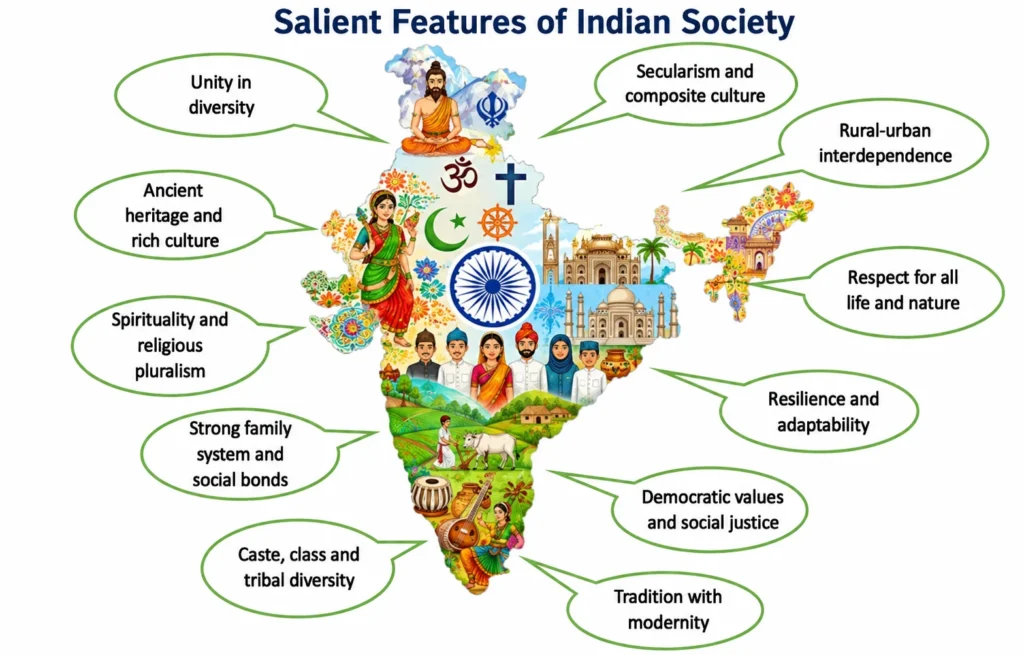
Indian society is a complex yet vibrant social system characterized by diversity, pluralism, continuity, and change. Its salient features include multi-ethnicity, multilingualism, multi-religious composition, caste-based stratification, strong family institutions, tribal diversity, cultural syncretism, and the coexistence of tradition and modernity. While challenges persist, the ability of Indian society to accommodate diversity and adapt to changing circumstances remains its greatest strength. This unique combination of continuity and transformation continues to shape India’s social and democratic journey in the twenty-first century.
FAQs
Q1. What are the salient features of Indian society?
Indian society is characterized by diversity, unity in diversity, pluralism, tolerance, coexistence, social stratification, strong family systems, and cultural continuity.
Q2. What is meant by ‘Unity in Diversity’ in Indian society?
Unity in Diversity refers to the harmonious coexistence of people belonging to different religions, languages, ethnicities, and cultures while maintaining a common national identity.
Q3. How does diversity manifest in Indian society?
Diversity is reflected in:
Food habits, dress, and lifestyles
Religions and faiths
Languages and dialects
Ethnic and racial groups
Regional cultures and traditions
Q4. What is the role of family in Indian society?
The family is the primary social institution in India, providing socialization, emotional support, cultural transmission, and economic security. Both joint and nuclear families coexist in contemporary India.
Q5. What is social stratification in Indian society?
Social Stratification refers to the hierarchical organization of society based on factors such as caste, class, gender, occupation, and economic status.
Click on the question to see the Answers
Visit LevelUp IAS: Click here