
Unification of Italy (Risorgimento)
Content
- Background
- Ideological Foundations
- Challenges in the Unification of Italy
- Factors Responsible
- Phases of Italian Unification
- Major Thinkers
- Impacts
- Conclusion
- FAQs
The Unification of Italy, popularly known as the Risorgimento (meaning “Resurgence” or “Revival”), was one of the most significant nationalist movements of nineteenth-century Europe. It transformed the Italian peninsula from a fragmented collection of states, foreign-controlled territories, and papal domains into a unified nation-state. The process formally began with the proclamation of the Kingdom of Italy in 1861 and was completed with the annexation of Rome in 1870.
Italian unification was neither a sudden event nor the achievement of a single individual. It was the result of a long struggle involving nationalist ideology, diplomatic manoeuvres, revolutionary movements, military campaigns, and popular participation. The movement became a classic example of the role of nationalism in the creation of modern nation-states.
Background of the Unification
At the beginning of the nineteenth century, Italy was merely a geographical expression rather than a political entity. Following the Congress of Vienna (1815), the victorious European powers restored the old monarchies and attempted to suppress nationalist and liberal movements that had emerged during the French Revolution and Napoleonic era.
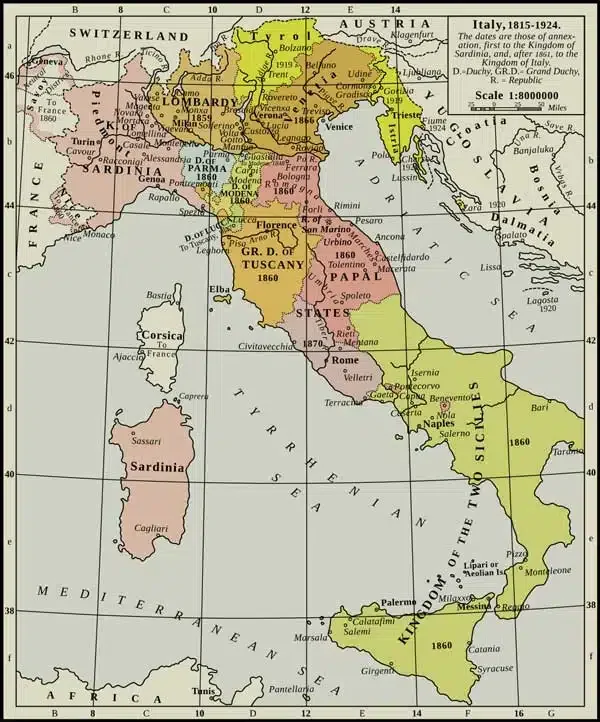
The Italian peninsula remained divided into several states. The Kingdom of Piedmont-Sardinia in the northwest emerged as the most progressive and politically dynamic state. The Kingdom of the Two Sicilies dominated southern Italy and remained conservative and economically backward. Central Italy was occupied by the Papal States, ruled directly by the Pope. Smaller states such as Parma, Modena, and Tuscany remained under Austrian influence, while Lombardy and Venetia were directly controlled by Austria.
This political fragmentation prevented economic integration, hindered national development, and made Italy vulnerable to foreign domination, particularly by Austria.
Ideological Foundations of Italian Unification
The unification movement was driven by powerful ideological currents that swept across Europe during the nineteenth century.
Nationalism
Nationalism provided the strongest foundation for Italian unification. It promoted the belief that people sharing a common language, culture, history, and traditions should form a single political community. Italian nationalists argued that despite political divisions, Italians constituted one nation and deserved a united state.
Liberalism
Liberal ideas strengthened the nationalist cause by advocating constitutional government, civil liberties, representative institutions, and political freedom. Liberalism challenged the conservative order established by the Congress of Vienna and inspired demands for self-government.
Romanticism
The Romantic movement encouraged pride in Italy’s historical heritage. Intellectuals glorified the achievements of Ancient Rome and the Renaissance, fostering a sense of common identity among Italians. Literature, poetry, and historical writings became important tools for nationalist awakening.
Role of Giuseppe Mazzini
Among the early nationalist thinkers, Giuseppe Mazzini played a crucial role. He believed that Italy could achieve unity only through popular revolution and national awakening. His ideas inspired thousands of young Italians and transformed nationalism into a mass political movement.
Challenges in the Unification of Italy
Austrian Dominance
Austria represented the greatest obstacle to unification because it directly controlled Lombardy-Venetia and exercised influence over several Italian states. Overcoming Austrian power required both diplomacy and military confrontation.
Opposition of the Papacy
The Pope strongly opposed unification because it threatened the independence of the Papal States. This created a complex political and religious challenge that persisted even after Rome was annexed.
Ideological Divisions
Differences between republicans and monarchists created tensions within the nationalist movement. Mazzini envisioned a democratic republic, whereas Cavour supported constitutional monarchy.
Piedmontization of Italy
Many historians argue that unification resembled an expansion of Piedmont-Sardinia rather than the creation of a genuinely inclusive national state. Piedmont’s administrative structures, laws, taxation system, and institutions were imposed across Italy without adequately considering regional differences.
This generated resentment, especially in southern Italy, where many viewed the new state as an external authority rather than a liberator.
Regional Imbalances
Northern Italy was relatively industrialized and economically advanced, whereas southern Italy remained predominantly agrarian and underdeveloped. This imbalance became known as the Southern Question, a challenge that continued long after unification.
Limited Popular Participation
Although nationalist leaders mobilized public support, the process remained largely elite-driven. The limited participation of peasants and workers weakened the development of a unified national identity.
Factors Responsible for the Success of Italian Unification
Rise of Nationalism and Romanticism
Nationalist sentiment created a shared sense of Italian identity despite regional differences. Writers, poets, and intellectuals promoted the idea that Italians belonged to one nation and should be politically united.
Impact of the French Revolution and Napoleon
The French Revolution introduced ideas such as liberty, equality, nationalism, and popular sovereignty. Napoleonic rule also brought administrative reforms and political integration, creating awareness about the benefits of unity.
Economic Considerations
Political fragmentation created barriers to trade and economic development. Merchants, industrialists, and the growing middle class supported unification because they wanted a unified market free from internal customs barriers and restrictions.
Role of Leadership
Italian unification succeeded because different leaders contributed in complementary ways. Mazzini provided ideological inspiration, Cavour offered diplomatic and political leadership, while Garibaldi contributed military strength and mass mobilization. Victor Emmanuel II provided monarchical legitimacy and political stability.
Role of Foreign Powers
International support played a crucial role. France assisted Piedmont against Austria, while Prussia’s victory over Austria facilitated the annexation of Venetia. Britain generally supported nationalist aspirations and indirectly favored Italian unity.
Phases of Italian Unification
Phase I: Revolutionary Nationalism (1830s-1848)
The first phase of unification was dominated by revolutionary nationalism led by Giuseppe Mazzini. In 1831, he established Young Italy, an organization dedicated to creating a united, independent, and republican Italy based on popular sovereignty.
Mazzini’s revolutionary activities inspired numerous uprisings across the Italian states. However, these movements largely failed because they lacked military strength, coordination, and international support. The revolutionary wave of 1848 further intensified nationalist aspirations. Several Italian states witnessed uprisings against conservative rulers and Austrian domination.
The Kingdom of Piedmont-Sardinia, under Charles Albert, attempted to challenge Austrian control but suffered defeat. The failures of 1848 demonstrated that nationalism alone was insufficient and that successful unification would require diplomatic skill, military power, and strong leadership.
Phase II: Diplomatic and Political Strategy (1852-1861)
A decisive turning point came with the rise of Count Camillo di Cavour, Prime Minister of Piedmont-Sardinia. Unlike Mazzini, Cavour was a pragmatic statesman who believed that unification could be achieved through diplomacy and statecraft rather than revolutionary idealism.
Cavour modernized Piedmont’s economy, expanded infrastructure, strengthened the military, and transformed the kingdom into the most advanced Italian state. He skillfully secured French support through the Plombières Agreement (1858) with Napoleon III.
This alliance resulted in the Austro-Sardinian War (1859), during which Austria was defeated. As a consequence, Lombardy was annexed to Piedmont. Through popular plebiscites, several central Italian states, including Tuscany, Parma, and Modena, also joined Piedmont-Sardinia.
This phase highlighted the effectiveness of diplomacy and international alliances in advancing the cause of unification.
Phase III: Popular Movement and Military Action (1860)
The next stage of unification was led by Giuseppe Garibaldi, one of the most charismatic figures of the Risorgimento.
In 1860, Garibaldi launched the famous Expedition of the Thousand (Red Shirts). With a volunteer force of around one thousand men, he landed in Sicily and successfully overthrew Bourbon rule. His campaign rapidly spread across southern Italy and gained widespread support from local populations.
Garibaldi’s military victories brought Sicily and the Kingdom of the Two Sicilies under nationalist control. Despite his republican beliefs, Garibaldi placed national unity above personal ideology and handed over the conquered territories to Victor Emmanuel II, the King of Piedmont-Sardinia.
This act removed the possibility of internal conflict and ensured the consolidation of Italy under a constitutional monarchy.
Phase IV: Final Unification (1861-1870)
The Kingdom of Italy was officially proclaimed in 1861, with Victor Emmanuel II becoming its first king. However, important territories still remained outside the new state.
The first major addition came in 1866, when Italy allied with Prussia during the Austro-Prussian War. Austria’s defeat enabled Italy to acquire Venetia.
The final step occurred in 1870 during the Franco-Prussian War. France withdrew its troops from Rome to fight Prussia, leaving the Papal States vulnerable. Italian forces occupied Rome and incorporated it into the kingdom.
Rome subsequently became the capital of Italy, completing the process of political unification and bringing the Risorgimento to its conclusion.
Major Personalities of Italian Unification
| Leader | Contribution |
| Giuseppe Mazzini | Ideological architect of Italian nationalism; founder of Young Italy |
| Count Cavour | Prime Minister of Piedmont-Sardinia; used diplomacy and alliances to achieve unification |
| Giuseppe Garibaldi | Military leader who unified southern Italy through the Expedition of the Thousand |
| Victor Emmanuel II | King of Piedmont-Sardinia and first King of unified Italy |
| Napoleon III | Supported Piedmont against Austria in 1859 |
| Massimo d’Azeglio | Highlighted the challenge of national integration after unification |
Impacts
Political Impact
The most significant achievement was the creation of a unified Italian nation-state, ending centuries of political fragmentation and foreign domination. Italy emerged as a sovereign power in European politics.
Impact on European Balance of Power
The decline of Austrian influence in Italy altered the European balance of power. Italy’s emergence as a nation-state contributed to the broader restructuring of Europe during the nineteenth century.
Spread of Nationalism
The success of Italian unification encouraged nationalist movements elsewhere, particularly in Germany. It demonstrated that nationalism could successfully challenge conservative political structures.
Economic Integration
Unification created a common market, improved communication networks, and facilitated trade and industrial development. However, economic disparities between regions remained substantial.
Church-State Conflict
The annexation of Rome created a prolonged dispute between the Italian state and the Papacy, known as the Roman Question, which remained unresolved until the Lateran Treaty of 1929.
Incomplete Nation-Building
Although Italy achieved political unity, social and cultural integration remained incomplete. Regional identities often remained stronger than national identity. This challenge was captured by Massimo d’Azeglio’s famous statement:
“We have made Italy; now we must make Italians.”
Conclusion
The Unification of Italy was one of the most important nationalist movements of the nineteenth century. It successfully transformed a fragmented and foreign-dominated region into a unified nation-state through a combination of nationalist ideology, diplomatic skill, military action, and popular mobilization. While unification resolved the political problem of fragmentation, it left unresolved issues of regional inequality, national integration, and Church-State relations. Nevertheless, the Risorgimento remains a landmark event in world history and a classic example of the transformative power of nationalism in the modern era.
FAQs
Q1. What was the Unification of Italy (Risorgimento)?
The Unification of Italy, known as the Risorgimento, was the process through which the fragmented Italian states were united into a single nation-state.
Q2. Why was Italy not unified before the 19th century?
Before unification, the Italian peninsula was divided into several states, many of which were under foreign control, particularly that of the Austrian Empire.
Q3. Who were the key leaders of Italian unification?
The main architects were:
Victor Emmanuel II
Giuseppe Mazzini
Count Camillo di Cavour
Giuseppe Garibaldi
Q4. What was the role of Mazzini in Italian unification?
Giuseppe Mazzini promoted nationalism through the organization Young Italy and inspired the idea of a united, republican Italy.
Q5. What was the contribution of Cavour?
Count Camillo di Cavour used diplomacy and alliances, especially with France, to weaken Austrian control over Italian territories.
Click on the question to see the Answers
Visit LevelUp IAS: Click here