India’s 100th Ramsar Site: Surha Tal
Content
- Why in News?
- India’s Achievement
- Wetlands
- What is a Ramsar Site?
- Surha Tal
- Importance
- Significance
- Conclusion
Why in News?
On the occasion of World Environment Day (5 June 2026), the Prime Minister congratulated the nation on the designation of Jai Prakash Narayan Bird Sanctuary (Surha Tal) in Ballia district of Uttar Pradesh as India’s 100th Ramsar Site under the Ramsar Convention on Wetlands.
This recognition marks a significant milestone in India’s wetland conservation efforts and further strengthens the country’s position as a global leader in wetland protection and biodiversity conservation.
India’s Achievement in Ramsar Site Conservation
The inclusion of Jai Prakash Narayan Bird Sanctuary as the 100th Ramsar Site has enhanced India’s global standing in wetland conservation.
India now possesses the highest number of Ramsar Sites in Asia and ranks third globally, behind only the United Kingdom and Mexico. This achievement reflects India’s growing commitment towards sustainable management of wetlands and the conservation of critical ecosystems.
Uttar Pradesh has emerged as a major contributor to this achievement. With the inclusion of Surha Tal, the state now hosts 13 Ramsar Sites, the highest among Indian states. Earlier in 2026, the Shekha Jheel Bird Sanctuary in Aligarh district and the Patna Bird Sanctuary in Etah district were also added to the Ramsar list.
Understanding Wetlands
Wetlands are among the most productive ecosystems on Earth and play a crucial role in maintaining ecological balance. According to the Ramsar Convention, wetlands include areas of marsh, fen, peatland, or water, whether natural or artificial, permanent or temporary, with fresh, brackish, or saline water. It also includes marine areas where the depth does not exceed six metres at low tide.
Wetlands perform multiple ecological functions. They act as natural water filters, recharge groundwater, reduce flood risks, support biodiversity, and provide livelihood opportunities to local communities.
In India, however, the Wetlands (Conservation and Management) Rules, 2017 exclude river channels, paddy fields, drinking water reservoirs, and water bodies specifically created for aquaculture, irrigation, recreation, or salt production from the definition of wetlands.
What is a Ramsar Site?
A Ramsar Site is a wetland designated as being of international importance under the Ramsar Convention on Wetlands, an international treaty adopted in 1971 at Ramsar, Iran.
The convention aims to promote the conservation and wise use of wetlands through national action and international cooperation. Sites designated under the convention are recognized for their ecological significance, biodiversity value, and contribution to sustainable development.
India became a contracting party to the Ramsar Convention in 1982 and has since significantly expanded its network of internationally important wetlands.
Jai Prakash Narayan Bird Sanctuary (Surha Tal)
Jai Prakash Narayan Bird Sanctuary, popularly known as Surha Tal, is located in the Ballia district of eastern Uttar Pradesh. It lies within the middle stretch of the Ganga River Basin, one of India’s most ecologically significant river systems.
The sanctuary was officially declared a bird sanctuary by the Government of Uttar Pradesh in 1991 and has since become one of the most important wetland ecosystems in northern India.
Formation and Geographical Features
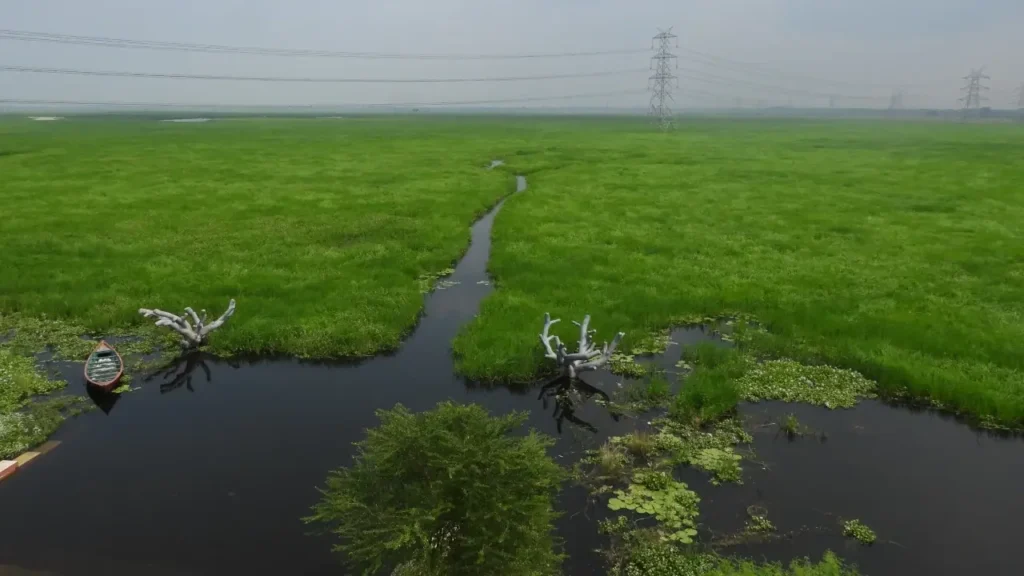
Surha Tal is a large natural oxbow lake, formed due to the meandering course of the Ganga River over centuries.
An oxbow lake is created when a river changes its course, leaving behind a crescent-shaped water body disconnected from the main river channel. Such wetlands are highly productive ecosystems and support rich biodiversity.
The lake receives freshwater through three major channels and undergoes significant seasonal expansion during the monsoon period. During floods, the surrounding floodplains and marshlands become interconnected, creating a vast wetland ecosystem that supports numerous plant and animal species.
This hydrological connectivity enhances nutrient circulation and contributes to the high biological productivity of the sanctuary.
Importance
Ecological:
The ecological significance of Surha Tal extends far beyond its geographical boundaries. The wetland serves as an important habitat for aquatic organisms, migratory birds, mammals, and local communities dependent on wetland resources.
Its location within the Ganga basin makes it a critical component of the region’s ecological network, helping regulate water flows, recharge groundwater, and maintain regional biodiversity.
The sanctuary also contributes to climate resilience by acting as a natural flood buffer and carbon sink.
Migratory Birds:
One of the most remarkable features of Jai Prakash Narayan Bird Sanctuary is its strategic location along the Central Asian Flyway (CAF).
The Central Asian Flyway is a major migratory route extending from Siberia and Central Asia to South Asia and the Indian subcontinent. Every year, thousands of migratory birds travel along this route during winter.
Surha Tal functions as an important stopover and wintering ground for these birds, providing food, shelter, and breeding habitats.
Some notable bird species recorded in the sanctuary include:
- Common Pochard (Aythya ferina) – Vulnerable
- Indian River Tern (Sterna aurantia)
- Sarus Crane (Antigone antigone)
- Bar-headed Goose (Anser indicus)
The presence of these species highlights the international importance of the wetland for bird conservation.
Rich Aquatic Biodiversity:
Apart from avifauna, the sanctuary supports a remarkable diversity of aquatic flora and fauna.
The wetland is home to more than 221 plant species, which form the ecological foundation of the wetland ecosystem. These plants provide food, breeding grounds, and shelter for numerous aquatic organisms.
The sanctuary also supports around 66 fish species, making it an important freshwater fish habitat in eastern Uttar Pradesh.
Among the notable fish species are:
- Wallago attu (Freshwater Shark) – Vulnerable
- Bagarius bagarius (Goonch Catfish) – Vulnerable
The abundance of fish contributes significantly to maintaining the food chain within the ecosystem.
Presence of Fishing Cat:
The rich fish diversity of Surha Tal attracts one of India’s most unique wetland predators, the Fishing Cat (Prionailurus viverrinus).
This vulnerable mammal depends heavily on wetland ecosystems for survival and is often considered an indicator species of healthy wetlands.
The sanctuary serves as an important feeding, breeding, and sheltering ground for the Fishing Cat, further enhancing its conservation value.
Significance of Ramsar Recognition
The inclusion of Jai Prakash Narayan Bird Sanctuary in the Ramsar List provides international recognition to its ecological importance.
The designation will help:
- Strengthen wetland conservation efforts.
- Enhance biodiversity protection.
- Promote sustainable livelihood opportunities.
- Increase scientific research and monitoring.
- Improve ecotourism potential.
- Support climate change adaptation and resilience.
The Ramsar status also brings greater attention to the conservation of wetlands in eastern Uttar Pradesh, which have historically received less focus compared to other protected areas.
Conclusion
The designation of Jai Prakash Narayan Bird Sanctuary (Surha Tal) as India’s 100th Ramsar Site marks a significant milestone in the country’s environmental conservation journey. As a biodiversity-rich oxbow lake situated along the Central Asian Flyway, the sanctuary plays a critical role in supporting migratory birds, aquatic life, and vulnerable species such as the Fishing Cat.
Its recognition under the Ramsar Convention not only strengthens India’s global standing in wetland conservation but also highlights the growing importance of protecting wetlands as vital ecosystems for biodiversity, climate resilience, water security, and sustainable development.
Visit LevelUp IAS- Click Here