Prelims: The Art of Spotting and Eliminating

Intro – Dr. Sayali Bhika Pagar
- UPSC Rank: Secured All India Rank (AIR) 87 in the UPSC Civil Services Examination 2025
- Place of Birth: Kalwan, Nashik District, Maharashtra
- Place of Study: Completed schooling and higher education in Maharashtra and Karnataka
- Graduation: MBBS (Bachelor of Medicine and Bachelor of Surgery)
- University/College: Studied at Sapthagiri Institute of Medical Sciences and Research Centre, Bengaluru
- Background: Medical doctor turned civil servant; left clinical practice to pursue UPSC full-time with a vision to contribute to public service through health, education, and women’s empowerment.
The Art of Spotting and Eliminating Extreme Options
The UPSC Prelims can often feel like a trap, but by understanding the specific language used by examiners, you can turn these challenges into scoring opportunities. Successfully navigating the exam requires a mix of conceptual clarity, common logic, and a keen eye for “extreme” statements that are designed to be eliminated.
The “Prelims Trap”: Identifying Extreme Language
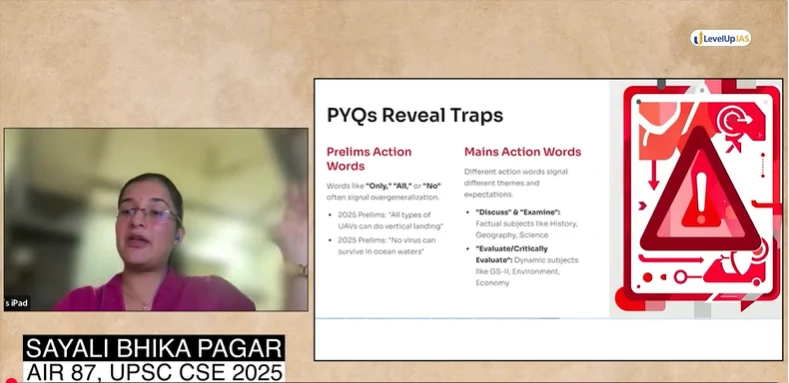
The most effective strategy for tackling Prelims is learning to spot words that indicate an extreme or absolute position. When you see the following words, they are often (though not always) markers of an incorrect statement:
- Only
- All
- None / No
- Not at all
- Permanently
For instance, in a question regarding viruses, a statement claiming that “no virus can survive in ocean water” or “no virus can infect bacteria” is an extreme statement that can be easily eliminated using basic scientific knowledge or logical deduction. Similarly, in a question about Unmanned Aerial Vehicles (UAVs), statements claiming that “all types” can perform vertical landing or “only” use batteries as a power source are extreme and likely incorrect.
The Power of “Some”: Embracing Vague Statements
While absolute words often signal a trap, vague and inclusive words often signal a correct statement. The word “Some” is a frequent indicator of this. For example:
- “Some mushrooms” having medicinal, psychoactive, or bioluminescent properties is a vague, plausible statement that is generally correct.
- “Some microorganisms” growing in extreme temperatures (above boiling or below freezing) is another example where the statement is vague enough to be scientifically possible without requiring the candidate to know the specific organism.
Strategic Exam Execution: Logic Over Rote Knowledge
A common mistake is believing you need “proh” (prior) exhaustive knowledge to answer every question. Instead, you should:
- Use Common Logic: For a question about soil porosity, simply thinking about the physical properties of everyday items like chalk and clay can help you eliminate statements like “clay is not at all porous”.
- Don’t Fear Multi-Statement Questions: Many students get intimidated by three-statement questions. However, if you can eliminate even one or two extreme statements, you can often arrive at the correct answer without even reading the entire question.
- Seek the 50/50 Edge: Even if you cannot find the absolute answer immediately, eliminating two extreme options gives you a 50/50 chance, which significantly improves your scoring potential.
Analyzing Previous Year Questions (PYQs)
PYQs should act as your primary guide to understanding the language of the questions. By studying how UPSC has used adjectives and extreme words in the past, you can identify recurring patterns. Themes like viruses are repeatedly asked, and seeing how they were framed in previous years helps you stay calm and analytical during the actual exam.
Beyond Prelims: Action Words in Mains
While Prelims focuses on elimination, the strategy for Mains shifts toward understanding action words (adjectives added to the end of a question):
- Discuss/Explain: Usually requires conceptual clarity, often seen in History or Geography (e.g., explaining Plate Tectonics).
- Critically Evaluate: Requires looking at both positives and negatives of a topic (like a government scheme) and providing a balanced conclusion or a “way forward”.
By mastering these linguistic cues and maintaining a calm, logical mindset, you can effectively navigate the complexities of the UPSC examination.
To know her strategy in detail, watch the video – https://youtu.be/qYhLpiHj000?si=jhjz3Aot-nStS9nV
Visit LevelUp IAS- Click Here